Nakagawa 中川町
なかがわちょう
A forest-and-dairy town on the middle reaches of the Teshio River, at the northern tip of Kamikawa. Its Cretaceous rocks yield iridescent ammonites, an 11 m plesiosaur billed as Japan's largest, and a new genus and species of therizinosaur dinosaur12. The preliminary 2025 Census count was 1,230 people, a fall of 19.5% in five years, the second-steepest drop in Hokkaido3.
- Population (2020 Census)
- 1,528
- Area
- 594.74 km²
- District
- Nakagawa District (中川郡)
- Official website
- www.town.nakagawa.hokkaido.jp
Known for
- Cretaceous fossils (化石の里): the town promotes itself as a "fossil village". Its ammonites and inoceramid clams sometimes keep their original iridescent nacre, one reason Nakagawa ammonites are known worldwide1. The plesiosaur found in 1991 has been restored as an 11 m skeleton, described as Japan's largest112.
- A new dinosaur: claw bones found in 2000 were named Paralitherizinosaurus japonicus in May 2022, a new genus and species of therizinosaur213.
- The Teshio River (天塩川): at 256 km it is Japan's fourth-longest river and it flows north. It is a Hokkaido Heritage site and a destination for canoeing and stream fishing1.
- Forests: national forest covers 34,572 ha of the town14. Hokkaido University's Nakagawa Experimental Forest was set up in 1902 and covers 19,364 ha across Nakagawa and Otoineppu15. The town's forestry past also produced "log-pushing sumo" (丸太押し相撲), first held in 198891.
- Dairy and Nakagawa beef: livestock earned about ¥1.32 billion of the town's estimated ¥1.64 billion farm output in 202416. Nakagawa beef (ナカガワ牛) and grass-fed organic beef are popular furusato nozei gifts17.
- Buckwheat: buckwheat is the largest field crop, with 678 ha in 2025, 2.5% of Hokkaido's buckwheat area16. Nakagawa soba is made from sprouted buckwheat flour18.
- Saitō Mokichi: the poet spent five days here in August 1932, and 57 tanka came out of the visit. The town has run a tanka contest in his memory since the 1990s1920.
Sights & activities
Nature & scenery
- Panke-yama and Penke-yama: the town's signature peaks, with views to Mt. Rishiri. The board of education leads a climb every year501.
- Miharashi Park (見晴公園): a lookout over the townsite and the Teshio, best for autumn leaves in early October. Open 1 May–31 October. There is no parking; take the narrow road up past the onsen51.
- Other parks: Yasukawa Nature Park looks over Saku and the Teshio. The Forest Park near the onsen was built for the 80th anniversary of settlement; camping is not allowed. The quiet Ikoigamori Park near Saku is good for birdwatching511.
- Seasonal wildflowers: behind the windbreak on the east side of Route 40, just before Teshio, a yellow carpet of wild day lilies (エゾカンゾウ) blooms in mid-June. About a month later the same field turns purple with wild irises (ノハナショウブ). Each peak lasts about a week12.
- Shibunnai Pass (志文内峠): the old school path that Mokichi walked with his niece was restored in 2002. It takes about 90 minutes from Kyōwa to the Yasukawa side; boots are recommended19.
- Hokkaido University forest: open-to-public nature walks and stream programs are held with the university5215.
Onsen
- Ponpira Aqua Rising (ポンピラアクアリズイング): the town's public onsen hotel at Nakagawa 439-1, beside the Teshio.
- The water is a sodium-calcium chloride spring, said to help rheumatism, neuralgia and wounds. There is a sauna18.
- Day bathing costs ¥400 for adults and ¥200 for children, 11:00–20:00 (last entry), closing at 21:0018.
- Rooms are Japanese-style, Western-style or maisonette, in cylindrical wings. All have Wi-Fi, and some take bicycles inside53.
- The spa opened in 1973 as a health center and reopened under its current name in 19939. As of December 2025 the town was drawing up the basic design for a rebuild30.
Museums & heritage
- Nakagawa Ecomuseum Center (中川町エコミュージアムセンター, "Ecole Nakagawa"): Yasukawa 28-9, off Route 40 on Road 119, in the former Saku Junior High School54.
- Exhibits include the 11 m plesiosaur skeleton, large ammonites and a 4.5 m skeleton of the therizinosaur Nothronychus. The real Paralitherizinosaurus claws went on show in May 202221242.
- Other local finds: the Nakagawa herring (Apsopelix miyazakii), a 3D-preserved Cretaceous fish and the first of its kind in East Asia55, designated a Hokkaido Natural Monument in 20201; the jaws of Yezoteuthis giganteus, a squid estimated at over 5 m long56; and a large pliosaurid lower jaw found in Yasukawa in 1994 and identified by Prof. Sato Tamaki's team2.
- Hours are 9:00–16:00. From May to October it closes on Mondays; from November to April it opens on weekdays only. It also closes 29 December–7 January. Admission is ¥200 for adults and free for junior-high students and younger5758.
- Groups of 10 or more can stay overnight (up to 55 people)58.
- Note: a notice on the museum's website (seen on 23 September 2026) says the exhibition rooms closed from 16 September for about two months for floor repairs. The office stays open on weekdays2.
- Saku Furusato Denshōkan (佐久ふるさと伝承館): inside Saku Station, whose building dates from 199159. It shows a Tanaka-type mint still, horse sleighs, a projector from Saku's old cinema and logging tools, all donated by residents601.
- Teshio-Nakagawa Station: the 1953 station building was restored in 2014 with local todomatsu fir to its original look. It now has a community space and free Wi-Fi22.
- Mokichi Park (茂吉小公園), Kyōwa: the site of the Shibunnai clinic, with a 1978 poetry monument and boards of winning tanka19.
Outdoor & seasonal activities
- Napōt Park auto campground (ナポートパーク): Nakagawa 435-1, next to the onsen. Open late April to 31 October.
- Sites: 3 RV sites with power and water (¥2,200 plus ¥2,000 per person aged 13+), 19 standard car sites (¥1,650 per person aged 13+), 3 cabins (¥6,600 each) and a free-site area (¥1,100).
- There are a BBQ house, coin showers, a coin laundry, Wi-Fi and gear rental. Pets are allowed61.
- Cycling: road bikes, mountain bikes and cross bikes can be rented. A road bike costs ¥1,800 a day for visitors. Bikes with spiked tires are available in winter6261.
- River and forest: yamame (masu trout) fishing, fly-fishing, snowshoe tours, igloo-building, outdoor sauna, and powder surfing on the slopes of the old town ranch (¥8,000 including gear)6364.
- Hunting: guided hunting days from October to March (¥70,000, including a game lunch), starting from the Michi-no-Eki before dawn65.
- Fossil programs: the Ecomuseum's summer "Forest School" sends children on dinosaur-hunting expeditions (the 22nd was in July 2026). There are also rock-layer observation classes2.
Food experiences
Roadside stations (Michi-no-Eki)
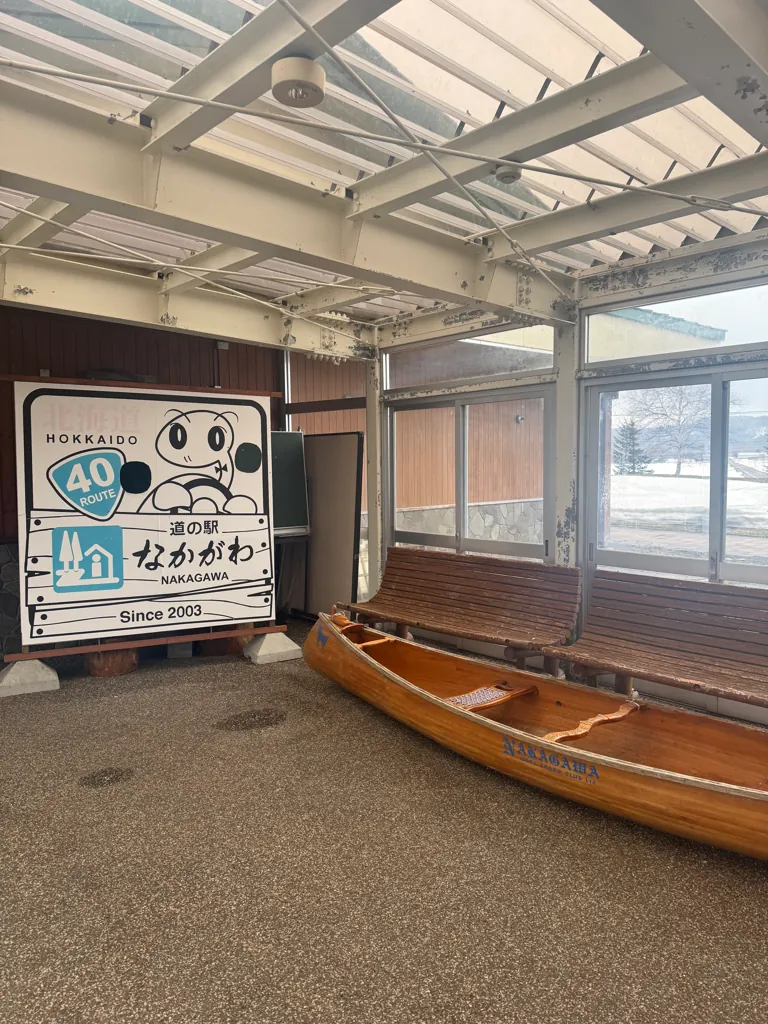
Nakagawa (道の駅なかがわ)
- Location: Homare 498-1, Nakagawa (中川郡中川町字誉498-1), on National Route 40, about 90 km south of Wakkanai42. It overlooks the Teshio River, about 5 minutes by car (20 minutes on foot) from Teshio-Nakagawa Station. It is about 3 hours from Asahikawa and 2 hours from the Shibetsu-Kenbuchi IC on the Dōō Expressway67. Mapcode 640 473 82642.
- Hours: the shop is open 9:00–17:00. The restaurant is open 11:00–13:30; the tourism association lists 11:00–14:00 with last orders at 13:30. Closed 30 December–4 January426739. Hours as of September 2026 — check before visiting.
- Shops & products: many of the products are made by the operator, 匠舎 (Shōya), at its own processing center43.
- Meat: gyōja-ninniku (Alpine leek) sausages (the No. 1 local product), cheese and haskap sausages, frankfurters, bacon, hamburg steaks and Nakagawa beef cuts423837.
- Sauces and seasonings: butadon sauce, leek powder and soy sauce, and a steak sauce38.
- Jams and honey: haskap jam, Tsujii Apiary honey and honey mustard38.
- Others: haskap cider, Nakagawa beef curry, Ammonite Curry, bamboo shoots in jars, charcoal goods and local pottery3842.
- A farm stand sells local produce from June to November42. In September 2026 the shop also stocked sake and plum wine from Yonezawa Sake Brewery in the sister village of Nakagawa, Nagano68.
- Food: the restaurant sits under a glass skylight with views of the Teshio.
- Ramen: ramen of 100% Hokkaido wheat with house-made chāshū, and stamina soy-sauce ramen with pickled Alpine leek.
- Rice dishes: the "Loin-katsu Three Brothers" (ロースかつ三兄弟) katsudon, katsu curry and katsu set meal, and the Stamina Nakagawa Steak Don of sausage and sirloin with leek powder.
- Soba: sansai (wild-vegetable) soba, and other soba dishes4139.
- Takeaway: haskap soft-serve (the top seller), chocolate soft-serve and summer-only grazing-cow soft-serve. Seasonal flavors such as corn (とうきび) and matcha appeared in September 2026. Also the coarse-ground Nakagawa frank, croquettes and fried taiyaki4169.
- Facilities:
- Parking: 40 cars, 10 large vehicles and 2 accessible spaces, with some covered parking7042.
- Toilets: open 24 hours, with an accessible toilet7142.
- Inside: a huge fireplace with an iron hood, lit with firewood in winter and described as one of the largest at any Hokkaido Michi-no-Eki; a kids' corner with wooden puzzles and picture books; massage chairs; a regional information corner; a nursing room and baby-changing table4243.
- Wi-Fi is available, and credit cards and other cashless payments are accepted4270.
- A dog run is open from June to October42.
- EV charging: the Hokkaido council page lists an EV charger, but the national Michi-no-Eki site shows none. Confirm before relying on it4270.
- Nearby: the onsen, Napōt Park campground and the Ecomuseum42.
- Notes:
Getting there & around
- Rail: JR Hokkaido's Sōya Main Line (宗谷本線) has two stations in town.
- Teshio-Nakagawa (天塩中川, W64) is unstaffed. The limited expresses Sōya and Sarobetsu stop there (three round trips a day, about 2 h 15 min to Asahikawa)22. The direct Sōya from Sapporo takes about 3 h 40 min. The Sarobetsu needs a change at Asahikawa to or from the Lilac6222. The station averaged 3.8 boarding passengers a day in FY202422.
- Saku (佐久) is unstaffed and has been maintained by the town since April 202159.
- Utanai closed in 202227.
- Road:
- National Route 40 (Asahikawa–Wakkanai) runs through town. The toll-free Otonaka Road (音中道路, Otoineppu IC–Nakagawa IC, 19 km) opened on 22 March 2026. It bypasses a section of old Route 40 that was often closed by avalanche and rockfall risk, and saves about 10 minutes between Asahikawa and Wakkanai29.
- Prefectural roads 118 (to Bifuka) and 119 (to Enbetsu) cross the mountains4.
- By car, it is about 4 hours (285 km) from Sapporo via the Dōō Expressway to Shibetsu and then Route 40, and about 2 h 45 min (160 km) from Asahikawa62. Wakkanai is about 1 h 30 min away67.
- Local transport: the town runs a free residents' bus (住民バス) on weekdays41. Heiwa Hire runs taxis, including jumbo and cycle-carrying cabs (01656-7-2111)62.
- Airports: the nearest are Wakkanai and Asahikawa4.
Practical tips
- Best seasons: June–July for wildflowers along Route 40, and July–September for canoeing, camping and festivals. Mid-September brings the Akiaji Matsuri and log-pushing sumo. Early October is best for autumn leaves124851.
- Check opening times: the Michi-no-Eki restaurant serves lunch only. The Ecomuseum closes on winter weekends, and a notice seen in September 2026 says it closed for floor repairs from mid-September for about two months. The campground runs only from late April to October6725761.
- Shops: there are only a few. Seicomart Teshio-Nakagawa is open 6:00–23:00 every day, and Q-Mart 9:00–19:0039.
- Where to stay: besides the onsen hotel and the campground, options include Sakaeya Ryokan (栄屋旅館, from ¥7,350 with two meals; pets allowed), the whole-house Teshio Nakagawa Vacation House (from ¥38,500 a night), a hunter's cottage in Yasukawa, and several ADDress co-living homes73.
- Tourist information: the tourism association office is inside the town hall's regional development section, open weekdays 9:00–17:0074.
- Winter: expect heavy snow from mid-November to April and temperatures that can fall below −30 °C132. The new Otonaka Road avoids the avalanche-prone old section of Route 4029.
- Wildlife: brown bears and a growing number of Ezo deer live in the forests115. Carry a bear bell in the hills, and watch for deer on Route 40 at dusk.
Photos
-
 Mar 2026
More about Nakagawa
At a glance
| Field | Details |
|---|---|
| Type | Town (町) |
| Subprefecture | Kamikawa (上川総合振興局). Nakagawa is its northernmost municipality4 |
| District | Nakagawa District (中川郡) of the old Teshio Province (天塩国). It is a different district from the Nakagawa District in Tokachi4 |
| Population | 1,528 at the 2020 Census. The preliminary 2025 Census count was 1,230 (650 men, 580 women), down 19.5%. Only Yubari fell faster in Hokkaido, and Nakagawa ranked 172nd of 179 municipalities by size3. The resident register showed 1,235 people (651 men, 584 women) in 715 households at the end of August 20265. The Hokkaido Government's register figure for 1 January 2026 was 1,2596 |
| Area | 594.74 km²7. Mountains cover 84.5% of the town, farmland 5.91% and residential land 0.17%8 |
| Density | About 2.1 people/km² (August 2026 register). It was about 2.6/km² at the 2020 Census |
| Municipal history | The unnamed villages of the district were named Nakagawa Village (中川村) on 29 April 1906; the area then also included present-day Otoineppu1. The village got its own office in 1912. Tokiwa Village (now Otoineppu) split off in 1916. Nakagawa became a second-class village on 1 April 191994. It became a town on 1 May 19641. There have been no mergers |
| Neighboring municipalities | Kamikawa: Bifuka, Otoineppu, Horokanai. Soya: Nakatonbetsu, Horonobe. Rumoi: Teshio, Enbetsu4 |
| Symbols | Flower: azalea (ツツジ). Tree: Japanese yew (イチイ). The town council confirmed both on 18 December 1978. No town bird is listed. The emblem is a stylized 中川: the outer circle stands for peace and harmony, and the sharp angle in the center for the town's growth10 |
| Mascot | Jueru (じゅえる), a leaf-shaped forest fairy said to drift on the Teshio River. The name combines ki o ueru (樹植える, "planting trees") and "jewel". It appeared in 2012: 9 July according to the town's cultural plan, September according to a 2013 Kamikawa Subprefecture page111 |
| Official website | https://www.town.nakagawa.hokkaido.jp/ |
Name origin
- Town name: when settlers arrived, the villages here had no name. In 1906 they were named after Nakagawa District, because the district name was easy to understand14. The district name means "the middle course of the Teshio River"; Nakagawa town is its most downstream part. The Hokkaido Government's Ainu place-name list considers it probably a Japanese name, not an Ainu one21.
- Ponpira (誉平): the old name of the town center. It comes from Ainu pon-pira, "small cliff", the name of a riverside cliff west of the townsite21. The station was Ponpira Station (誉平駅) until it was renamed Teshio-Nakagawa on 20 July 195122. The district of Homare (誉) keeps the first character1.
- Other Ainu names in town:
- Utanai (歌内) is from ut-nay, "rib river": a tributary joining the main river at nearly a right angle, like a rib joining the spine23.
- Kamiji (神路) is from kamuy-ru-e-san-i, "the gods' slope where the path comes down to the shore". Matsuura Takeshirō's Teshio diary says travelers left inau (whittled offering sticks), tobacco and rice there, or falling rocks would smash their boats24.
- Saku (佐久) is from sak-kotan-nay, "summer-village river". According to the town history, people camped at its mouth in summer to fish251.
- Shibunnai (志文内, now Kyōwa) means "river with dace (ugui)". Chirashinai (now Fuwa) means "river with itō (Sakhalin taimen)". Wakkauenbetsu (now Yamato) means "river with bad drinking water"1.
- Teshio: the river's name is usually derived from teshi-o-pet, "river with many fish weirs", after rock ledges that cross the river like weirs1.
History
- Prehistory: Jōmon sites lie along the Abeshinai and Teshio rivers; obsidian arrowheads have been found, but no pit dwellings yet. The Ponpira site, excavated from 1976, holds a settlement of the Satsumon period1.
- Ainu era: three chashi (Ainu fort or ritual enclosure) sites are known in town. The Ofui Chashi overlooks the meeting of the Teshio and Abeshinai rivers. Test digs below it in 2011 found river-pearl-mussel shells, blue glass beads, lacquer flakes, iron objects and flints. Specialist Akino Shigeki sees this as a probable "offering deposit" (納めの場). Brown-bear bones were found nearby in 20141.
- Edo period: the first Wajin recorded here were Matsumae retainer Takahashi Sōshirō and three others, who surveyed the Teshio in 1797. In 1857 Matsuura Takeshirō spent the 9th–11th days of the 6th month in present Nakagawa, camping at today's Nakagawa 2 and Yasukawa 3 and recording the hard lives of local Ainu1. A monument to his survey went up in Fuwa in 20189.
- Meiji surveys: in 1898 government engineer Kondō Toragorō stayed at the Ainu kotan (village) of Abeshinai while traveling down the Teshio by dugout canoe. His photo of an Ainu family beside a bear cage shows that the kotan still kept traditional ways1.
- Settlement (1896–1912): the first Wajin settler, Kitamura Kyōsuke, is said to have arrived in 1896. In 1897, 11,121 chō (about 11,000 ha) along the Teshio became Imperial estate land (御料地). Leasing to settlers began in 1903, which the town counts as its founding year1. District names record where settlers came from: Yamato (大和) for settlers from Totsukawa in Nara, and Fuwa (富和) for a "peaceful settlement opened by people from Toyama"1. Many people in Shibunnai around 1932 were from Gifu19. Hokkaido University's forest was founded in 190215, and the road that is now Route 40 reached the village in 19089.
- Railway, mint and starch (1912–1930s): the rail line reached Ponpira (now Teshio-Nakagawa) and Saku stations on 8 November 1922. The town center then moved from old Ponpira to new townsites around the Nakagawa and Saku stations122. By 1915 Nakagawa was the Teshio basin's largest producer of peppermint (薄荷)12. At the peak, Kitami and Nakagawa together grew about 80% of Japan's mint. Mint declined after 192519. The World War I boom brought 85 starch factories by 19201.
- Floods and hardship: in 1940 a ferry capsized at the Utonai crossing, drowning 17 schoolchildren and 2 parents9. Work to straighten the meandering Teshio ran from 1940 to 19531. Floods and cold summers caused crop failures in 1932 and 19349.
- Postwar: the population was 6,937 at the 1950 Census26. From the late 1960s many farm families left1. Nakagawa became a town in 1964. It was designated a depopulated area and a special heavy-snowfall area in 19719.
- Fossil town: plesiosaur finds in 1974 and 1991 led to the fossil-village strategy. The Ecomuseum Center opened in 2002, and the Michi-no-Eki followed in 200391.
- Recent events: Utanai Station closed on 12 March 2022, the first closure of a station that a municipality had taken over from JR Hokkaido27. On 11 August 2022, two shallow earthquakes (M5.2 and M5.4) struck the northern Soya region. Nakagawa recorded the maximum intensity for both: 5-lower, then 5-upper281. Nobody was hurt, but homes, a prefectural road and the town pool were damaged1. The 19 km Otonaka Road (音中道路) bypass opened on 22 March 202629. In December 2025 the town was drawing up the basic design for rebuilding its onsen hotel30.
Geography & climate
- Setting: Nakagawa is a long, narrow valley town. The Kitami Mountains run along the east: 小車岳 (724.3 m), 鬼刺山 (728 m), Penke-yama (716.2 m) and Panke-yama (631.9 m) form the divide between the Sea of Japan and Okhotsk sides. The Teshio Mountains run along the west1. From the top of Panke-yama you can see both seas, Mt. Rishiri and sometimes Sakhalin1.
- Rivers: the Teshio flows north through the middle of town. It is 256 km long with a basin of 5,590 km², fourth in Japan for length and tenth for basin area. Its ice breaks up in spring in large floes1. The Abeshinai River (安平志内川) is its largest tributary in town, at 54.5 km with 23 side streams1. The town's lakes include Mikazuki-numa (三日月沼, "crescent pond")4.
- Geology: the town sits on the Sorachi–Ezo belt of Cretaceous marine rocks. The Osoushinai Formation is the richest fossil layer. The Omagari limestone preserves an 83-million-year-old cold-seep community of tube worms and chemosynthetic clams12.
- Forest and wildlife: in the Hokkaido University forest, katsura, kitakobushi magnolia and the katakuri lily reach their northern limits. The whole forest is a wildlife sanctuary15. Steller's sea eagles and white-tailed eagles arrive around October to winter on the Teshio and Abeshinai, and black woodpeckers live here1. No national, quasi-national or prefectural natural park was found in the sources consulted.
- Climate: JMA's Nakagawa station (1991–2020 normals) gives:
- annual mean temperature 5.9 °C, with January at −7.5 °C and August at 19.4 °C
- annual precipitation 1,248.3 mm, wettest from August to November
- annual sunshine 1,361.1 hours31
- Extremes: the record high is 36.2 °C (28 July 2021) and the record low −35.6 °C (24 January 1985). The wettest day was 8 August 2022, with 167.0 mm32.
- Snow: the station does not measure snow. The town reports average snowfall of about 8.9 m a year (2003–2011). Snow stays on the ground from mid-November until mid-April on the flats1. Nakagawa has been a special heavy-snowfall area since 19719.
Economy & industry
- Farm output: MAFF estimates the town's 2024 farm output at about ¥1.64 billion. Livestock accounts for about ¥1.32 billion, nearly all of it dairy (¥1.26 billion, including ¥1.16 billion of raw milk)16.
- Dairy and beef: in FY2020, 20 farms kept 1,311 dairy cattle and 4 farms kept 264 beef cattle14. Dairy cattle numbers peaked at 4,590 in 1992. A large corporate barn with 510 milking cows opened in 20221. Organized dairying began in 1924, when 22 subsidized Ayrshire cows were brought from Iwate91.
- Crops: in FY2020, fields included buckwheat (461.39 ha), pumpkin (87.41 ha), adzuki beans (53.97 ha) and soybeans (35.35 ha). Hay and pasture covered 1,598.3 ha14. By 2025, buckwheat had grown to 678 ha, yielding 306 t (1.8% of Hokkaido's harvest)16. Mint, rice, flax and pyrethrum were once grown here1.
- Forestry: national forest covers 34,572 ha, private forest 17,158 ha, town forest 2,145 ha and Hokkaido forest 518 ha14. About 11,675 ha of the Hokkaido University forest lies within the town1. The town has a seed orchard for "clean larch", a hybrid larch said to fix 7–20% more carbon than Japanese larch1. Hokkaido's Forestry Research Institute has its Dōhoku branch here12.
- Fisheries: a salmon hatchery has run at the Pankenai River since 19641.
- Tourism: Kamikawa's survey counted 88,600 visitors in FY2025, 97.7% of the previous year's 90,700. Of these, 85,400 were day-trippers and 3,200 stayed overnight. More people used the Michi-no-Eki, but fewer construction workers stayed in town33.
- Population: the town lost 19.5% of its people between 2020 and 20253. The National Institute of Population and Social Security Research projects 736 people by 2045, as cited in the town's cultural plan1.
- Revitalization:
- The town's regional trading company, Nakagawa-chō Chiiki Kaihatsu Shinkō Kōsha (founded 1993), calls itself "Nakagawa no Nakagawa". Its business list includes running the onsen hotel, managing the Michi-no-Eki, a Tokyo "satellite" shop and an online store34.
- The satellite opened in October 2016 on the Shimotakaido shopping street in Setagaya, Tokyo. The street's link with the town's chamber of commerce began in 2001. In 2017 the chamber's "Nakagawa no Nakagawa" revitalization work was chosen as one of MAFF's "Discover Treasures of Farming, Mountain and Fishing Villages" (ディスカバー農山漁村の宝) examples35.
- The town's 2022 tourism strategy stresses adventure travel and "eco-mobility": cycling, canoeing and trekking136.
- In the "Nakagawa-style hut" project, supervised by Kawano Shin'ya of Oklahoma (Office CUE), local people build huts from local wood and soil36.
Local specialties
| Specialty | Category | Details & where to get it |
|---|---|---|
| Nakagawa beef (ナカガワ牛) | Meat | Fattened on a farm in town. Fillet (about 6 kg per animal) and sirloin are furusato nozei gifts17. The Michi-no-Eki sells kalbi, jingisukan and sliced beef, plus a Nakagawa beef curry3738. The pop-up HUNGRY MAN serves 100% Nakagawa-beef burgers at Teshio-Nakagawa Station39 |
| Kusamaru Beef (草丸Beef) | Meat | Grass-grazed beef from Marufuji Farm (丸藤牧場), certified organic under JAS and raised without pesticides or chemical fertilizer. Sold through furusato nozei17 |
| Grazing-cow soft-serve (放牧牛ソフト) | Dairy | Made from the milk of the town's grazing cows. Sold at the Michi-no-Eki in summer only4041 |
| Haskap (ハスカップ) products | Fruit | Haskap soft-serve with haskap sauce is the station's No. 1 takeaway; the berries are hand-picked on its own farm. Also haskap jam (from pesticide- and fertilizer-free berries), haskap cider and haskap-cheese sausage4138. The town launched a haskap wine, "Juan", in 19899 |
| Gyōja-ninniku (行者にんにく) goods | Wild vegetable | Alpine-leek sausages, powder, salted powder and soy sauce, and "Ezo-negi" ramen noodles made with the powder. The leek sausage is the station's best-selling local product3842 |
| Station-made sausages and bacon | Processed meat | Coarse-ground wieners and frankfurters of 100% Hokkaido pork, bacon and hamburg steaks, all made at the operator's own processing center4338 |
| Sprouted-buckwheat soba (発芽そば) | Noodles | "Homare Soba" (誉そば) dried noodles are a furusato gift17. Restaurant Well Be at the onsen serves tempura zaru soba and prawn-tempura "Nakagawa soba"18 |
| Butadon sauce (豚丼のたれ) | Condiment | Recreates the pork-bowl sauce of Izakaya Jūichi (居酒屋十一), whose butadon costs ¥700. Sold at the Michi-no-Eki3839 |
| Honey (はちみつ) | Honey | Linden, thistle and amur-cork-tree honey from Tsujii Apiary (辻井養蜂場), plus a honey mustard38 |
| Nakagawa Ammonite Curry (ナカガワアンモナイトカレー) | Retort curry | A black butter-chicken curry styled after fossil-bearing rock strata38 |
| Crafts | Woodwork, textiles | Hand-woven throws of wool plant-dyed with dyes gathered in the town, by textile artist Shimomura Kōko (下村好子)44, and the "ORIKOMI" folding table of Hokkaido timber (furusato gifts)17. The craft union "Mori to Te to" (森と手と) runs a forest gallery36 |
| Mid River (ミッドリバー) | Spirit (historic) | A corn whisky released in 19919; whether it is still made was not confirmed |
Culture & festivals
| Event | When | Highlights |
|---|---|---|
| Nakagawa Kikori Matsuri (中川町きこり祭) | February | A festival for woodcutters and their tools, with log races, forestry experiences and snow play1 |
| Teshio River spring quiz (天塩川春・発信 in なかがわ) | From January | Guess the exact day and time the frozen Teshio breaks up, "the day the door to spring opens"1 |
| Saku Shrine Festival (佐久神社祭) | July | Eve-of-festival beer party, Ponpira taiko drumming and the town brass band1 |
| Down the Teshio-o-pet (ダウン・ザ・テッシ-オ-ペッ) | July | One of Japan's largest canoe touring events, down the Teshio through town1 |
| Teshio River de Mizukiri (天塩川de水切り) | July | A Hokkaido stone-skipping contest on the Teshio at Saku, first held in 201291 |
| Michi-eki Ennichi Summer Festival and Koyanowa Marché | Early August (8–9 Aug in 2026) | Fair stalls at the Michi-no-Eki, plus a market of bakeries and cafés in the "Nakagawa-style huts" at Napōt Park; workshops, cycling and a stamp rally45 |
| Nakagawa Festival (中川祭り, Nakagawa Shrine) | Early August (2–4 Aug per Japanese Wikipedia) | A children's plesiosaur parade, a yakko (costumed retainers') parade, portable shrines, Ponpira taiko, a 100-person dance and the Ponpira ekiden relay14 |
| Hoshikuzu BAR (星屑BAR) | Late Aug–early Sept (25 Aug–3 Sep in 2026) | A pop-up food and drink village at the Napōt Park campground, with lunch and dinner sittings46 |
| Nakagawa Akiaji Matsuri (なかがわ秋味まつり) and Hokkaido Log-Pushing Sumo | Mid-September (13 Sep 2026: 42nd and 35th editions) | The town's big autumn fair on the Teshio riverbank, with food from nearby towns and goods from the sister village in Nagano147. In the sumo, men's teams of five (400 kg combined weight limit) push a 10 m, 100 kg log; women's teams of three push a 6 m, 25 kg log. The men's winners get ¥200,000481 |
| Saitō Mokichi Memorial Tanka Festival | Entries May–June; anthology in late December | A national tanka contest with general, high-school and elementary/junior-high sections; the 33rd was held in 202620 |
- Shrines and churches: Nakagawa Shrine began as a small shrine in 1910 and became a village shrine (村社) in 1934. A Christian church opened at Ponpira in 19099.
- Performing arts: Nakagawa Ondo and Nakagawa Kouta were written for the 1964 town status. The yosakoi team Nakagawa Tenryū formed in 19979. Ponpira taiko (誉平太鼓) drummers play at local festivals45.
- Mokichi's visit: Saitō Mokichi's older brother Moriya Tomitarō was the settlement doctor at Shibunnai (now Kyōwa) from 1928. Mokichi walked there through heavy rain on 14 August 1932 and stayed five days. The 57 tanka from this stay appear in his collection Sekisen (石泉)19.
- Museums: the Ecomuseum Center (natural history and local memory) and the Saku Furusato Denshōkan (folk tools in Saku Station). The Abeshinai Hakka Distillery Hall (安平志内薄荷蒸溜館), built by residents in 2009, keeps mint distilling alive as local culture19.
Ainu heritage
- Eleven chashi sites are known along the Teshio, built at key points for river travel; three of them are in Nakagawa. Excavations at the Ofui Chashi (オフイチャシ跡) in Yasukawa found a probable offering deposit and bear bones1.
- Ainu kotan stood at Abeshinai into the Meiji era. Matsuura Takeshirō (1857) and Kondō Toragorō (1898) both recorded them. Most district names in town are Ainu in origin (see Name origin)1.
- The Hokkaido Government's Ainu-culture guide lists no facility in Nakagawa. Listed facilities in northern Hokkaido include the Nayoro City Kitaguni Museum and the Shibetsu City Museum49. The Ecomuseum Center keeps archaeological and folk collections, including 110 archaeology and ethnology items1.
Sister & friendship cities
- Nakagawa Village (中川村), Nagano Prefecture: sister village since 1 June 198110. The town sends second-year students of Nakagawa Junior High to the village on exchange visits36.
- Hida City, Gifu Prefecture: "sister forest" (姉妹森) agreement, 20189.
- Shimotakaido shopping street, Setagaya, Tokyo: the town's chamber of commerce has exchanged with the street since 2001 and signed a friendship agreement with its merchants' association in 2019. The town signed a comprehensive partnership with Nihon University's College of Humanities and Sciences in 202135.
- Hokkaido University: the town has a comprehensive partnership with the university's northern forest office on forest management (2013 according to the town's timeline; 2012 in its cultural plan)91.
Notable people
Sources
Numbers in the text link to these sources. Figures as of 23 September 2026
- 中川町文化財保存活用地域計画(本編及び資料編、令和7年3月) — Nakagawa Town Board of Education JA accessed 2026-09-23
- 中川町エコミュージアムセンター・中川町自然誌博物館 — Nakagawa Ecomuseum Center JA accessed 2026-09-23
- 令和7年国勢調査速報 北海道の人口・世帯数(要計表に基づく人口・世帯数の集計) — Hokkaido Government, Statistics Division JA accessed 2026-09-23
- 中川町 - Wikipedia — Japanese Wikipedia JA accessed 2026-09-23
- 町の人口 | 住民課 | 中川町 — Nakagawa Town JA accessed 2026-09-23
- 令和8年住民基本台帳人口・世帯数(令和8年1月1日現在)市区町村別 — Hokkaido Government, Statistics Division JA accessed 2026-09-23
- 令和8年全国都道府県市区町村別面積調(4月1日時点) — Geospatial Information Authority of Japan JA accessed 2026-09-23
- 中川町の概要と統計 | 中川町の概要 | 中川町 — Nakagawa Town JA accessed 2026-09-23
- 町の歴史 | 中川町の概要 | 中川町 — Nakagawa Town JA accessed 2026-09-23
- 町のシンボル | 中川町の概要 | 中川町 — Nakagawa Town JA accessed 2026-09-23
- 中川町まちのオンリーワン/TESHIO13のまち(2013年, archived) — Hokkaido Government, Kamikawa General Subprefectural Bureau via Internet Archive JA accessed 2026-09-23
- 観光情報 - 北海道中川町観光協会オフィシャルサイト — Nakagawa Tourism Association JA accessed 2026-09-23
- テリジノサウルス科の新種恐竜と判明 | 北海道大学総合博物館 — The Hokkaido University Museum JA accessed 2026-09-23
- 町の産業 | 地域振興課 | 中川町 — Nakagawa Town JA accessed 2026-09-23
- 中川研究林 - 北海道大学 森林圏ステーション — Hokkaido University Field Science Center for Northern Biosphere JA accessed 2026-09-23
- 北海道中川町 基本データ(わがマチ・わがムラ) — Ministry of Agriculture, Forestry and Fisheries JA accessed 2026-09-23
- 北海道中川町のふるさと納税 お礼の品ランキング【ふるさとチョイス】 — Furusato Choice JA accessed 2026-09-23
- 施設紹介 | ナカガワのナカガワ(ポンピラアクアリズイング) — Nakagawa-chō Chiiki Kaihatsu Shinkō Kōsha JA accessed 2026-09-23
- 茂吉小公園と志文内峠 | 中川町教育委員会 | 中川町 — Nakagawa Town JA accessed 2026-09-23
- 斎藤茂吉記念中川町短歌フェスティバル(第三十三回募集要項) — Nakagawa Ecomuseum Center / Nakagawa Town Board of Education JA accessed 2026-09-23
- アイヌ語地名リスト トヨト~ノブシ P91-100(2007, archived) — Hokkaido Government, Ainu Policy Promotion Office via Internet Archive JA accessed 2026-09-23
- 天塩中川駅 - Wikipedia — Japanese Wikipedia JA accessed 2026-09-23
- アイヌ語地名リスト P11-20(2007, archived) — Hokkaido Government, Ainu Policy Promotion Office via Internet Archive JA accessed 2026-09-23
- アイヌ語地名リスト P31-40(2007, archived) — Hokkaido Government, Ainu Policy Promotion Office via Internet Archive JA accessed 2026-09-23
- アイヌ語地名リスト P51-60(2007, archived) — Hokkaido Government, Ainu Policy Promotion Office via Internet Archive JA accessed 2026-09-23
- Nakagawa, Hokkaido — English Wikipedia EN accessed 2026-09-23
- 歌内駅 - Wikipedia — Japanese Wikipedia JA accessed 2026-09-23
- 令和4年8月11日00時53分頃の宗谷地方北部の地震について — Japan Meteorological Agency JA accessed 2026-09-23
- 音中道路「音威子府IC~中川IC」2026年3月22日開通【北海道・国道40号バイパス】 — JAF Mate Online JA accessed 2026-09-23
- 温泉宿泊施設改築工事に関する町民説明会開催のお知らせ | 地域振興課 | 中川町 — Nakagawa Town JA accessed 2026-09-23
- 過去の気象データ検索 中川(上川地方) 平年値(年・月ごとの値) — Japan Meteorological Agency JA accessed 2026-09-23
- 過去の気象データ検索 中川(上川地方) 観測史上1~10位の値 — Japan Meteorological Agency JA accessed 2026-09-23
- 令和7年度(2025年度)上川管内観光入込客数調査報告書 — Hokkaido Government, Kamikawa General Subprefectural Bureau JA accessed 2026-09-23
- 企業紹介 | ナカガワのナカガワ — Nakagawa-chō Chiiki Kaihatsu Shinkō Kōsha JA accessed 2026-09-23
- 世田谷区交流事業 - 中川町商工会 — Nakagawa Chamber of Commerce and Industry JA accessed 2026-09-23
- 中川町ふるさと納税 | 地域振興課 | 中川町 — Nakagawa Town JA accessed 2026-09-23
- シルバーウィークにおすすめお土産 – 道の駅なかがわ(2026年9月17日) — 道の駅なかがわ JA accessed 2026-09-23
- 道の駅なかがわ(買う) — 道の駅なかがわ / 有限会社匠舎 JA accessed 2026-09-23
- 飲食店 - 北海道中川町観光協会オフィシャルサイト — Nakagawa Tourism Association JA accessed 2026-09-23
- ナカガワのナカガワ(トップページ) — Nakagawa-chō Chiiki Kaihatsu Shinkō Kōsha JA accessed 2026-09-23
- 道の駅なかがわ(食べる) — 道の駅なかがわ / 有限会社匠舎 JA accessed 2026-09-23
- なかがわ | 北の道の駅 — Hokkaido Michi-no-Eki Liaison Council JA accessed 2026-09-23
- 道の駅なかがわ(道の駅なかがわについて) — 道の駅なかがわ / 有限会社匠舎 JA accessed 2026-09-23
- スロウ(膝掛け)1枚 - 北海道中川町|ふるさとチョイス — Furusato Choice JA accessed 2026-09-23
- 〈ライブ時間・出店者変更〉「ミチ駅縁日夏祭り&こやのわマルシェ」同時開催 — Nakagawa Tourism Association JA accessed 2026-09-23
- 星屑BAR 2026年開催のお知らせ — Nakagawa Tourism Association JA accessed 2026-09-23
- 商工会からのお知らせ - 中川町商工会 — Nakagawa Chamber of Commerce and Industry JA accessed 2026-09-23
- 第42回秋味まつり、第35回北海道丸太押し相撲大会開催のお知らせ — Nakagawa Tourism Association JA accessed 2026-09-23
- 道北圏 | アイヌ文化情報検索 | 赤れんが庁舎 展示ガイド — Hokkaido Government JA accessed 2026-09-23
- 道の駅なかがわ(公式サイト トップ) — 道の駅なかがわ / 有限会社匠舎 JA accessed 2026-09-23
- 各公園 | 地域振興課 | 中川町 — Nakagawa Town JA accessed 2026-09-23
- 「北大研究林と音中道路 — 動物たちのすみかも守る道づくりのヒミツ —」開催のお知らせ — Nakagawa Tourism Association JA accessed 2026-09-23
- 泊まる | ポンピラアクアリズイング | ナカガワのナカガワ — Nakagawa-chō Chiiki Kaihatsu Shinkō Kōsha JA accessed 2026-09-23
- 中川町エコミュージアムセンター「エコールなかがわ」 | 中川町教育委員会 | 中川町 — Nakagawa Town JA accessed 2026-09-23
- ナカガワニシン — Nakagawa Ecomuseum Center JA accessed 2026-09-23
- エゾテウシス・ギガンテウス — Nakagawa Ecomuseum Center JA accessed 2026-09-23
- PRICE LISTS(利用料金) — Nakagawa Ecomuseum Center JA accessed 2026-09-23
- GUIDANCE(利用案内) — Nakagawa Ecomuseum Center JA accessed 2026-09-23
- 佐久駅 - Wikipedia — Japanese Wikipedia JA accessed 2026-09-23
- 佐久ふるさと伝承館 | 総務課 | 中川町 — Nakagawa Town JA accessed 2026-09-23
- 【公式】ナポートパーク オートキャンプ場 - 北海道中川町観光協会オフィシャルサイト — Nakagawa Tourism Association JA accessed 2026-09-23
- 移動手段 - 北海道中川町観光協会オフィシャルサイト — Nakagawa Tourism Association JA accessed 2026-09-23
- アクティビティ - 北海道中川町観光協会オフィシャルサイト — Nakagawa Tourism Association JA accessed 2026-09-23
- パウダーサーフ - アウトドア体験 - 北海道中川町観光協会オフィシャルサイト — Nakagawa Tourism Association JA accessed 2026-09-23
- 狩猟体験、狩猟ガイド・アテンド - 北海道中川町観光協会オフィシャルサイト — Nakagawa Tourism Association JA accessed 2026-09-23
- ワインティスティング - 北海道中川町観光協会オフィシャルサイト — Nakagawa Tourism Association JA accessed 2026-09-23
- 道の駅なかがわ(アクセス・施設案内) — 道の駅なかがわ / 有限会社匠舎 JA accessed 2026-09-23
- 長野県中川村からのお届け物!姉妹町村の美味しいお酒が入荷しました – 道の駅なかがわ(2026年9月16日) — 道の駅なかがわ JA accessed 2026-09-23
- 期間限定ソフトクリーム – 道の駅なかがわ(2026年9月19日) — 道の駅なかがわ JA accessed 2026-09-23
- 道の駅「なかがわ」 — National Michi-no-Eki Liaison Council JA accessed 2026-09-23
- 道の駅なかがわ - Wikipedia — Japanese Wikipedia JA accessed 2026-09-23
- 音中道路開通前記念プレイベントを開催します! | 地域振興課 | 中川町 — Nakagawa Town JA accessed 2026-09-23
- 宿泊施設 - 北海道中川町観光協会オフィシャルサイト — Nakagawa Tourism Association JA accessed 2026-09-23
- 北海道中川町観光協会オフィシャルサイト — Nakagawa Tourism Association JA accessed 2026-09-23
- ラッシャー木村 - Wikipedia — Japanese Wikipedia JA accessed 2026-09-23