Village Rumoi Subprefecture
Shosanbetsu 初山別村
しょさんべつむら
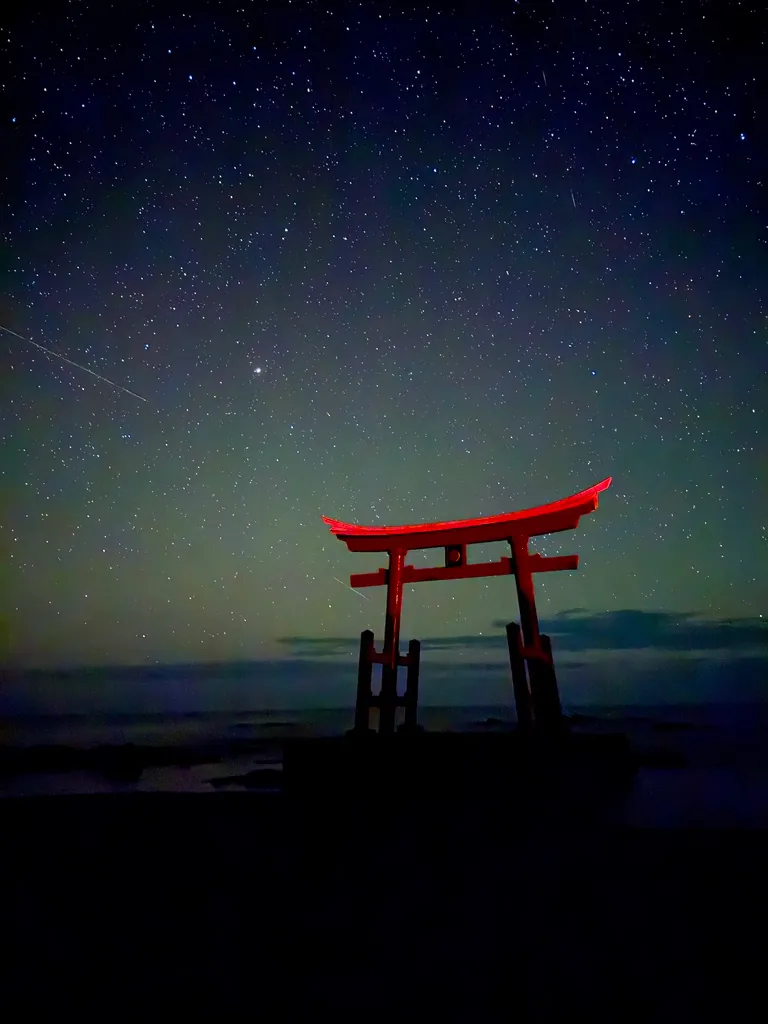
Shosanbetsu is the only village in Rumoi Subprefecture.1 Fewer than 1,000 people live here,2 in a strip of forest, farmland and small fishing harbours that runs 28.7 km north to south along the Sea of Japan between Haboro and Enbetsu.3 It is known for Japan's northernmost astronomical observatory, wild pufferfish and octopus,2 and sunsets seen through a Shinto torii that stands in the sea.4
- Population (2020 Census)
- 1,080
- Area
- 279.52 km²
- District
- Tomamae District (苫前郡)
- Official website
- www.vill.shosanbetsu.lg.jp
Known for
- Japan's northernmost observatory. Shosanbetsu Observatory (しょさんべつ天文台) stands on a seaside bluff in Misaki-dai Park. The village calls it the northernmost observatory in Japan.2 Its 65 cm Cassegrain reflector gathers 8,600 times as much light as the naked eye.9 Since 1995, the "My Stars" system has let anyone give a name to an unnamed star. The village keeps a permanent record of each name.10
- Wild mafugu (真ふぐ) pufferfish. The village's boats landed 93.1 t of pufferfish in fiscal 2019.11 The village says its mafugu catch is one of the largest in Hokkaido.12 It flavours the soba broth and ramen soups sold at the fishing co-op's shop,13 and it goes into the teriyaki-don rice bowl first served in 2009.1
- Octopus. Octopus is the most valuable catch: 266.0 t, worth ¥143.1 million, in fiscal 2019.11 It is also made into tako chinmi, a chewy snack sold at the co-op's shop.13
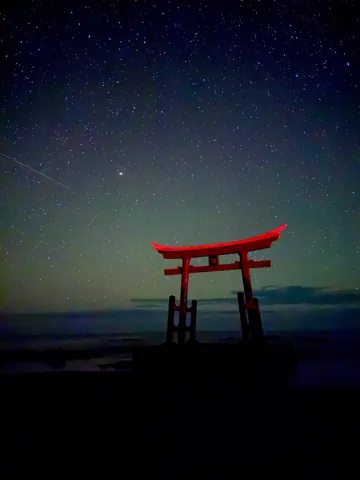
- The sea torii at Konpira Shrine. A red torii stands in the sea off Konpira Cape, and the sun sets behind it.414
- Misaki-dai Park (みさき台公園). One seaside bluff holds an onsen hotel, campgrounds, bungalows, the observatory, a go-kart track and park golf. The whole park is registered as the village's roadside station.1115
- Haskap (ハスカップ). A village-run processing centre makes the berry into jam, juice, syrup, vinegar and dried fruit.132
- Island views. On clear days you can see Teuri, Yagishiri and Rishiri Fuji from the campground.1415
Sights & activities
Nature & scenery
- Konpira Cape and Konpira Shrine (金比羅岬・金比羅神社). The red torii in the sea is the village's signature sunset view.414
- Misaki-dai Park lookout. The campground on the bluff looks out over the Sea of Japan to Teuri, Yagishiri and Rishiri islands.1415
- Ariake Dam (有明ダム). A reservoir inland from Ariake, surrounded by greenery. It has a campsite and is known for cherry blossom in spring.4 Higashiyama Juen (東山樹園), also listed as a sight, is in the same area.14
- Toyosaki Beach (豊岬海水浴場). A quiet beach with a shallow swimming area, 1.5 m deep at most, and free hot showers.15 It is open from late July to mid-August.24
- Sakura Road (桜ロード). A cherry-tree avenue that the village looks after.11 The trees line the road from the national highway to Ariake Dam and usually bloom around Golden Week, so you can view the blossom from the car.23
Onsen
- Shosanbetsu Onsen Hotel Misaki-no-Yu (しょさんべつ温泉 ホテル岬の湯). 153 Toyosaki, in the Misaki Center building, which is also called Cosmic Inn (宇宙の館).15
- The outdoor bath faces sunsets over the Sea of Japan.4
- Rooms come in four types: Japanese-style, Western-style and combined rooms in the main and east wings. Check-in is 15:00 and check-out 10:00. Parking is free.27
- The Hanamisaki restaurant (花みさき) serves local pufferfish, octopus and flounder. Lunch is 11:30–14:00 and dinner 17:00–20:00. Breakfast is for hotel guests only.23
- It had 33,000 visitors in fiscal 2025.20
- The village pamphlet lists day bathing at ¥500 for adults and ¥250 for children, and a private family bath at ¥1,000. Check current prices.4 A book of six bath tickets is offered as a furusato nōzei gift.12
- The spring is a sodium chloride spring (ナトリウム塩化物泉), according to the village's furusato nōzei gift list.12
Museums & heritage
- Shosanbetsu Observatory (しょさんべつ天文台). 153-7 Toyosaki, 46 m above sea level.9
- The building is modelled on the Apollo lunar module. Its 6 m stainless-steel dome was renovated in November 2004.9
- The main telescope is a 65 cm Cassegrain reflector (focal length 7,800 mm, F12) that can show stars down to magnitude 15.8. A 15 cm refractor on the same mount is used for the Moon and large nebulae.9
- Open 14:00–21:00 from April to September and 12:00–19:00 from October to March. Last entry is 15 minutes before closing.28
- Closed Tuesdays and Wednesdays, and all winter from 1 December to the end of February.28
- Admission is ¥200 for high-school students and adults, ¥100 for elementary and junior-high students, and free for younger children. No booking is needed.28
- Stars can be viewed only in clear weather. Couples can hold a wedding under the stars.28
- My Stars registration costs ¥3,000 and includes a star-shaped acrylic certificate, an ID plate and star charts.10
- Nature Exchange Centre (自然交流センター). 155-1 Shosanbetsu. The village's hall and library.2
Outdoor & seasonal activities
- Misaki-dai Park Auto Campground (みさき台公園オートキャンプ場). Open 6 June–23 September in 2026: every day in July and August, but only at weekends and on holidays in June and September.25
- Sites: 30 standard car sites (¥3,500 with power, ¥3,000 without), 3 camper-van sites (¥3,500, 5 A power), and free sites at ¥500 per adult and ¥250 per child.25
- Check-in 13:00–17:00, check-out by 12:00. Book car sites through the "Nap" (なっぷ) website. Free sites cannot be booked online; register on arrival.25
- No open fires, generators, fireworks or karaoke.25
- Free-site campground and bungalows. Nine log bungalows sleep 4–5 people each, for ¥5,200 a night, from 29 April to 23 October. Book through the hotel.23
- Tebura de Camp (てぶらdeキャンプ). Hire all the gear you need, for beginners who want to camp without bringing equipment.14
- Go-karts. The track is next to the roadside station. The roadside-station site gives ¥300 a lap,15 while the older pamphlet gives ¥400.4 In 2026 it runs 13:00–16:00 from 29 April to 23 October, on days that vary by month.29
- Bicycle hire. Electric bikes and cross bikes are available at the hotel front desk,14 9:00–17:00 in the same season.29 The Rumoi cycle route "Roman Kaidō Shosanbetsu" (ロマン街道しょさんべつルート) passes through.14
- Park golf. An 18-hole seaside course, 994 m in total. You pay a voluntary contribution, and club hire is ¥200.414
- Skiing. The village ski area opens in late January.24
Food experiences
- Tomoshibi (ともしび). The roadside station's rest house has a café and light-meal corner, a barbecue corner and a souvenir corner. The barbecue specialities are grilled octopus (焼きタコ) and grilled pufferfish (焼きフグ).234 The roadside-station site still lists a Hokkyokusei (北極星) restaurant,15 but the village now calls that building the former Hokkyokusei, home to Kino Seiwaen.23
- Maruten Shokudō (○天食堂). A long-running diner in the village centre, and one of the two restaurants where the teriyaki-don began.41
- Café Tailwind. The community café in Tsunagoya, open Wednesday–Saturday 11:00–16:00.2 The pamphlet recommends its pasta made with local wheat.4
- Fish shops. Ume no Hoshi (梅の干し), a long-established fishmonger in Ariake, sells local seafood.414 The Kita-Rumoi co-op shop sells its own fugu and octopus products.134
- Farm stops. Kino Seiwaen serves gelato,23 and Kinoshita Apple Orchard (木下りんご園) has unusual varieties for apple picking.15
Roadside stations (Michi-no-Eki)
Roman Kaidō Shosanbetsu (道の駅☆ロマン街道しょさんべつ)
- Location: 153-1 Toyosaki (字豊岬153-1), Shosanbetsu, on the sea side of National Route 232 (the Nippon-kai Ororon Line). The station covers the whole of Misaki-dai Park, including the onsen hotel, observatory, go-karts and park golf.1511
- Hours: The shop and café are open 10:00–21:00 from April to October and 10:00–20:00 from November to March. Closed Tuesdays and over the New Year.1523 Closing days move around public holidays. In August 2026, for example, the station opened on Tuesday 11 August (Mountain Day) and closed on Monday 10 August instead.30 (As of September 2026; check before visiting.)
- Shops & products: The core facility is the Tomoshibi rest house (観光物産館ともしび), across from the Misaki Center, with a café and light-meal corner, a barbecue corner and a souvenir corner.1523 The souvenir corner sells village specialties, including chinmi and ice cream made by Furenbetsu Gakuen and peeled pufferfish meat.15 You can also buy the co-op's fugu-dashi soba broth and ramen soups, tako chinmi, haskap products and Shosanbetsu ice cream.13
- Food:
- The Hokkaido roadside-station site lists fugu-dashi ramen and seafood curry at the Hokkyokusei (北極星) restaurant, and an ikura-jū (salmon roe on rice) set meal.15 The village's tourism page, however, now calls that building the former Hokkyokusei; it houses the Kino Seiwaen gelato and milk shop, open late April to early October.23 Check what is serving before you go.
- The fugu-tako bento costs ¥650 and is sold from April to September, 20–40 a day.15
- There is a barbecue corner, where grilled pufferfish is popular.423
- The Misaki Center restaurant next door serves the wild mafugu teriyaki-don, fugu hot pot and octopus shabu-shabu.15
- Facilities:
- Parking: the Hokkaido roadside-station site lists 5 large and 381 regular spaces. Japanese Wikipedia gives 132 spaces; the difference may be the park's other car parks (unverified).1516
- Toilets: washlet and accessible toilets.15 They stay open on closing days,30 and the village says the toilets and information corner are open 24 hours a day.2316
- Also: Wi-Fi, tourist information, a dog run, a park, the onsen, lodging and campgrounds.15
- EV charging is not listed (unverified).
- Notes:
- Registered on 1 March 2007 as Hokkaido roadside station No. 98.15 It opened on 1 June 2007.16
- The stamp can be collected 24 hours a day. On closing days it is kept at the neighbouring onsen hotel.1530
- The nearest other stations are Enbetsu Fujimi (道の駅えんべつ富士見) in Enbetsu and Hotto Haboro (道の駅ほっと・はぼろ) in Haboro.31
Getting there & around
- Rail: There is no railway. The JNR Haboro Line closed in 1987.1 The JR Rumoi Main Line, which linked Rumoi with Fukagawa, closed in stages: the Rumoi end in 2023 and the rest on 1 April 2026.32 On its route from Wakkanai Airport, the village suggests changing from the JR Sōya Main Line to the bus at Horonobe (幌延).2 The observatory's access page gives bus routes from Sapporo Station (to the Toyosaki stop) and from Asahikawa Station via Rumoi (to the Misaki Center-mae stop).9
- Express bus: The Engan Bus express Haboro-gō (特急はぼろ号) runs from Sapporo Station (bus stop 32) and must be booked ahead.33
- Stops in the village: Ariake (有明), Shosanbetsu Yakuba-mae (初山別役場前, the village office) and Toyosaki (豊岬).33
- Timetable from 1 October 2026: three buses a day from Sapporo reach the village. For example, the 13:00 from Sapporo gets to the village office at 16:52. Three buses a day go back, such as the 7:07 from the village office, which reaches Sapporo Station at 11:07.33
- Fare from Sapporo: ¥5,200, or ¥4,890 if you book and pay online.33
- Local buses: Engan Bus runs local routes along the coast: the Toyotomi–Haboro and Horonobe–Rumoi lines, which replaced the Haboro Line.1 For the observatory, get off at Misaki Center-mae (岬センター前, 6 minutes' walk) or Toyosaki (24 minutes' walk).9 Residents can also use the Shosamaru-gō demand bus.6
- Car: National Route 232 runs the length of the village.1
- From New Chitose Airport: about 3 h 20 min, by the Dō-Ō Expressway and Fukagawa–Rumoi Expressway to Rumoi IC, then Route 232.2
- From Asahikawa Airport: about 2 h 47 min.2
- From Wakkanai Airport: about 1 h 40 min, by Routes 40 and 232.2
- Sapporo is 233 km away by national roads, about 4 hours.6
- Haboro is 20 km (about 23 min) and Rumoi 75 km (about 1 h 30 min).4 Enbetsu is 22.4 km (about 22 min).14
- Air: Japanese Wikipedia lists Wakkanai and Asahikawa as the village's airports;1 New Chitose is the main gateway to Hokkaido. By public transport from New Chitose, take the JR to Sapporo and then the Haboro-gō: about 4 h 30 min, not counting connections.2 From Wakkanai Airport, take the Sōya Bus to Minami-Wakkanai, the JR to Horonobe and the Engan Bus to the Shosanbetsu bus terminal: about 2 h 35 min.2
Practical tips
- When to go: July and August. The beach is open from late July to mid-August, and the Star Festival and Cape Festival fall on the first weekend of August.24 Tourism is concentrated in summer.6
- The observatory: It is closed on Tuesdays and Wednesdays and from December to February. Night viewing depends on clear skies.28 Most campground services run only from late April or June to September or October.2523
- Winter driving: Expect heavy snow and strong winter winds, which blow mainly from the north-west.6 The strongest gust on record is 36.3 m/s.19 The village is a designated special heavy-snow area.1
- Cycling: Between Haboro and the village centre, Route 232 climbs and drops again and again. There is no convenience store or public toilet on that stretch, and a steep climb after the centre leads up to the roadside station.14
- Wildlife: Brown bears live throughout the village. Outside hibernation (December–March) they come close to homes in farm settlements, and the village puts up warning signs where they have been seen.1734 Sika deer are numerous: 486 were culled in fiscal 2024. Raccoons are an increasing pest.34 Keep food packed away when camping.
- Tourist information: Contact the village office's Economic Affairs Division or the Shosanbetsu Tourism Association (初山別村観光協会); both use 0164-67-2211.4 The express bus must be booked in advance.33
Photos
-
 Aug 2026
More about Shosanbetsu
At a glance
| Field | Details |
|---|---|
| Type | Village (村) |
| Subprefecture | Rumoi (留萌振興局). It is the subprefecture's only village.1 |
| District | Tomamae District (苫前郡)1 |
| Population | 1,080 at the 2020 National Census (518 men, 562 women, 498 households).5 That was 11.3% fewer than the 1,217 counted in 2015.6 Resident register: 947 people (469 men, 478 women) in 488 households on 31 August 2026.2 The subprefecture's 2026 overview gives 960 people on 1 January 2026.7 The highest census count was 5,640, in 1955.5 The village's own depopulation plan gives 5,167 (1960) as the peak instead.6 |
| Area | 279.52 km² (GSI figure, as listed by the subprefecture for 1 January 2026).72 The village measures 15.8 km east to west and 28.7 km north to south.3 |
| Density | About 3.4 people/km² on the August 2026 register (947 ÷ 279.52, calculated). About 3.9 people/km² at the 2020 Census (calculated). |
| Municipal history | 1880: placed under the Tomamae village-headman's office (戸長役場). 1894: moved to the Haboro office.2 September 1901: Shosanbetsu gets its own headman's office. The village counts this as its founding (開基).2 Japanese Wikipedia gives the date as 7 June 1900.1 April 1909: becomes a second-class village (二級町村制) named 初山別村.2 It has kept that status ever since and has not merged with any neighbour.6 |
| Neighboring municipalities | Haboro to the south. Enbetsu to the north, and to the east beyond the Teshio Mountains.36 |
| Symbols | Tree: Japanese rowan (ナナカマド). Flower: azalea (ツツジ). There is no village bird.1 The flag and emblem date from 16 April 1968.1 The emblem is a stylised し with three mountain shapes, which stand for the village's southern, central and northern districts.2 |
| Mascot | Shosamaru (しょさまる) was chosen in 2016 from 167 entries. It is a fairy with a hat shaped like the observatory, ears shaped like shooting stars, a haskap necklace and a pouch shaped like a pufferfish.2 English Wikipedia says it was designed by Eiichi Shiozaki of Osaka.8 |
| Official website | https://www.vill.shosanbetsu.lg.jp/ (Japanese)2 |
Name origin
- The village's reading. The village says the name comes from the Ainu Sō-san-betsu (ソウサンベツ), "the river where a waterfall flows out." This follows the place-name notes of Matsuura Takeshirō as published by the Ainu Place Name Society (アイヌ語地名普及会). There used to be four competing explanations. The village has used only this one since 2000.2
- The willow theory. The village also mentions a reading by Sarashina (更科地名解): Shushu-sam-pet (シュシュ・サム・ペツ), "the river near the willow grove."2 Japanese National Railways gave the same meaning for the old Shosanbetsu Station in its 1973 book on the origins of Hokkaido station names.1
- The Hokkaido list. Japanese Wikipedia summarises the Hokkaido government's list of Ainu place names. The list gives the place-name scholar Yamada Shūzō's (山田秀三) reading so-e-san-pet, "the river where a waterfall flows out." It also notes that the explorer Matsuura Takeshirō wrote "Sōsanbetsu, meaning a waterfall falls." That suggests so-san-pet, "waterfall–go down–river." Nagata Hōsei (永田方正) suggested susam-pet, "shishamo (smelt) river," but this reading is doubted.1
- The subprefecture's spelling. The Rumoi Subprefecture writes it Soesanpetsu (ソエサンペツ), "the river where a waterfall flows out."7
History
- Ainu era and the Edo period. The 1781 chronicle Matsumae-shi (松前史) already lists the local names Morokubetsu, Shushabetsu, Furarebetsu and Otakobetsu. Edo-period survey and exploration records mention a fishing station (番屋), a rest house, a signal-fire tower (烽火台) and a Benten shrine, and say that Ainu people lived here. The area later came under the Akita and Shōnai domains.2
- 1880–1909: becoming a village. The area was run from the Tomamae headman's office from 1880, and from the Haboro office from 3 February 1894.21 Shosanbetsu got its own office in September 1901. Japanese Wikipedia dates this to 7 June 1900.21 It became a second-class village on 1 April 1909.1
- Settlement. The 1920 census, the first ever held, counted 4,233 people.5 The sources consulted do not say which prefectures the Meiji settlers came from.
- 1941. Nine aza (districts) were created: Ariake, Sakae, Hatsuura, Chiyoda, Toyosaki, Akesato, Ōsawa, Kyōsei and Goryō.1
- Peak and decline. The census count peaked at 5,640 in 1955.5 The village blames the fall since then on the decline of herring fishing, a lack of farm successors, and young people leaving after high school.6
- 1965. The aza of Hatsuura was renamed Shosanbetsu.1
- 1987. The JNR Haboro Line closed. The village had six stations on it: Teshio-Ariake, Teshio-Sakae, Shosanbetsu, Toyosaki, Teshio-Ōsawa and Kyōsei.1
- 1988–89: the observatory. A regional cultural facility was proposed at the "Youth Summit in Rumoi" in February 1988. After review, the plan became an observatory in Shosanbetsu. Its 65 cm telescope was built in Tokyo by Mitaka Kohki (三鷹光器) in 1988 and installed in 1989.9
- 1995. The My Stars star-naming system started on 1 April.10
- 2007. Misaki-dai Park was registered as a roadside station on 1 March15 and opened as one on 1 June.16
- 2009. The wild mafugu teriyaki-don was launched on 18 March.1
- 2016. The Shosamaru mascot was chosen.2 A volunteer group was set up to perform the Ariake lion dance, at the urging of a regional revitalisation volunteer.1
- 2023. The mayor was returned unopposed. It was the 13th uncontested mayoral election in a row since 1971.1
- 2020s: brown bears. Bear damage to crops has grown since 2021. The village culled 5–9 bears a year from fiscal 2019 to 2023, then 20 in fiscal 2024 and 25 in fiscal 2025.17
Geography & climate
- Terrain. The village lies near the middle of the Rumoi coast, facing the Sea of Japan to the west.3 The Teshio Mountains (天塩山系) fill the east, with Pisshiri-yama (ピッシリ山) as the main peak. Low hills about 200 m high spread out from them as spurs. The farm settlements line the valleys of the Shosanbetsu (初山別川), Furenbetsu (風連別川) and Mochikubetsu (茂築別川; romanization unverified) rivers, where the soil is fertile.3 The narrow coastal strip has poorer soil.6
- Settlements. Seven settlements form three districts: south (Ariake 有明, Sakae 栄), centre (Shosanbetsu 初山別, Chiyoda 千代田) and north (Toyosaki 豊岬, Akesato 明里, Kyōsei 共成). Public buildings are in the centre. Ariake and Toyosaki are the other main settlements.1
- Forest. Forest covers 84% of the village, 23,551 ha in all. More than half of it, 12,927 ha, is national forest.11
- Coast. Misaki-dai Park sits on a bluff above Toyosaki fishing port (豊岬漁港), with Toyosaki Beach below it. Konpira Shrine and its sea torii are close by.4
- Protected areas. The sources consulted list no national, quasi-national or prefectural natural park in the village (unverified).
- Climate. Shosanbetsu has an AMeDAS weather station. Its averages for 1991–2020:18
- Mean temperature for the year: 7.5 °C. January averages −4.6 °C (mean daily low −8.7 °C). August averages 20.2 °C (mean daily high 24.2 °C).
- Precipitation: 1,109.6 mm a year. October is the wettest month (143.6 mm).
- Snow: 658 cm of snowfall a winter. The average deepest snow cover is 81 cm.
- Sunshine: 1,543.9 hours a year.
- Records.19
- Highest temperature: 33.8 °C (1 August 2021, equalling 7 August 1989).
- Lowest temperature: −27.7 °C (14 February 1978).
- Deepest snow: 120 cm (11 February 2005).
- Strongest gust: 36.3 m/s from the south-west (12 December 2010).
- Wettest day: 156.5 mm (8 August 2022).
- Winds and snow. The warm Tsushima Current keeps winters milder than inland. Seasonal winds blow from the north-west in winter and the south-west in summer. Snow can be 2 m deep in the mountains.6 The village is a designated "special heavy-snow area" (特別豪雪地帯).1
Economy & industry
- Jobs. In 1960 about 70% of workers farmed or fished. At the 2020 Census the figure was about 33%. About 11% worked in construction and small manufacturing, and about 56% in services, where health and welfare jobs are growing.6
- Ageing. In 2020, 39.0% of residents were 65 or older, and only 90 people were under 15. The national population institute projects 944 people for 2025, 822 for 2030 and 634 for 2040.6
- Fishing. Boats land their catch through the Shosanbetsu branch of the Kita-Rumoi Fisheries Cooperative (北るもい漁業協同組合).1 The 2020 fishery census counted 26 fishing businesses, mostly working 3–5 t boats.6 The main catches are octopus (ミズダコ, giant Pacific octopus) and salmon.11 Fiscal 2019 figures:11
- Total catch: 945.3 t, worth ¥352.7 million.
- Octopus: 266.0 t (¥143.1 million).
- Sea cucumber: 14.9 t (¥74.9 million).
- Scallop spat: 123.9 t (¥54.6 million).
- Salmon: 106.6 t (¥51.9 million).
- Herring: 252.8 t, but worth only ¥3.9 million.
- Pufferfish: 93.1 t (¥3.6 million).
- Seafood processing came to 159.9 t (¥165.3 million). Fresh-frozen octopus made up 115.5 t of that.
- Farming. The 2020 farm census counted 65 farm businesses. They work 781.5 ha of paddy and 929.8 ha of fields, including 681.7 ha of pasture. Five dairy farms kept 754 cattle and three beef farms kept 495.11 Farm sales in fiscal 2019 came to ¥880.2 million:11
- Raw milk: 3,500 t (¥358.2 million).
- Rice: 22,215 bales (¥266.6 million). The table lists it as mochi rice.
- Cattle: 432 head (¥162.3 million).
- Smaller amounts of sugar beet, soybeans and wheat.
- The village's mochi rice is the Hakuchō-mochi (はくちょうもち) variety.12
- Milk yield per cow is below the Hokkaido average, and new farmers are hard to find.116 The village has supported new farmers since fiscal 2006.1
- Tourism. The village had 64,400 visitors in fiscal 2025, down from 68,300 the year before. The lowest recent figure was 47,800, in fiscal 2021. The onsen hotel Misaki-no-Yu alone had 33,000 visitors.20 Most visitors come in summer, and overnight stays are flat or falling.6
- Energy and public finance. Wind power is expanding, with large projects being sited in the village. The village plan says they need local agreement and care for the landscape.6 In fiscal 2020 the village budget was ¥2.98 billion, about 40% of it from the national local allocation tax. The fiscal strength index was 0.113.6
- Revitalisation. Tsunagoya (繋小屋) is a multi-generational community space diagonally across from the village office. It has a free lounge, the community café Café Tailwind, an evening study room, and the office of the regional revitalisation volunteers (地域おこし協力隊).2 A demand-responsive shared bus, the Shosamaru-gō (しょさまる号), helps residents get around.6 Furusato nōzei brought in ¥2,985,000 from 99 donors in fiscal 2025.21 Donations go to five funds, including specialty-food branding and a "star village" project, and are taken through 14 portal sites.22
Local specialties
| Specialty | Category | Details & where to get it |
|---|---|---|
| Wild mafugu teriyaki-don (初山別天然真ふぐ照り焼き丼) | Signature dish (ご当地グルメ) | Local mafugu, glazed teriyaki-style, on rice. It was first served on 18 March 2009 at the Misaki Center (岬センター) and at Maruten Shokudō (○天食堂).1 The roadside-station site lists it at the Misaki Center restaurant, along with fugu hot pot and octopus shabu-shabu (たこしゃぶ).15 |
| Fugu-dashi soba broth and ramen soups (ふぐだし そばつゆ・ラーメンスープ) | Seasoning | Soba broth, soy ramen soup and salt ramen soup made with pufferfish stock. Each is 1 L for ¥1,620. They are sold at the Kita-Rumoi co-op's Shosanbetsu processing-plant shop, Hotel Misaki-no-Yu and Tomoshibi at the roadside station.13 |
| Fugu-tako bento (ふぐたこ弁当) | Boxed lunch | Tempura-style local pufferfish and simmered octopus on Rumoi-grown rice, for ¥650. Sold at the roadside station from April to September, 20–40 a day.15 |
| Fugu nabe (ふぐ鍋) | Hot pot | Local pufferfish hot pot at Hotel Misaki-no-Yu. Book ahead.4 |
| Tako chinmi (たこ珍味) | Seafood snack | Octopus head made into a pressed, chewy snack. 100 g for ¥1,080, sold at the fishing co-op's shop, Hotel Misaki-no-Yu and Tomoshibi.13 |
| Haskap products (ハスカップ) | Fruit | Jam (60 g, ¥420, made only from haskap, sugar and pectin), a 15% juice drink, syrup, dried haskap and haskap vinegar. They are made at the village's Agricultural and Marine Products Processing Research Centre (農水産物加工試験研究センター) in Akesato. You can buy them at Tomoshibi and Hokkyokusei.13 |
| Shosanbetsu ice cream (初山別あいす) | Dairy / sweets | Vanilla, haskap, tomato, pumpkin and mochi flavours, 120 g for ¥450. Made with fresh local milk and no stabilisers by Furenbetsu Gakuen (風連別学園), a welfare facility. Sold at Tomoshibi and Hokkyokusei.13 |
| Kino Seiwaen gelato and milk (木野精和園) | Dairy | Gelato and milk from a Shosanbetsu dairy farm. The shop has sea views from inside and from its terrace.4 It stands across from the observatory, in the building the village calls the former Hokkyokusei (旧北極星).23 Open 11:00–16:00 from late April to early October, closed Mondays and Tuesdays.23 |
| Hakuchō-mochi rice (はくちょうもち) | Rice | Local mochi rice sold as "Ororon rice." The village recommends it for sekihan, okowa and daifuku. It is a furusato nōzei gift.12 |
| Kimura beef (きむら牛) | Meat | Lean Holstein beef raised at Kimura Farm in the village. Offered as a furusato nōzei gift (yakiniku loin).12 |
| Wild amaebi gift (天然甘えびギフト) | Seafood | Whole dried sweet shrimp, shrimp furikake and shrimp stock.12 The Rumoi tourism league suggests the stock for camp cooking.14 |
| Salmon and ikura (鮭・いくら) | Seafood | Aramaki salted salmon, salmon jerky (鮭とば) and soy-marinated ikura, all offered as furusato nōzei gifts.12 The salmon catch was 106.6 t in fiscal 2019.11 |
| Chijimi spinach (チヂミほうれん草) | Vegetable | Crinkled spinach grown in the cold, which makes it sweeter. Shipped from December to February.12 |
| Hoshi-musume and Roman-boshi (星娘・ロマン星) | Baked sweets | Two old-fashioned baked sweets, sold together as the star-themed "Hoshizora Kaidō" set (星空街道お菓子セット).12 |
| Furusato nōzei gifts (ふるさと納税) | Tax-donation gifts | The list has 29 items from ¥10,000. As well as food, it includes My Stars star registration (¥15,000), a book of six onsen tickets, campground and hotel vouchers, and Shosamaru goods.12 Shosamaru goods are also sold at the Misaki Center and the roadside station.2 |
Culture & festivals
Dates are for 2026–27, from the subprefecture's event calendar.
| Event | When | Highlights |
|---|---|---|
| Misaki-dai Park campground opens (みさき台公園キャンプ場オープン) | 29 April | Start of the season for the free-site campground.24 |
| Misaki-dai Park Auto Campground opens | 6 June | Car and camper-van sites open for the season.2425 |
| Shosanbetsu Chamber of Commerce youth beer garden (商工会青年部ビアガーデン) | 11 July | Beer garden in the village centre.24 |
| Toyosaki Beach season (豊岬海水浴場) | 25 July–17 August | The beach below Misaki-dai Park opens for swimming.24 |
| Shosanbetsu Star Festival (しょさんべつ星まつり) | 1 August | Plastic-bottle rocket workshop and launch contest for children, and free admission to the observatory.2426 |
| Shosanbetsu Cape Festival (しょさんべつ岬まつり) | 1–2 August (47th festival) | Fireworks at Misaki-dai Park on the Saturday night, then a song concert on the Sunday, recorded in front of an audience for STV Radio. Food stalls both days.26 It is usually held on the first weekend of August.15 |
| Furusato Bon Odori (ふるさと盆おどり) | 11 August | Bon dancing and fair stalls at the Nature Exchange Centre car park.24 |
| Ariake Lion Dance (有明獅子舞) | 14 September | A village cultural property, kept by the village's folk-arts preservation society. A volunteer group formed in 2016 now offers the dance every year on this date.1 |
| Autumn harvest thanksgiving (秋の味覚 感謝祭) | Mid-September | Sale of local autumn salmon and farm produce, plus a prize draw. Listed in the village pamphlet, but not in the 2026 calendar (unverified for 2026).4 |
| Village ski area opens (初山別村スキー場) | 22 January 2027 | Opening day of the village ski area.24 |
| 2027 Snow Festa (スノーフェスタ) | 6 February 2027 | Races on long wooden geta, sled-pulling "bobsleigh" races, fair stalls and a mochi throw around the Nature Exchange Centre.24 |
- Konpira Shrine (金比羅神社). The shrine's torii stands in the sea, and it is the village's best-known sunset view.4
- Nature Exchange Centre (自然交流センター). The village's cultural hall has a large and a small hall, a tatami room, a kitchen and a library. It hosts the cultural festival and ceremonies, and the board of education has its office there.2 The original artwork for its stage curtain is by the Western-style painter Umesawa Tamio (梅沢民雄), who came from the village.7
- On screen. Misaki-dai Park was a location for the 1997 TV special Hakusen Nagashi Special: Jūku no Haru (白線流しスペシャル~19の春~) and the 2009 film Kansen Rettō (感染列島).7 An episode of NHK's Document 72 Hours, "A village convenience store in winter Hokkaido," was filmed at the Seicomart in Shosanbetsu.1
- Museums. The sources consulted list no local history museum. The observatory is the village's main educational facility.
Ainu heritage
The village's own history says Ainu people lived here in the Edo period. It also says the 1781 Matsumae-shi records Ainu-derived names for the village's main places: Morokubetsu, Shushabetsu, Furarebetsu and Otakobetsu.2 The village name, and river names such as the Furenbetsu, come from Ainu. The explorer Matsuura Takeshirō recorded the area as "Sōsanbetsu."1 No Ainu cultural facility, archaeological site open to visitors, or living tradition in the village was found in the sources consulted.
Sister & friendship cities
None found.
Notable people
- Yamamoto Heikichi (山本兵吉, 1858–1950): the hunter who shot the bear in the 1915 Sankebetsu brown bear incident. He is said to have been born in Shosanbetsu, and he died here in July 1950.35
- Umesawa Tamio (梅沢民雄): a Western-style painter from the village. He designed the stage curtain of the Nature Exchange Centre.7
- Satō Ikuo (佐藤郁夫), a management scholar, and 宮本勇人, a playwright and stage director, are listed by Japanese Wikipedia as coming from the village.1
Sources
Numbers in the text link to these sources. Figures as of 23 September 2026
- 初山別村 — Wikipedia JA accessed 2026-09-23
- 初山別村について(歴史・基本データ・しょさまる・アクセス) — 初山別村 JA accessed 2026-09-23
- 第8期初山別村総合振興計画 第1部 序論 — 初山別村 JA accessed 2026-09-23
- 初山別村 観光パンフレット(絵手紙・特産品カタログ・初山別村MAP) — 初山別村・初山別村観光協会 JA accessed 2026-09-23
- 過去の国勢調査結果(市町村別 男女別人口・世帯数 大正9年~令和2年, danjobetu.xls) — 北海道 総合政策部計画局統計課 JA accessed 2026-09-23
- 初山別村過疎地域持続的発展市町村計画(令和8年度~令和12年度) — 初山別村 JA accessed 2026-09-23
- 留萌の概要2026 市町村コーナー(P26–29) — 北海道留萌振興局 JA accessed 2026-09-23
- Shosanbetsu, Hokkaido — Wikipedia EN accessed 2026-09-23
- しょさんべつ天文台 施設について — 初山別村 JA accessed 2026-09-23
- マイスターズシステム — しょさんべつ天文台/初山別村 JA accessed 2026-09-23
- 第8期初山別村総合振興計画 中間見直し(令和8年3月改訂) — 初山別村 JA accessed 2026-09-23
- 初山別村ふるさと納税 記念品リスト — 初山別村 JA accessed 2026-09-23
- 特産品 — 初山別村 JA accessed 2026-09-23
- オロロンまっぷ Part7 初山別(「北海道の左上」アウトドアフィールドガイド、2026年7月現在) — 留萌観光連盟 JA accessed 2026-09-23
- ☆ロマン街道しょさんべつ — 北の道の駅(北海道道の駅連絡会) JA accessed 2026-09-23
- 道の駅☆ロマン街道しょさんべつ — Wikipedia JA accessed 2026-09-23
- 鳥獣被害防止総合対策事業 クマ特別対策事業における捕獲計画(令和8年度) — 初山別村 JA accessed 2026-09-23
- 初山別 平年値(年・月ごとの値) — 気象庁 JA accessed 2026-09-23
- 初山別 観測史上1~10位の値(年間を通じての値) — 気象庁 JA accessed 2026-09-23
- 令和7年度(2025年度)留萌管内観光入込客数について(通年・下期) — 北海道留萌振興局 JA accessed 2026-09-23
- 初山別村ふるさと応援寄附(令和7年度 寄附金及び基金の状況) — 初山別村 JA accessed 2026-09-23
- ふるさと納税(一般の方) — 初山別村 JA accessed 2026-09-23
- 観光・宿泊 — 初山別村 JA accessed 2026-09-23
- 令和8年度 留萌管内イベントカレンダー — 北海道留萌振興局 JA accessed 2026-09-23
- オートキャンプ場(みさき台公園オートキャンプ場) — 初山別村 JA accessed 2026-09-23
- 第47回 しょさんべつ岬まつり開催について — 初山別村 JA accessed 2026-09-23
- しょさんべつ温泉 ホテル岬の湯 客室・プラン — ホテル岬の湯 JA accessed 2026-09-23
- しょさんべつ天文台 ご利用案内 — 初山別村 JA accessed 2026-09-23
- しょさんべつ温泉 ホテル岬の湯(公式サイト) — ホテル岬の湯 JA accessed 2026-09-23
- ☆ロマン街道しょさんべつ 営業日変更のお知らせ — 北の道の駅 JA accessed 2026-09-23
- 道の駅 住所一覧 — 北の道の駅 JA accessed 2026-09-23
- 留萌本線 — Wikipedia JA accessed 2026-09-23
- 沿岸バス時刻表 特急はぼろ号(令和8年10月1日改正) — 沿岸バス JA accessed 2026-09-23
- 初山別村鳥獣被害防止計画 — 初山別村 JA accessed 2026-09-23
- 山本兵吉 — Wikipedia JA accessed 2026-09-23