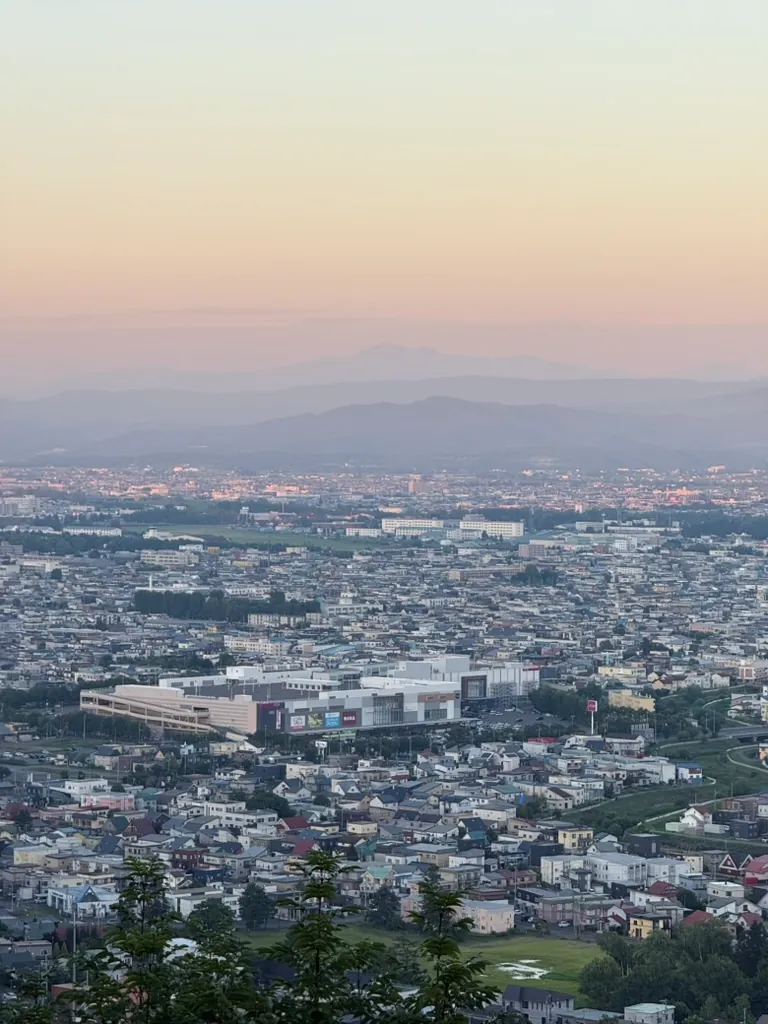
Takasu 鷹栖町
たかすちょう
Takasu is a rice-growing town on the northern edge of the Kamikawa Basin, directly north of Asahikawa. It is best known for Okami no Momo (オオカミの桃, "wolf's peach"), a one-liter bottled tomato juice first sold in 1986. Its hilltop park, Pallet Hills, is planted with cherry trees and looks out on the Daisetsuzan range.123
- Population (2020 Census)
- 6,567
- Area
- 139.42 km²
- District
- Kamikawa District (上川郡)
- Official website
- www.town.takasu.hokkaido.jp
Known for
- Okami no Momo (オオカミの桃): tomato juice made from tree-ripened tomatoes that are picked in the morning and bottled the same day. It comes salted or unsalted, in one-liter bottles only. It was named in 1983 and has been made commercially since 1986.212 The juice turned 40 in August 2026.6
- Rice: In 2025 paddy rice covered 2,418 ha, about 73% of the town's planted area.13 Nanatsuboshi and Yumepirika are the main varieties.14
- Asahikawa's northern suburb: The town center is about 25 minutes by car from JR Asahikawa Station.1 The Kitano district in the south grew as a commuter suburb of Asahikawa.4
- Pallet Hills (パレットヒルズ): a hilltop park where residents have planted about 2,000 cherry trees. It has a Daisetsuzan viewpoint, a campground and a park-golf course.153
- Honda's Takasu Proving Ground: a 7.89 km² cold-weather and handling test site, opened in 1990. One of its courses is modeled on the Nürburgring Nordschleife.16
- New local drinks and meats: gin from the Takasu Distillery (鷹栖蒸溜所, 2023), the Domaine Toi winery (2024),6 Takasu beef (鷹栖牛) and Ezo deer venison.17
- Melody Bridge (メロディー橋): built in 1981 and billed as Japan's first bridge that plays a tune. It plays the children's song "Yūyake Koyake".18
Sights & activities
- Nature & scenery
-
Pallet Hills (パレットヒルズ, 17-sen 8-gō): a hill park where residents planted the cherry trees.15 Its zones:3
- A hilltop lookout with a mountain-identification board for the Daisetsuzan peaks.
- A cherry-and-maple forest planted by residents.
- A pond-and-stream area with carp and freshwater shrimp.
- A fountain for children to splash in.
- A management building with toilets, a diaper-changing table and a herb garden.53
It is 10 minutes by car from the Asahikawa-Takasu IC and 30 minutes from Asahikawa Station.54
-
Arashiyama Park (嵐山公園): 126.8 ha of hill forest with an observation deck. "Arashiyama and the view from it" is one of the Eight Views of Asahikawa (旭川八景). Snowshoe walks are possible in winter.24
-
Hoppō Wildflower Garden (北邦野草園, Arashiyama, Takasu-chō): 12.25 ha of northern wild plants, opened in 1972, with about 5.2 km of trails on 30-minute, 1-hour and 2-hour loops. Open late April to 15 October, 9:00–17:00 (last entry 16:30). Free entry.55 Spring flowers include katakuri (dogtooth violet) and Ezo corydalis.56
-
Maruyama Haiku Monument Forest: woodland walks among about 180 haiku stones. See Culture & festivals.48
-
- Onsen: No hot-spring facility was found in the town's official tourism and facility listings.
- Museums & heritage
- Takasu Local History Museum (鷹栖町郷土資料館, Minami 1-jō 1-chōme): open Wednesdays and Saturdays only, 10:00–17:00 (April–September) and 10:00–16:00 (October–March). Free entry.22 Exhibits include:22
- the registered horseshoeing collection
- a diorama of the Kunimi Monument (国見の碑), described as the oldest stone monument in Kamikawa
- a recreated Taishō-era farmhouse
- lion-dance gear
- a hands-on corner with old toys
- Kunimi Monument on Mt. Chikabumi (近文山国見の碑): the monument itself stands in Arashiyama Park and is an Asahikawa City historic site.24
- Melody Bridge (Kitano Bridge, 北野橋): rebuilt in 2013 with chimes that replaced the original glockenspiel-style bars. Walk across and play "Yūyake Koyake."57
- Arashiyama Park Center: displays on wildflowers, local nature and Ainu culture. Free entry.52
- Takasu Local History Museum (鷹栖町郷土資料館, Minami 1-jō 1-chōme): open Wednesdays and Saturdays only, 10:00–17:00 (April–September) and 10:00–16:00 (October–March). Free entry.22 Exhibits include:22
- Outdoor & seasonal activities
- Park golf:
- Maruyama course (たかす丸山パークゴルフ場, 21-sen 14-gō): 36 holes by the water, with views of the Daisetsuzan and Tokachi-dake ranges, late April to late October, ¥500 a day.58
- Pallet Hills course: ¥500 for adults and ¥300 for children. Jingisukan grilled mutton can be booked for groups of five or more.15
- The town has four park-golf courses in all.59
- Golf: St. Asahikawa Golf Club, Asahikawa Takasu Golf Club and Great Asahikawa Country Club.59
- Camping: The Pallet Hills campground is open from late April to late October. Adults pay ¥500 a night, school-age children ¥300, and day camping is free.60
- Winter camping and snow play: There is also a winter season, from December to February, and a Taka-Snowland (たかスノーランド) snow-play area. Snowshoes, snow tubes, snow-surf boards, cross-country skis and fat bikes can be rented.60
- Summer: stargazing nights and pick-your-own berries.4638
- Park golf:
- Food experiences
- Tofu courses at Densho-kan.40
- Venison dishes at Sankei. It has a dog run, and summer hours are 11:00–19:00.37
- Gatatan soba (ガタタンそば, ¥1,100) at the handmade-soba shop Taka-no-Sato (手打ちそば処 鷹の里, 8-sen 10-gō).61
- Weekday set lunches from ¥600 at the restaurant Sansan in Towa Hokuto (14-sen 17-gō). The complex is a converted former Hokuto Elementary School and also has a craft shop.62
- Gin tours at the Takasu Distillery.41
Roadside stations (Michi-no-Eki)
No Michi-no-Eki is located in Takasu. None is listed for the town in the Hokkaido roadside-station directory.63 Nearby stations:
- Asahikawa (道の駅あさひかわ), Asahikawa: Kagura 4-jō 6-chōme, on National Route 237. The station is open 9:00–21:00 and closed 30 December–4 January. It was registered in 2000 and includes a large exhibition hall.64
- Tōma (道の駅とうま), Tōma: on National Route 39, with Daisetsuzan views. Open 9:00–18:00. Registered in 1998.65
- Higashikawa "Michikusa-kan" (道の駅ひがしかわ「道草館」), Higashikawa: Higashi-machi 1-chōme.63
- Rice Land Fukagawa (道の駅ライスランドふかがわ), Fukagawa: at the junction of National Routes 12 and 233, with a rice theme. Registered in 2002.66
- Ehon-no-Sato Kenbuchi (道の駅絵本の里けんぶち), Kenbuchi: to the north. Registered in 2006.63
For Takasu products, the town's own shop is the closest equivalent. Takamāru (鷹栖町物産館たかま〜る) opened on 13 November 2025 together with the new Tsuruha drugstore. It sells Okami no Momo, local foods and crafts, and soft-serve made with Nitta Farm milk in a red-and-white cone. Hours are 10:00–18:00; it is closed Wednesdays and over New Year; tel. 0166-56-1166 (as of December 2025 — check before visiting).29
Getting there & around
- Rail:
- The town has no station. The JR Hakodate Main Line crosses its southern tip through the Arashiyama Tunnel between Osamunai and Chikabumi, without stopping.4
- The nearest stations are Chikabumi (Hakodate Main Line) and Nagayama (Sōya Main Line), both in Asahikawa.4
- Sapporo–Asahikawa takes about 85 minutes by JR.67
- Asahikawa Station is about 12 km from town, about 25 minutes by car.251
- Bus:
- Dōhoku Bus (道北バス) runs from Asahikawa Station. For Melody Hall and the gym, get off at "Fureai Center Iriguchi," "Kita 1-jō 3-chōme" or "9-sen 9-gō."67
- For Arashiyama and the wildflower garden, take Asahikawa Denki Kidō bus No. 3 from Asahikawa 1-jō 8-chōme (stop 14) to "Hoppō Yasōen Iriguchi," then walk about 15 minutes.55
- Getting around town: The town bus runs on demand only.68
- Book by phone at 0166-87-5489 at least an hour ahead.
- There are ten runs a day.
- Adults pay ¥200 a ride; riders 18 and under ride free.
- Stops include Pallet Hills, Maruyama Park Golf, Takamāru and the town hall.68
- Road:
- Asahikawa-Takasu IC on the Dō-ō Expressway opened in 1990. Its ramps are in Takasu, but the tollgate is in Asahikawa.28 Japanese Wikipedia names the Asahikawa-Kita IC as the nearest interchange to the town center.4
- Sapporo IC to Asahikawa-Takasu IC takes about 90 minutes.67
- Japanese Wikipedia lists no national route in the town. The main roads are Hokkaido prefectural roads, including 37 (Takasu–Higashikagura), 72 (Asahikawa–Horokanai), 99 (Wassamu–Takasu) and 1125 (Arashiyama Park).4
- Road distances from Takasu: Asahikawa 15 km, Furano 67 km, Sapporo 141 km, Wakkanai 261 km.67
- Air:
Practical tips
- When to go:
- Where to stay: Hokkaido's FY2025 survey recorded no overnight guests in Takasu.32 Plan to stay in Asahikawa, 15 km away,67 or camp at Pallet Hills in season.60
- Tourist information: The Takasu Tourism Association (鷹栖町観光協会) is inside the Chamber of Commerce at Plaza Cross 10, Minami 1-jō 1-chōme 1-26 (tel. 0166-87-2210).2769 Its website, Tabitakasu (たびたかす), posts event news.43
- Addresses: Rural addresses follow a grid of "sen" (lines) and "gō" (numbers), for example 17-sen 8-gō for Pallet Hills. Enter them exactly into a navigation app.43
- Brown bears: Bears are active around town. From late August to mid-September 2026, sensor cameras filmed bears repeatedly at 15-sen 22–23-gō (near Takashima Bridge and the former Chienbetsu Elementary School site), 21-sen 12-gō, 24-sen 15-gō and 26-sen 18-gō, and a bear crossed in front of a car.70 The town asks campers to carry a radio or something else that makes noise, even at night.60 Arashiyama Park asks walkers to carry bells.24
- Limited opening days:
- Winter: Snow usually lies from late November to mid-April.13 Honda chose Takasu for winter testing partly because it gets a lot of snow.16
Photos
-
 Aug 2026
More about Takasu
At a glance
| Field | Details |
|---|---|
| Type | Town (町) |
| Subprefecture | Kamikawa (上川総合振興局) |
| District | Kamikawa District (上川郡), the one in old Ishikari Province (石狩国)4 |
| Population | 6,567 at the 2020 Census. The preliminary 2025 Census count was 6,173, down 394 (6.0%).5 The town's resident register showed 6,300 people in 3,058 households on 26 August 2026.6 The Hokkaido Government's register figure for 1 January 2026 was 6,414.7 |
| Area | 139.42 km²8 |
| Density | About 45 people/km² (6,300 residents). It was 47.1/km² at the 2020 Census. |
| Municipal history | Takasu Village (鷹栖村) was created on 4 February 1892. It covered the whole right bank of the Ishikari River in Kamikawa District.69 It adopted the second-class village system in 1906 and the first-class system in 1909. On 4 June 1924 the original village was renamed Higashitakasu (東鷹栖村), and the present Takasu Village and Etanbetsu Village (江丹別村) were split off from it.4 Takasu became a town on 1 January 1969.6 It has not merged with any other municipality. Higashitakasu joined Asahikawa in 1971.9 |
| Neighboring municipalities | Asahikawa (east, south and west) and Wassamu (north)410 |
| Symbols | Tree: Japanese rowan (ななかまど). Flower: marigold (マリーゴールド). The emblem dates from 1 January 1968.1 No town bird was found. A new official logo mark was completed in April 2025.6 |
| Mascot | Attakasu-kun (あったかすくん) is a hawk with big, lovable eyes. He carries a bottle of Okami no Momo on his back and is good at jumping. His birthday is 8 August, which is Town Day, and he stands about 190 cm tall. He was created in 1995 and redesigned in 2013.11 |
| Official website | https://www.town.takasu.hokkaido.jp/ |
Name origin
- "Takasu" is a translation, not a sound-spelling, of the Ainu name Chikap-un-i (チカップニ). The town explains that kites (トンビ), Eurasian sparrowhawks and northern goshawks once circled over the area. People who saw them called it "the place where big birds (hawks) live (nest)." The Japanese rendering became 鷹 (hawk) + 栖 (nest, dwelling).1
- The glosses differ slightly. Britannica Japan gives "the place with the nests of large birds."10 Japanese Wikipedia, in its article on the former Higashitakasu, gives the plain "place where birds are" (chikap-un-i). It adds that the name is said to have been chosen by Iwamura Michitoshi (岩村通俊), who became the first governor of Hokkaido.9
- The same Ainu name, spelled out by sound, gave Chikabumi (近文) in Asahikawa (chikapu-un-ni, "place where birds are").19 Before 1973, three old place names (字) in the town were Chikabumi (近文), Chikabumi Genya (近文原野) and Osarappe (オサラッペ). That year they were abolished, and rural addresses became grid numbers of the form "○-sen ○-gō" (○線○号).4
- The Osarappe River (オサラッペ川) is said to come from Ainu o-sar-pet ("river-mouth, reed-marsh, river") or o-sara-pet ("river whose mouth is open").20
- Takasu should not be confused with Takasu in Gifu Prefecture or Takasu Station in Hiroshima.21
History
- Before settlement: The town museum shows stone tools used about 10,000 years ago.22 It also shows obsidian arrowheads and pottery replicas from sites in Takasu.23 Near the Asahikawa boundary, Arashiyama keeps a chashi-kotsu (チャシコツ), an Ainu fort or lookout site.24
- Edo period: The sources consulted record no trading post or other Edo-period Japanese presence in the present town area.
- Opening the right bank (1886–1895): Organized settlement of Kamikawa District began around 1886. When Kamui, Asahikawa and Nagayama villages were created in September 1890, the right bank of the Ishikari belonged to none of them. The first settlers there, people from Saitama Prefecture and others, entered the Chikapuni plain on 15 April 1891, around today's Asahimachi–Ōmachi in Asahikawa. A Hokkaido Government ordinance of 4 February 1892 created Takasu Village to cover the whole right bank. Its population doubled from about 600 in 1893 to about 1,300 a year later, and the village got its own office in 1895.9 The town's industrial-park page dates the founding to February 1891.25 The town celebrates 4 February 1892 as its founding and marked the 130th anniversary in 2022.6
- Shrinking the giant village (1897–1924): Aibetsu split off in 1897. The Chikabumi area was transferred to Asahikawa Town in 1902, taking 384 households and 1,750 people. Pippu split off in 1906.9 In 1898 Kawabe Genzaburō (川辺源三郎), a settler bringing a lion dance from Toyama Prefecture, dedicated a male lion (雄獅子) to Kitano Shrine.26 In the Taishō era, development shifted to the Osarappe area. Residents of the Chikabumi plain then pushed for separation. On 4 June 1924 the old village became Higashitakasu, and the present Takasu (Osarappe area) and Etanbetsu became separate villages.9
- Rice and water: The museum records how settlers built irrigation to draw water from the Ishikari and fought to control floods on the Osarappe River. It displays one of only two models in Hokkaido of the wooden pipes used for irrigation intakes.22
- Postwar: The population peaked at 10,436 at the 1960 Census.21 From the later 1960s people left for the cities. From the late 1970s Takasu became a farming suburb of Asahikawa.25 It became a town on 1 January 1969.6 Health checkups for all residents began in 1975. Three years in, they showed that residents were short of vitamins, and this led to home-made tomato juice. The juice was named Okami no Momo in 1983,27 the year the town's own timeline gives for the start of sales.1 Full-scale production began in 1986 under the Takasu Agricultural Promotion Corporation (鷹栖町農業振興公社).27
- Growth years (1978–2008): Milestones in this period:
- 1978: the Local History Museum opened.
- 1981: Melody Bridge was completed.1
- 1990: Honda opened its proving ground,16 and the Asahikawa-Takasu IC on the Dō-ō Expressway opened on 30 October.28
- 1991–2003: new housing estates were built, including Paradigm Town (1991) and Symphony Town (2003) in Kitano and Forest Town (1994) and Harmony Park (1998) in Takasu.13
- 1994: Takasu Melody Hall opened.
- 1995: sister-city ties with Gold Coast were signed.1
- 2008: a new 5.9 ha section of industrial land was completed.25
- Recent:
- 2018: the farm-training center Attaka Farm (あったかファーム) opened.1
- June 2022: the town declared itself a "Zero Carbon City."6
- August 2023: the Takasu Distillery was completed in the Chūō district.6
- March 2024: 399 horseshoeing tools and related items became a Registered Tangible Folk Cultural Property of Japan.22 According to Japanese Wikipedia, this was the first such registration in Hokkaido.23
- 2024: a rainstorm dropped 177 mm in one day and caused damage.13
- September 2024: the Domaine Toi winery was completed in Hokuto.6
- November 2025: a Tsuruha drugstore and the town product shop Takamāru opened.29
- May 2026: the town newsletter was renamed Attakasu.6
Geography & climate
-
Setting: Takasu lies at the northern end of the Kamikawa Basin. It is a small basin of its own, ringed on the east, north and west by a horseshoe of hills.10 Rural roads follow a near-perfect grid.4 The town spans 11.8 km east–west and 19.7 km north–south, between 43°47′ and 43°57′N and 142°16′ and 142°25′E.30
-
Districts: The town has five districts. Takasu and Kitano are built-up; Chūō, Hokuto and Hokusei are farm districts.4
-
Land use (tax survey):13
- paddy fields: 26.3%
- upland fields: 7.0%
- forest: 33.2%
- residential land: 2.3%
-
Honda's test site: Honda's proving ground alone covers 7.89 km², about 5.7% of the town.16
-
Osarappe River (オサラッペ川): a 25.7 km tributary of the Ishikari with a 195.5 km² basin. It rises in the hills on the Wassamu boundary, flows south through the middle of town and joins the Ishikari at the town's southern tip.201
-
Arashiyama (嵐山): Arashiyama rises on the southern boundary with Asahikawa. Its forest grows on serpentinite soils and includes many plants of scientific interest.24 The Arashiyama area belongs to the national Arashiyama–Kamui Natural Recreation Forest (嵐山・神居自然休養林), which extends into Takasu.31 No national, quasi-national or prefectural natural park was found in the town.
-
Climate (town observations since 1964):13
- Record high: 37.7 °C on 31 July 2021.
- Record low: −37.6 °C on 17 February 1978.
- Wettest day: 189.5 mm on 6 September 1991.
- Warmest year: an annual mean of 8.9 °C in FY2023, the highest on record.
- Snow: on average the first snow falls on 27 October. Lasting snow cover starts on 24 November and melts by 15 April.
- Frost: the last spring frost comes around 18 May on average.
Honda reports that snow falls for about half the year, from November to April, and that some winter days drop below −20 °C.16
Economy & industry
- Farming:
- Rice is the base of the economy.1 In 2025, 3,317 ha were planted. Paddy rice took 2,418 ha; forage 455 ha; wheat 81 ha; grains and beans 80 ha; buckwheat 57 ha; vegetables 35 ha.13
- Rice varieties in 2023: Nanatsuboshi on 1,015 ha (43.5%), Yumepirika on 774 ha (33.2%) and Kirara 397 on 404 ha (17.3%).14
- The town counts its cucumbers as a high-value crop.1 In 2023, 35 growers farmed 5.9 ha of cucumbers and 58 growers farmed 3.9 ha of tomatoes for processing.14
- The 2020 Census of Agriculture counted 227 farm businesses, 265 dairy cattle and 126 beef cattle.13
- A FY2023 town survey found 258 farm households, 29 of them incorporated. The average farmer was 62.6 years old.14
- Jobs: 3,159 residents were employed at the 2020 Census. Primary industry employed 532 (525 in farming), secondary 419 and tertiary 2,011.13 In the 2021 Economic Census the town had 259 business establishments with 2,517 workers. Medical and welfare work was the largest field, with 875.13
- Industry:
- The Takasu Industrial Park (たかす工業団地, 19.8 ha) sits on the Asahikawa boundary near the Asahikawa-Kita IC. Its tenants include Asahikawa Nissan, Hokuren's compound-feed and trucking arms, and the Kamikawa Rice Terminal.25
- Honda's proving ground opened in 1990. Its 6,180 m winding course (1993) has a 57.5 m elevation change and copies the character of the Nürburgring Nordschleife. The site also has a high-speed loop (1995) and courses that recreate European and U.S. roads, with 54 road-surface types in all.16
- Tourism: Hokkaido counted 105,400 visitors in FY2025. All were day-trippers from within Hokkaido, and August was the busiest month, with 31,200. The survey recorded no overnight guests.32
- Population trends:
- Revitalization efforts:
Local specialties
| Specialty | Category | Details & where to get it |
|---|---|---|
| Okami no Momo (オオカミの桃) | Tomato juice | Fully ripe tomatoes from Takasu and nearby Asahikawa are picked in the morning and bottled the same day in the town factory. The salted version uses Sōya sea salt (宗谷の塩); there is also an unsalted version. Sold in 1-liter bottles in sets of 3 or 6.2 The name translates the tomato's scientific name Lycopersicon, "wolf peach."27 The juice is sold at Da-Marché Kitano, Towa Hokuto and Chikori.27 The maker also sells tomato dressing and miso.2 |
| Lycopinage (リコピナージュ) | Liqueur | A pale-pink liqueur made with Okami no Momo and developed with the National Institute of Technology, Asahikawa College. Launched in 2021.126 |
| Takasu rice (鷹栖米) | Rice | Yumepirika and Nanatsuboshi.14 The town rice drew more than 1,000 furusato nozei requests in six months.33 Donation gifts include 2 kg of Yumepirika from Takasu Taro Farm (たかすタロファーム) for ¥5,000.34 |
| Takasu beef (鷹栖牛) | Beef | Only heifers aged 25–30 months are shipped from Nitta Farm (新田ファーム). The cattle are fed Takasu rice straw.35 The farm shop Moo-chan-chi (モゥーちゃん家, Minami 1-jō 3-chōme) sells a 100% Takasu-beef burger (¥650 before tax) and milk soft-serve. It is closed Wednesdays.36 |
| Ezo deer venison (エゾシカ肉) | Game meat | Venison processed in-house at Sankei (山恵, 13-sen 16-gō). The restaurant serves rump steak (¥2,420) and stews.37 Canned venison is also sold.38 The furusato nozei portal lists 21 deer-meat gifts from the town.34 |
| Takasu-gyū Curry (たかすぎゅうカレー) | Local dish | A hamburger-steak curry made with a set blend of Takasu beef and venison, plus diced venison. It is served on Takasu rice and must cost no more than ¥1,200 before tax. You can order it at Daihachi Shokudō and Yamashita.39 |
| Handmade tofu | Tofu | Densho-kan (伝承館, 18-sen 9-gō) makes tofu from Takasu-grown Ōsodefuri (大袖振) soybeans. It serves it in tofu courses (¥2,600 and ¥3,600) inside a farmhouse built in the early Taishō era.40 |
| Takasu Distillery gin (鷹栖蒸溜所) | Spirits | A craft-gin distillery run by Son&Heir Co., completed in 2023.416 Tours with tastings are sold through the Taisetsu Kamuimintara DMO's experience catalog.41 |
| Towa Hokuto wine (とわ北斗) | Wine | The social-welfare corporation Takasu Kyōseikai runs the Domaine Toi winery, completed in 2024. It also has grape-picking tours.641 Its wines include Assemblage Rouge.14 |
| Honey, haskap and lavender | Farm products | Mitsubachi Kōbō Yamaji sells acacia, clover and wildflower honey. Bio Agri Takasu makes haskap juice and jam.35 It also makes Taisetsuzan Tomato Juice.42 Grass Farm makes lavender products by low-temperature vacuum extraction from hand-picked organic "Okamurasaki" lavender, plus an apple-lavender juice.35 |
| Pick-your-own | Farm experience | Advance phone booking is required.38 • Kikurage mushrooms at Sukeyasu Farm, mid-July to late August, ¥200 per 100 g. • Blueberries at Takasō, mid-July to mid-August, ¥200 per 100 g plus a ¥500 adult entry fee. • Haskap at Haskap Farm, July, ¥100 per 100 g. |
Other gifts listed include Okami no Momo (a 3-bottle set for a ¥15,000 donation) and local honey.34 Takamāru, the town product shop, sells Okami no Momo, other foods and crafts, Honda goods and merchandise of the pro volleyball team Voreas Hokkaido.29
Culture & festivals
| Event | When | Highlights |
|---|---|---|
| Cross-country ski events: Okami-no-Sato Kitano Cross-Country Race (オオカミの里北野クロスカントリー大会) and Takasu Walking-Ski Festival (たかす歩くスキーフェスティバル) | January and March4 | The tourism association describes a winter walking-ski event on the cross-country course of St. Asahikawa Golf Club. The route runs through woods and rolling hills, with town views from Pallet Hills, and courses suit all ages.43 |
| Sakura Festa and Night Cherry Light-up (さくらフェスタ・夜桜ライトアップ) | Early May; in 2026, light-up 4–6 May and festival 5–6 May | About 2,000 cherry trees at Pallet Hills.44 There are food stalls, and visitors who buy meat can borrow a charcoal grill free to barbecue Takasu beef or venison.43 The light-up runs 19:00–20:30.44 |
| Takasu Jogging Festival (たかすジョギングフェスティバル) | June | Community running event.4 |
| Kitano Shrine Festival (北野神社例大祭) | 4 August | Lion dance (獅子舞). One lion head, five dancers in the body and a lion-handler who faces it with a naginata, a sickle-and-chain or a staff, all to drums and flutes.26 |
| Takasu Nekka Festa (たかす熱夏フェスタ, "Hot Summer Festa") | Early August; 8–9 August in 2026 | This is the town's biggest summer festival.6 Held around Takasu Melody Hall, it has an eve event and a main day.45 Highlights are a portable-shrine procession for adults and children, the local street-dance crew IZATAKA, more than 30 food stalls and closing fireworks.43 |
| Pallet Hills Stargazing (星空観望会) | Mid-August; 13 August in 2026 | Free Perseid-meteor viewing with a curator from the Asahikawa science museum. Limited to about 30 people; booking required.46 |
| Pallet Hills Tree-Planting Festival (植樹祭) | September; 13 September in 2026 | Residents plant Ezo mountain cherries and other trees. A nature walk is held the same day.47 |
| Autumn harvest fair (English name not confirmed) | Autumn | Fresh vegetables and local products. Limited coupons for discounted new-crop rice are handed out, and a Takasu-beef sale usually sells out.43 |
| Takasu Tekion Music Festival (たかすてき音楽祭) | November | Music festival.4 |
- Kitano Shrine lion dance: The dance came to Toyama Prefecture from old Kaga Province (Ishikawa). A settler brought it to Takasu, and the lion was dedicated in 1898.26 In December 1978 it became the town's first designated cultural property.22 Its preservation society marked 60 years in 2025.6 The shrine is in the Kitano district.4
- Maruyama Haiku Monument Forest (丸山句碑の森, 21-sen 13-gō): about 180 stones carved with haiku stand in natural woodland. The tea-house-style Genkyū-an (玄穹庵) is rebuilt from part of a pioneer-era house. Ezo corydalis and other wildflowers bloom here in spring.48
- Takasu Melody Hall (たかすメロディーホール, Minami 2-jō 4-chōme): a 502-seat hall with seats upholstered in Yūkara-ori (ユーカラ織) weave. It hosts touring concerts and plays, and local dance, folk-song and band groups perform there.49 It opened in 1994.1
- Music names: After Melody Bridge, the town gave music-themed names to other places, such as Melody Hall, Harmony Town and Symphony Town.18
- Town Day (町民の日): set as 8 August in 1974.1
- "Hawks" exchange (ホークス交流): Takasu is one of several municipalities named with 鷹 ("hawk") that have held summits together.50
Ainu heritage
- Both "Takasu" and Asahikawa's "Chikabumi" come from the Ainu name Chikap-un-i.119 In 1894, as Asahikawa's streets were being laid out, Ainu living scattered around the area were gathered at Chikabumi, which became the site of an Ainu settlement.19 At that time Chikabumi still belonged to the original Takasu Village. It passed to Asahikawa Town in 1902.9 Chikabumi today has an Ainu memorial museum displaying houses, clothing and tools.19 Hokkaido's Ainu-culture guide describes the Kawamura Kaneto Ainu Memorial Museum (川村カ子トアイヌ記念館), opened in 1916 by the Kawamura family, as the oldest Ainu museum in Japan.51 See Asahikawa.
- Arashiyama Park (嵐山公園): The park straddles the Asahikawa–Takasu boundary.24
- The Ainu Culture Forest "Denshō no Kotan" (アイヌ文化の森・伝承のコタン) has three reconstructed chise (traditional houses), run by the Asahikawa City Museum.
- There is a chashi-kotsu (fort or lookout site).
- A monument honors Kuchinkoro (クーチンコロ).24
- The Arashiyama Park Center, whose address is Arashiyama, Takasu-chō, includes an exhibit of Ainu materials.52
- In Takasu itself: No Ainu cultural facility run by the town was found. The Ainu heritage visible in town is mainly in place names: Takasu and the Osarappe River.120
Sister & friendship cities
- Gold Coast, Queensland, Australia: sister city since 18 November 1995.71
- Takasu chose nearby Albert Shire as its friendship partner, and resident exchanges began in FY1991. When Albert merged into the new City of Gold Coast in March 1995, the tie moved to Gold Coast.
- The partnership was reaffirmed in 2015 and in 2025. For the 30th anniversary, Mayor Tom Tate visited in August 2025, and a Takasu delegation signed a reaffirmation in Gold Coast that November.
- Each year a young Gold Coast resident works in Takasu as an assistant language teacher (since FY1991), and Takasu students visit Gold Coast. Gold Coast also has a park called "Takasu Garden."71
- Matsuura, Nagasaki Prefecture: formerly the town of Takashima (鷹島町). Takasu met it through the "Hawks Summit" of municipalities whose names contain 鷹. Takasu sends elementary pupils there in August, and Matsuura pupils visit Takasu in January.50 The wider Hawks group, which also included Takanosu (now Kitaakita), Mitaka and Shirataka, disbanded at the end of March 2007.4
Notable people
Sources
Numbers in the text link to these sources. Figures as of 23 September 2026
- 鷹栖町について — 鷹栖町 JA accessed 2026-09-23
- 株式会社 鷹栖町農業振興公社|オオカミの桃【公式】 — 鷹栖町農業振興公社 JA accessed 2026-09-23
- ゾーン紹介(パレットヒルズ) — 鷹栖町 JA accessed 2026-09-23
- 鷹栖町 — Wikipedia JA accessed 2026-09-23
- 令和7年国勢調査速報 北海道の人口・世帯数(要計表に基づく人口・世帯数の集計) — 北海道総合政策部計画局統計課 JA accessed 2026-09-23
- 広報誌あったかす 2026年9月号(No.900) — 鷹栖町 JA accessed 2026-09-23
- 住民基本台帳人口・世帯数(令和8年1月1日現在 市区町村別) — 北海道総合政策部計画局統計課 JA accessed 2026-09-23
- 令和8年 全国都道府県市区町村別面積調(1月1日時点) — 国土地理院 JA accessed 2026-09-23
- 東鷹栖町 — Wikipedia JA accessed 2026-09-23
- 鷹栖町とは — コトバンク(ブリタニカ国際大百科事典 小項目事典・日本歴史地名大系) JA accessed 2026-09-23
- “あったかすくん”の部屋 — 鷹栖町 JA accessed 2026-09-23
- オオカミの桃 — Wikipedia JA accessed 2026-09-23
- 鷹栖町統計資料(令和7年度版、2025ver.) — 鷹栖町まちづくり推進課 JA accessed 2026-09-23
- 鷹栖町農業の概要(鷹栖町農業ビジョン 別添2) — 鷹栖町 JA accessed 2026-09-23
- パレットヒルズパークゴルフ場 — 鷹栖町 JA accessed 2026-09-23
- 道が製品を鍛える「鷹栖プルービンググラウンド」|Hondaの研究開発施設 — 本田技研工業 JA accessed 2026-09-23
- Takasu Town — Heart of Hokkaido Tourism Guide (Taisetsu Kamuimintara DMO) EN accessed 2026-09-23
- メロディー橋 — 鷹栖町 JA accessed 2026-09-23
- 近文とは — コトバンク(ブリタニカ国際大百科事典 小項目事典) JA accessed 2026-09-23
- オサラッペ川 — Wikipedia JA accessed 2026-09-23
- Takasu, Hokkaido — Wikipedia EN accessed 2026-09-23
- 鷹栖町郷土資料館 — 鷹栖町 JA accessed 2026-09-23
- 鷹栖町郷土資料館 — Wikipedia JA accessed 2026-09-23
- 嵐山公園 — 公益財団法人旭川市公園緑地協会 JA accessed 2026-09-23
- たかす工業団地の概要 — 鷹栖町 JA accessed 2026-09-23
- 北野神社 — たびたかす(鷹栖町総合観光ガイド) JA accessed 2026-09-23
- たかす名物オオカミの桃 — たびたかす(鷹栖町総合観光ガイド) JA accessed 2026-09-23
- 旭川鷹栖インターチェンジ — Wikipedia JA accessed 2026-09-23
- 広報たかす 令和7年12月号 — 鷹栖町 JA accessed 2026-09-23
- 統計情報 — 鷹栖町 JA accessed 2026-09-23
- 嵐山・神居(あらしやま・かむい)自然休養林 — 林野庁 北海道森林管理局 JA accessed 2026-09-23
- 北海道観光入込調査報告書(令和7年度 資料編)5 市町村別・月別観光入込客数 — 北海道経済部観光局 JA accessed 2026-09-23
- たかす名物 美味しいお米 — たびたかす(鷹栖町総合観光ガイド) JA accessed 2026-09-23
- 北海道鷹栖町のふるさと納税 お礼の品ランキング — ふるさとチョイス JA accessed 2026-09-23
- たかす名物 おみやげにどうぞ! — たびたかす(鷹栖町総合観光ガイド) JA accessed 2026-09-23
- 新田ファーム「CAFE&FOOD モゥーちゃん家」 — 鷹栖町 JA accessed 2026-09-23
- 鹿肉レストラン 山恵 — 鷹栖町 JA accessed 2026-09-23
- 鷹栖町農産物・農産加工品販売マップ(鷹栖NOCHIKARAマップ) — 鷹栖町 JA accessed 2026-09-23
- たかすぎゅうカレー — たびたかす(鷹栖町総合観光ガイド) JA accessed 2026-09-23
- 手作り豆腐料理の店 伝承館 — 鷹栖町 JA accessed 2026-09-23
- TAISETSU TIME-with CRAFTMAN- — 鷹栖町 JA accessed 2026-09-23
- バイオアグリたかす — 北海道まんなか観光ナビ(大雪カムイミンタラDMO) JA accessed 2026-09-23
- たかすイベント情報 — たびたかす(鷹栖町総合観光ガイド) JA accessed 2026-09-23
- 【さくらフェスタ・夜桜ライトアップ2026】開催 — 鷹栖町 JA accessed 2026-09-23
- 【たかす熱夏フェスタ2026】 — 鷹栖町 JA accessed 2026-09-23
- 【2026パレットヒルズ星空観望会】開催のお知らせ — たびたかす(鷹栖町総合観光ガイド) JA accessed 2026-09-23
- 【パレットヒルズ植樹祭2026】開催のお知らせ — たびたかす(鷹栖町総合観光ガイド) JA accessed 2026-09-23
- 丸山句碑の森 — たびたかす(鷹栖町総合観光ガイド) JA accessed 2026-09-23
- たかすメロディーホール — たびたかす(鷹栖町総合観光ガイド) JA accessed 2026-09-23
- ホークス交流 — 鷹栖町 JA accessed 2026-09-23
- 川村カ子トアイヌ記念館 | 道北圏 | アイヌ文化情報検索 — 赤れんが庁舎 展示ガイド(北海道) JA accessed 2026-09-23
- 嵐山公園センター(嵐山公園) — 公益財団法人旭川市公園緑地協会 JA accessed 2026-09-23
- 管理棟について(パレットヒルズ) — 鷹栖町 JA accessed 2026-09-23
- パレットヒルズ — 北海道まんなか観光ナビ(大雪カムイミンタラDMO) JA accessed 2026-09-23
- 北邦野草園(嵐山公園) — 公益財団法人旭川市公園緑地協会 JA accessed 2026-09-23
- 北邦野草園 — Wikipedia JA accessed 2026-09-23
- メロディ-橋 — たびたかす(鷹栖町総合観光ガイド) JA accessed 2026-09-23
- たかす丸山パークゴルフ場 — 鷹栖町 JA accessed 2026-09-23
- 令和8年度のゴルフ場・パークゴルフ場のオープン予定日をお知らせします【4月9日現在】 — 鷹栖町 JA accessed 2026-09-23
- キャンプ場について(パレットヒルズ) — 鷹栖町 JA accessed 2026-09-23
- 手打ちそば処 鷹の里 — 鷹栖町 JA accessed 2026-09-23
- とわ北斗 — 鷹栖町 JA accessed 2026-09-23
- 住所等一覧 — 北の道の駅(北海道道の駅連絡会) JA accessed 2026-09-23
- あさひかわ — 北の道の駅 JA accessed 2026-09-23
- とうま — 北の道の駅 JA accessed 2026-09-23
- ライスランドふかがわ — 北の道の駅 JA accessed 2026-09-23
- 交通アクセス — 鷹栖町 JA accessed 2026-09-23
- 町営バス(デマンドバス)ご利用案内 — 鷹栖町 JA accessed 2026-09-23
- 商工業者の拠点プラザ・クロス10 — 鷹栖町 JA accessed 2026-09-23
- ヒグマにご注意を!【目撃・痕跡情報】 — 鷹栖町 JA accessed 2026-09-23
- 姉妹都市ゴールドコースト — 鷹栖町 JA accessed 2026-09-23
- 有倉雅史 — Wikipedia JA accessed 2026-09-23
- 千葉隆広 — Wikipedia JA accessed 2026-09-23