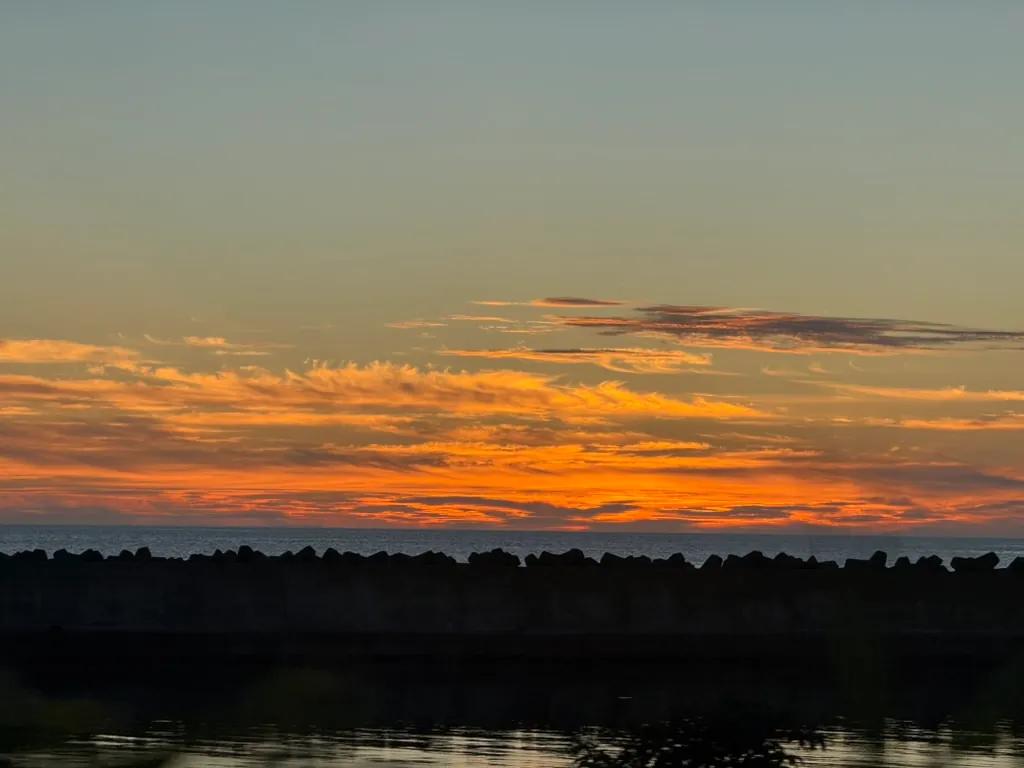
Town Rumoi Subprefecture
Obira 小平町
おびらちょう
Obira is a coastal fishing and farming town on the Sea of Japan, just north of Rumoi. It keeps the largest surviving herring-fishing lodge in Hokkaido, the Former Hanada Family Banya (旧花田家番屋), which is also the northernmost building in Japan designated a national Important Cultural Property.12 Today the town lives on scallops, octopus, rice, black wagyu and a rare netless melon.345
- Population (2020 Census)
- 2,994
- Area
- 627.22 km²
- District
- Rumoi District (留萌郡)
- Official website
- www.town.obira.hokkaido.jp
Known for
- The Former Hanada Family Banya (旧花田家番屋). Built around 1905, it is the largest herring-fishing lodge still standing in Hokkaido.1 It is the northernmost building in Japan designated a national Important Cultural Property, and it is a Hokkaido Heritage site.222
- Herring food at Michi-no-Eki Obira Nishin Banya. The station's restaurant serves herring oyako-don (herring and herring-roe bowl) and grilled herring with sanpei-jiru soup.18
- Scallops and octopus. Scallops are by far the largest catch: 5,827 in 2023, against 60 for octopus (the town's catch table does not state its unit).23 Fishermen's stalls at Usuya port sell live scallops and octopus boiled on the spot.19
- Ivory melon (アイボリーメロン). This netless, green-fleshed melon is grown nowhere else in Hokkaido.185 It is in season from mid-July to early August.4
- Obira black wagyu. The town ships Japanese Black beef.5 A 100% Obira-beef hamburger patty has been sold since 1995.4
- Cretaceous fossils. The upper Obirashibe River is a source of Cretaceous fossils.5 A plesiosaur fossil was dug up in the Kawakami district in 1988.9 In March 2026 a fossil plant from the town was reported as a new genus and species, Kamikinensugi (カミキネンスギ).20
- The Oronon Line coast. National Route 232 runs along beaches, surf points and sunset viewpoints, such as the Onishika Twin Beach.242526
- Olympic skiers. Nordic combined skier Abe Masashi (阿部雅司), born in Obira, won team gold at the 1994 Lillehammer Olympics.2721
Sights & activities
Nature & scenery
- Herring Culture and History Park (にしん文化歴史公園). Across Route 232 from the banya. Its sunset-shaped arch carries a tanka by Matsuura Takeshirō. The best photo is when the sun sets into the arch over the Sea of Japan.262
- Lake Obirashibe and Takimi Ōhashi.
- Tengu Falls (天狗の滝). Chosen in 1993, together with the Hanada banya, as one of the "100 Best of the Sea of Japan" (日本海百選).9
- Hanaoka coast (花岡海岸). The town calls it one of Hokkaido's best places to photograph Japanese green pigeons (アオバト) drinking seawater, from mid-May to late September.63
- Bōyōdai hill (望洋台). Looks down over the town center and the Sea of Japan. The campground and ski area are here.6521
Onsen
- Yuttarikan (ゆったりかん), Obira-machi 458. A lodging facility opened in 1998, with 15 rooms for up to 53 guests.64
- Its large bath is called the "Kōmyōseki Onsen" (光明石温泉), with a jacuzzi and sauna. The town says it eases fatigue and leaves skin smooth.64 Kōmyōseki baths generally use water treated with a mineral ore rather than a natural hot spring (unverified for this facility).
- Day bathing 10:00–21:00 (last entry 20:30). Adults ¥500; children aged 4 to elementary school ¥300.64
Museums & heritage
- Former Hanada Family Banya (旧花田家番屋), Onishika Hirotomi 35-2.2
- A wooden lodge, mostly single-story with part of a second floor, with a shingled hipped roof.2
- 39.39 m wide and 22.72 m deep, with a floor area of 906.5 m².2
- The timber was cut in the Ōtodo hills, carried by boat and sawn by hand.2
- About 200 fishermen and craftsmen lived here.22
- It passed 1 million visitors in 1999.9
- A statue of a woman carrying a herring mokko (wooden carrying box) stands at the entrance. It was donated by the Tokyo Onishika Association and unveiled in 1998.92
- The admission fee could not be confirmed.
- Three Ships memorial. The "Monument to the Three Ships Disaster" (三船遭難慰霊之碑) stands on the Onishika coast.35 The town chronology records a memorial built in Hirotomi in 1975 and a memorial poem monument unveiled in 2004.9
- Culture Exchange Center (文化交流センター), Obira-machi 356-2. Fossil gallery and library. Open 9:00–22:00; closed over New Year.62
Outdoor & seasonal activities
- Onishika Twin Beach (おにしかツインビーチ), Onishika Motohama.24
- A breakwater jetty shelters it, so you can play by the sea even when waves are high. The jetty doubles as a walking path.38
- It has a closed beach and an open beach, a roofed center house with a barbecue corner, showers, a shop and free parking.24
- Auto-camping pitches on the open ground: ¥1,000 for a day, ¥2,000 for one night.24 Pets are not allowed.24
- Usuya Beach (臼谷海水浴場). It was not opened in fiscal 2025. Swimming is prohibited and there is no parking.70
- Surfing and fishing.
- Bōyōdai Campground (望洋台キャンプ場), Hanaoka.65
- Bōyōdai Ski Area (望洋台スキー場).21
- Park golf. Both 18-hole courses are closed for fiscal 2026: the free Obira course behind Yuttarikan and the Onishika course.6869
- Pottery at Tōkōbō Obira (陶工房おびら), Obira-machi 465-1.66
- The brick Hokusō-gama (北創窯) is a climbing kiln with five chambers and 10 m long, built in 1997. The town calls it the largest climbing kiln in northern Hokkaido.6651
- The workshop has electric wheels and kilns for beginners. Individuals pay ¥200 per session, plus clay at ¥900 per kg (glaze and firing included).66
- B&G Marine Center (B&G海洋センター). Canoe and yacht experiences in summer, for booked groups only.6766
- Yūyūsō (ゆうゆうそう/夕遊創). An urban–rural exchange lodge where visitors can try processing local farm and sea produce.71
Food experiences
- The Usuya fishermen's stalls: live scallops, and octopus boiled in the shop that morning.19
- Summer uni-don at Onishika restaurants such as Sumire and Oshokujidokoro Kura (お食事処 蔵, closed Tuesdays).52
- Hand-made soba at Karakure, facing the sea at sunset.53
- The seafood restaurant Umi no Shiki (海の四季) at Yuttarikan serves sashimi sets of local scallop, octopus, hirame and sweet shrimp. Open 11:30–14:00 and 17:00–20:00.6453
Roadside stations (Michi-no-Eki)
Obira Nishin Banya (道の駅おびら鰊番屋)
- Location.
- Onishika Hirotomi, Obira (留萌郡小平町字鬼鹿広富), on National Route 232, the Oronon Line.38 Route 239 runs on the same road here.61
- The station surrounds the Former Hanada Family Banya, with the Herring Culture and History Park across the road.262
- The Engan Bus stop "Hanada Banya-mae" (花田番屋前) is in front.7361
- Mapcode 959 184 151.38
- Hours (as of September 2026 — check before visiting).
- Tourism Exchange Center (shop and gallery): 9:00–17:00, but until 16:00 on the last day of each month. Closed over New Year. Tel. 0164-56-1828.2638
- Restaurant (食材供給施設): opens 11:00. Last orders: April 14:25; May–October 15:25; November–December 14:25; January–March 13:45.18
- Food-facility shop: April 9:00–16:00; May–October 9:00–17:00; November–December 9:00–15:00; January to mid-March 9:00–14:00; from mid-March 9:00–16:00. On Golden Week, and on July–August weekends, 8:00–17:00.18
- Restaurant and shop are closed on Mondays, but open every day from the first Monday of July to the second Monday of August. Tel. 0164-57-1411.18
- Hanada banya: April 9:00–16:00; May–September 9:00–17:00; closed in winter (the town page lists December–March). Autumn hours are unclear: the same page lists "November–December 9:00–16:00", which clashes with the December closure. Last entry 30 minutes before closing. Closed Mondays, except from the third Monday of June to the second Monday of August.2 The official Michi-no-Eki site gives slightly different open-every-day dates (6 July – 10 August).38
- Shops & products.
- The Tourism Exchange Center sells Obira's specialties and vegetables, as well as local products from the wider Rumoi area.438
- Highlights: ivory melon (mid-July to early August), Summer Orange watermelon, and the Obira-beef hamburger and curry (120 g patty ¥250).4
- Also: Majima Shōten's beko-mochi, "Takokun" whole octopus and Obimaru goods.185211
- Food. The restaurant serves Sea of Japan seafood and dishes from the yanshū herring-fishing tradition.18
- Facilities.
- Parking: 69 cars and 10 large vehicles. Japanese Wikipedia gives 67 + 12, plus 2 accessible spaces.3861
- Toilets: 24-hour, including accessible and ostomate toilets.2638
- An EV quick charger near the Tourism Exchange Center.72
- The official site also lists Wi-Fi, a nursing room, a diaper-changing table, a restaurant, direct produce sales, and credit-card and other cashless payment.38
- Inside the center: a gallery with real big-catch flags (大漁旗) on the atrium wall, a tatami rest area around an irori hearth called "Oyakata no Ma" (親方の間), a history exhibition hall, and a "mokko wagon" modeled on the herring carrying box.4
- Notes.
- Registration. Registered on 16 April 1996 (Hokkaido registration No. 27).38 The food facility opened on 26 May 1996.9
- Tourism Exchange Center. The current building opened in April 2015.26
- Stamp. Can be stamped 24 hours a day, even on closing days, from a machine in front of the 24-hour toilets.38
- Heritage. The Hanada banya is part of the Hokkaido Heritage "Rumoi Herring Route" (留萌のニシン街道), recognized in 2001.222
- Nearest other stations.
Getting there & around
- Rail.
- Highway bus from Sapporo: Engan Bus "Express Haboro" (特急はぼろ号).73
- Reservation only. Departs from Sapporo Station-mae stop 32.
- Timetable from 1 October 2026: departs Sapporo 9:30, 13:00, 15:00 and 17:30. Arrives Obira Chūō (小平中央) at 12:07, 15:37, 17:37 and 20:07, about 2 h 37 min. Hanada Banya-mae is 13 minutes later.
- Toward Sapporo, it leaves Obira Chūō at 8:29, 10:19, 13:49 and 17:49.
- Fares from Sapporo: ¥3,000 to Obira Chūō; ¥3,700 to Hanada Banya-mae and Onishika. Cashless and online-booking discounts are available.
- Local buses.
- The Engan Bus Horonobe–Rumoi Line (幌延留萌線) replaced the Haboro Line and runs along the coast through Obira.5
- One morning run of the Rumoi–Asahikawa Line starts at Haboro. It picks up at Onishika (8:20) and Obira Chūō (8:37) on its way to Asahikawa.77
- The Obira Demand Bus (小平町デマンドバス) is run by Tentetsu Bus. It links the Takinoshita and Tappu area with Obira Chūō and connects there with buses to Rumoi.75 Book by phone on 0800-800-3447 (free call). Fares ¥100–500.75
- Getting around Onishika. The "Kukiru" ride-share runs within Onishika (Toyohama to Tomioka) on weekdays, 8:00–16:00. It costs ¥500 per ride; book by the previous day.76
- By car.
- National Route 232 runs along the whole coast.38
- Prefectural Road 126 (Obira–Horokanai Line) runs inland past Lake Obirashibe.540
- The Fukagawa–Rumoi Expressway was completed on 28 March 2020. It ends at Rumoi IC in neighboring Rumoi.973
- By highway bus, Obira Chūō is 8 minutes from Rumoi's Kasugachō 1-chōme stop, and Hanada Banya-mae 21 minutes.73
- Air.
Practical tips
- When to go.
- Late May: the Nishin Banya Festival.56
- Mid-July to early August: ivory melon season.4
- June–September: local sea urchin.52
- July–August: beaches and camping (the campground's 2026 season ended on 18 August).2465
- Late August: the Industry Festival's wagyu barbecue.57
- Herring kuki have appeared in front of the banya in April (2019–2022).9
- Seasonal closures.
- Visitor information.
- Where to stay. Yuttarikan, Otoo Ryokan and Mikami Minshuku (both in Onishika Minatomachi), and Katagiri Minshuku (Usuya).81 Also Yūyūsō and the Bōyōdai Campground.7165
- Brown bears.
- The town warns that bears, their droppings and footprints are seen often, especially in the wild-vegetable (sansai) season. Avoid entering forests near bear warning signs.79
- A bear was sighted in the town center, between the Yasuragi-sō group home and Obira Shrine, on 19 June 2025.80
- The town has adopted a brown-bear zoning plan under the Hokkaido Brown Bear Management Plan.82
- From 3 to 15 May 2022 bears were seen daily in Ōtodo, Sōen and Hanaoka.9
- Forest entry. To enter the national forest in Tappu, send an entry notice directly to the Rumoi Nanbu Forest Office (留萌南部森林管理署). Notices no longer go through the town's board of education. The town notes that geological surveys are a common reason for entering.83
- Roads and weather.
- Obira is a special heavy-snowfall area.9
- In July 2018 a landslide in heavy rain closed Route 232 between Hanaoka and Ōtodo for three days.9
- The JA-run A-Coop supermarket closed in 2018. The town has basic shops, and larger supermarkets are in a neighboring town about 20 minutes' drive from the town hall, so self-caterers should plan ahead.551
- Money. The Michi-no-Eki takes credit cards and other cashless payment.38 Smaller shops and fishermen's stalls may not (unverified).
Photos
-
 Aug 2026
 -
 Mar 2026
 -
 Aug 2026
More about Obira
At a glance
| Field | Details |
|---|---|
| Type | Town (町) |
| Subprefecture | Rumoi (留萌振興局) |
| District | Rumoi District (留萌郡)5 |
| Population | 2,994 at the 2020 National Census (1,431 men, 1,563 women; 1,366 households). This was 10.3% below the 2015 count of 3,336.612 The town's five-year age table for 2020 sums to 2,998, a small internal discrepancy.13 The 2025 Census count listed by the town is 2,562 (1,262 households).6 Resident register: 2,550 people (1,245 men, 1,305 women) in 1,473 households, posted 1 September 2026.7 The population peaked at 17,047 in the 1950 Census (the town's strategy document gives 17,046).614 |
| Area | 627.22 km² (GSI, 1 April 2026).8 The town measures 34 km east–west and 32 km north–south.15 |
| Density | About 4.1 people/km² (September 2026 register ÷ GSI area); about 4.8/km² at the 2020 Census (calculated). |
| Municipal history | 1878: the town counts this as its founding (開基); it held its centenary in 1978.169 1906: Onishika Village (鬼鹿村) formed by absorbing Tentogari Village (天登雁村).17 1 July 1919: Obirashibe Village (小平蘂村) became an independent village, split off from Rumoi Town, with its office in Usuya.59 1 January 1948: renamed Obira Village (小平村). 30 September 1956: absorbed Onishika Village. 1 September 1966: became a town.9 2003–2005: joined merger talks with Rumoi and Mashike; the statutory council was dissolved in February 2005, so the town never merged.9 |
| Neighboring municipalities | Rumoi: Rumoi (south), Tomamae (north). Sorachi: Fukagawa, Numata. Kamikawa: Horokanai.515 |
| Symbols | Town tree: Japanese yew (イチイ). Town flower: azalea (ツツジ). The town's symbols page dates both to 8 May 1979; the town chronology lists them under 1978.109 Town emblem adopted 26 November 1937: a Pole Star inside a snowflake made from the characters 小 and 平.10 No town bird was found. |
| Mascot | Obimaru (おびまる), "born" 12 August 2014, first shown at the 38th Industry Festival on 31 August 2014. The name comes from "Obira's specialties, marugoto (all of them)": the town says it took its shape from eating Obira's melon, beef, octopus, scallops, herring and rice. The star on its forehead and ribbon comes from the town emblem.11 |
| Official website | https://www.town.obira.hokkaido.jp/ (Japanese; tourism pages at /kanko/)7 |
Name origin
- Obira comes from the Ainu name of the Obirashibe River (小平蘂川), O-pira-us-pet (オピラウㇱペッ), "the river with a cliff at its mouth."285
- From Obirashibe to Obira. The village was first named Obirashibe (小平蘂).5
- When the railway station opened in 1927, the character 蘂 was dropped "because it has too many strokes for a station name."5
- The village took the shorter name, Obira Village (小平村), in 1948.5
- The kanji 小平 are read Kodaira in Tokyo's Kodaira City, which became Obira's sister city because of the shared spelling.16
- Other Ainu names in the town.
- Onishika (鬼鹿). Two uncertain readings: o-nis-ka ("above the clouds"), from a story that lightning struck here and rose with the clouds (Uehara's theory), or o-ni-us-ka-pet ("river flowing through the forest"). Confidence level C.29
- Ōtodo (大椴). A half-translation of Poro-Totoko (大椴子), "big Totoko." Totoko is variously explained as tu-tuk ("a jutting cape"), "a lake above," or tu-etoko ("the end of the mountain"). Level C.29
- Usuya (臼谷). Us-ya, "the shore of the inlet," describing a gently curving sandy bay. Level B.30
History
- Ainu era and archaeology.
- The town has 19 registered archaeological sites. They include settlement sites such as the Takasago site (高砂遺跡), a burial site on the Kawajiri sand dune, and the Ingarushi site.32
- An emergency excavation of the Takasago site began in 1980.9 A building displaying a burned dwelling from the site is listed among town facilities.33
- Matsumae era: trading posts and herring (1600s–1860s).
- Around the Keichō era (1596–1615), the Matsumae domain opened the Rurumoppe trading post (ルルモッペ場所), which covered this coast.9
- A Benten shrine was founded at Onishika in 1714, and the Itsukushima Shrine (厳島神社) in 1786.9
- In 1844 Kōzaki Kyūemon (甲崎久右衛門) of Fukuyama (Matsumae) came to Onne-Onishika (Onishika) as a seasonal fisherman and began running a fishery there.9
- In 1854 Harada (later Nishizawa) Shigejirō (原田繁次郎) of Fukushima Village opened the first herring fishery at Tentogari (天登雁).9
- From 1859 the Rurumoppe and Tomamae posts were placed under the Shōnai domain (庄内藩). Shōnai samurai-farmers settled in the Rurumoppe area in 1861 and withdrew after the Meiji Restoration in 1868.9
- In 1862 a farmer named Matazō (又蔵) began clearing land at Obirashibe.9
- Hanada Denshichi (花田伝七) of Fukushima Village arrived in 1863 to run a fishery.9
- Meiji settlement (1870s–1910s).
- In 1880 a village office for Onishika and Tentogari was set up in the Banya-no-sawa area (now Hirotomi).95
- In 1891 the Rumoi District herring catch hit a record 79,000 koku.9
- Land on the Obirashibe plain began to be leased out in 1890. In 1896 the plain was released for settlement, and group settlers came from Ishikawa, Nara, Akita, Iwate and Toyama prefectures and Tokyo. Serious farming settlement began.9
- More groups followed: Ishikawa settlers at Ō-Todoko (1898); Miyagi settlers at Orimappu (1905); a Gifu group (1906); and Tsugaru, Iwate and Sendai groups (1907).9
- Hanada Densaku (花田伝作) built the family's banya around 1905. At its peak the family ran 18 herring set-net operations.1
- Coal, rail and the end of herring (1920s–1960s).
- The Haboro Line reached Ōtodo in 1927 and Onishika in 1928.9
- The Tenshio Coal Railway (天塩炭礦鉄道) opened between Rumoi and Tappu (達布) in December 1941. It was 25.4 km long.34
- August 1945. After Japan's surrender, Soviet submarines attacked three evacuation ships from Sakhalin off Rumoi. The Taitō Maru sank about 25 km west of Obira, and 667 of the roughly 780 people aboard died. Bodies washed ashore in Obira. A memorial stands on the Onishika coast, and relics are kept in the town's local museum.35
- The Tappu Forest Railway (達布森林鉄道) ran up the Obirashibe River from 1945 to 1957.36
- Obira was a coal-mining area within the Rumoi coalfield (留萌炭田), and its mining peaked around 1947.531
- The population reached 17,047 in the 1950 Census, counting Obira and Onishika together.65
- 1955. The herring catch was the worst since the village was founded. After that the fish almost disappeared from this coast.9
- 1967. All the town's coal mines closed, and the Tenshio Coal Railway was abolished.934 One open-pit mine in Obira, the Yoshizumi mine, was still working in 2017.31
- Late 20th century.
- In 1971 the Hanada banya was designated an Important Cultural Property.2 The town bought it and spent three years and about ¥190 million taking it apart and restoring it.2
- Ivory melon growing began in 1974.9
- The Haboro Line closed at the end of March 1987 (the town gives 29 March as the last day), and replacement buses started on 30 March.937
- Obira Dam was completed in September 1992 after more than 20 years of work.9
- The roadside station was registered on 16 April 1996.38
- Recent events.
- On 14 December 2004 an M6.1 earthquake struck southern Rumoi Subprefecture. The town chronology calls it the largest on record in Rumoi. It caused heavy damage, mainly in Onishika.9
- In 2015 a new Tourism Exchange Center opened at the roadside station.26
- On 28 April 2019 a kuki (群来) appeared in front of the banya for the first time in about 30 years. This is when spawning herring turn the sea milky white; this one was 50 m wide and 100 m deep. Kuki were seen again each year through 2022.9
- In 2020 the head office of the Shinsei Marine fishing cooperative moved from Rumoi to Usuya.9
- In 2021 the Onishika disaster-prevention and community center "Kukiru" (群来る) opened.9
Geography & climate
- Position. Obira lies in the south of Rumoi Subprefecture. It faces the Sea of Japan to the west and is enclosed by mountains on the other three sides.15 It spans latitudes 43°55′–44°12′ N and longitudes 141°38′–142°04′ E.15
- Land use. 585.93 km² of the 627.22 km² is forest (about 93%). Rice paddies cover 18.97 km².39
- Mountains. The peaks belong to the Teshio Mountains (天塩山地). The highest are Obirashibe-dake (小平蘂岳, 961 m), Kamashiri-yama (釜尻山, 913 m), Obirashibe-yama (小平蘂山, 877 m) and Poroshiri-yama (ポロシリ山, 731 m).5
- Rivers and lakes.
- The Obirashibe River (小平蘂川) is 61.7 km long and drains 465.2 km², 94% of it forest. The town center sits on its lower reaches.40
- Lake Obirashibe (おびらしべ湖) is the reservoir of Obira Dam. The town says the Takimi Ōhashi bridge (滝見大橋) over the lake is the longest bridge over a lake in Hokkaido.4140
- The dam body is 475 m long and 42.4 m high.9
- The Neira Reservoir (寧楽貯水池) is also in the town.5
- Coast. The town's coast includes swimming beaches at Usuya and Onishika, surf points at Usuya, Ōtodo and Tomioka, and fishing beaches at Ōtodo and Hanaoka.32544
- Parks. No national or quasi-national park land in the town was found in the sources checked.
- Climate. Humid continental (Köppen Dfb), with large daily and yearly temperature ranges.545 Figures below are for the Tappu (達布) AMeDAS station, 30 m above sea level, using 1991–2020 normals.425
- Annual mean temperature 6.8 °C. January averages −6.4 °C and August 20.5 °C.42
- Annual precipitation 1,653.6 mm. November is the wettest month (202.9 mm). Annual sunshine is 1,399.4 hours.42
- Record high: 38.7 °C on 7 August 2021.43 Japanese Wikipedia attributes it to the foehn effect and says it is the highest August temperature ever recorded in Hokkaido (the Hokkaido record is unverified).5
- Record low: −30.0 °C on 24 February 1978.43
- Snow: the town was designated a special heavy-snowfall area (特別豪雪地帯) in 1971.9 The town's own snow records (1975 and 1980–2001) show maximum depths of up to 290 cm (1982).46
Economy & industry
- Jobs (2020 Census). 1,594 people were employed.47
- Fishing.
- The Shinsei Marine Fisheries Cooperative (新星マリン漁業協同組合) was formed on 1 April 2003. It has an office in Usuya and a branch in Onishika.933
- 2023 catch (unit not stated in the town's table): scallops 5,827, herring 309, "other" 75, salmon 72, octopus 60, flatfish (hirame) 34, sea cucumber 15.23
- The scallop catch was highest in 2020 (7,625) within the 2012–2023 table. Herring rose from 11 in 2012 to more than 300 each year from 2020.23
- The town farms scallops and ships young scallops to growing areas across Japan.5 Sea urchin and sea cucumber are taken in a short summer season, and ginnansō seaweed and sculpin in winter.5
- An "octopus-pot owner" scheme, in which the public sponsor octopus pots, returned in 2017. The town chronology says after six years; Wikipedia says about ten.95
- In 2008 the Onishika sea-cucumber group won the top prize at the 28th National Rich Sea-Making Festival (全国豊かな海づくり大会).9
- Farming.
- 2020 Census of Agriculture: 118 farm households; 1,010 ha planted in paddy rice.48
- Local rice has won national awards.5 Nanatsuboshi grown in Ōtodo won the top gold award in its category at the 10th Rice Taste Analysis and Appraisal Competition (米・食味分析鑑定コンクール) in 2008. A local grower won gold at the competition's international contest in 2022.9
- Other products: potatoes, green peppers, corn, lisianthus flowers and Japanese Black beef.5
- Obira wheat (Hokkai 259, 北海259) is being promoted as a local brand.14
- In 2009 a Tomisato grower won the Minister of Agriculture's award at the national buckwheat awards.9
- Businesses. The 2021 Economic Census counted 144 establishments with 969 workers.23
- Town finances. The general budget for fiscal 2024 was ¥4.477 billion. Local allocation tax from the national government made up 54.7% of revenue.50
- Tourism (fiscal 2025).49
- 158,500 visitors, down 4.4% from 165,800.
- August was the busiest month, with 42,500.
- 150,800 were day-trippers; 8,700 overnight stays were recorded.
- Population trends.
- The population has fallen from 17,047 (1950) to 2,994 (2020).6
- About 40% of residents were 65 or older in 2020 (1,201 of 2,998 in the age table, calculated).13 The town's migration page gives 40.9% (undated).51
- The national population institute (IPSS) projects 734 residents by 2070. The town's strategy aims for 800.14
- Revitalization.
- "Chotto kurashi" trial housing lets people try living in the town before moving.51
- The town is recruiting regional revitalization volunteers (地域おこし協力隊).7
- Shopping is limited: the JA-run A-Coop supermarket closed in June 2018.59 The town points residents to larger supermarkets in the neighboring town, about 20 minutes' drive from the town hall.51
Local specialties
| Specialty | Category | Details & where to get it |
|---|---|---|
| Herring oyako-don (にしん親子丼) | Signature dish | Soy-marinated herring roe (kazunoko) on rice, topped with two thick halves of sweet-simmered herring. Served at the Michi-no-Eki restaurant.18 |
| Grilled-herring set with sanpei-jiru (焼きニシン定食・三平汁) | Local dish | Sanpei-jiru is a salty soup packed with vegetables. The town calls it the soul food that warmed the yanshū (seasonal herring fishermen). Served at the Michi-no-Eki restaurant.18 |
| Obira burger (小平ハンバーガー) | Local dish | Listed among the station's foods by the official Michi-no-Eki site.38 |
| Uni-don (うに丼) | Seasonal dish | Local sea urchin is served only from June to September. The bafun urchin season opens about 20 times, on calm days, from June.52 At Sumire (すみれ, Onishika Minatomachi 212-4), the "uni-uni aburi half-don" combines bafun and purple urchin, raw and seared.52 |
| Scallops, boiled octopus, hiratsume crab | Seafood | Fishermen's stalls at Usuya port sell live scallops in the shell, octopus boiled in the shop that morning, and seasonal fish, all cheaply.19 |
| "Takokun" octopus products (ふじたの「たこくん」) | Seafood processing | An octopus specialist with its own factory and shop at Onishika Hirotomi 90, open 8:30–18:00. Its best-seller is ippai-tako, a whole boiled octopus, also sold at the roadside station. It also sells soft-serve.52 |
| Ivory melon (アイボリーメロン) | Fruit | A netless melon with green flesh and a light sweetness. It keeps well and is grown nowhere else in Hokkaido. In season mid-July to early August.418 |
| Summer Orange (サマーオレンジ) | Fruit | A watermelon with bright orange, crisp flesh and few seeds.4 |
| Obira beef hamburger and curry (おびら牛のハンバーグ&カレー) | Meat | The hand-made patty is 100% Obira beef. It took about a year to develop and has been sold since 1995. A 120 g patty costs ¥250 at the Tourism Exchange Center.4 It is made at the workshop Hop Step (ほっぷすてっぷ) and offered as a furusato nozei gift.54 |
| Rice (Nanatsuboshi etc.) | Grain | A furusato nozei gift of 10 kg of 2025-crop Nanatsuboshi is offered for a ¥28,000 donation.54 |
| Wheat "Hokkai 259" (北海259) | Grain | Promoted by the town as a local brand.14 |
| Hand-made soba | Noodles | Soba & Café Karakure (そば&カフェ からくれ, Obira-machi 116-1) makes soba from 100% Obira buckwheat, milled by the owner, limited to 30 servings a day. It also makes soba-flour crêpes. Closed Mondays.53 |
| Beko-mochi (べこ餅) | Sweets | A nostalgic rice cake from Majima Shōten (真島商店), a sweet shop in Onishika more than 100 years old. Sold at the Michi-no-Eki.18 |
| Soft-serve | Sweets | Made with Hokkaido milk. The town recommends eating it at the station while watching the sunset.18 |
| Obira wines (historical) | Wine | Obira Melon Wine went on sale in 1999. The first wine from Obira-grown grapes, "Ō Birāju" (オー・ビラージュ), went on sale in town in 2006.9 Whether they are still sold is unverified. |
| Furusato nozei gifts | Hometown tax | Categories include beef (8 items), octopus (5), smoked goods (4), seafood hot-pot sets (3), melon (2), watermelon, sea urchin, crab and an accommodation voucher.55 |
| Obimaru goods | Souvenirs | Straps, key rings, clear files and fans, sold at the Tourism Exchange Center and Yuttarikan. There are also LINE stickers.11 |
Culture & festivals
| Event | When | Highlights |
|---|---|---|
| Nishin Banya Festival (鰊番屋まつり) | Mid- to late May (41st held 17 May 2026) | Held in front of the Hanada banya to pass on the herring era. Games and events, and free sanpei-jiru.562 First held in 1983.9 |
| Obira Industry Festival (小平町産業まつり) | Late August (47th: Sunday 30 August 2026) | An outdoor barbecue of Obira black wagyu, which the town says you can taste only once a year. Also performances, a singing stage, a rice-scooping game and direct sales of local produce.57 |
| Usuya Fireworks Festival (臼谷花火まつり) | July (first held 6 July 2014) | Fireworks at Usuya.9 Current dates unverified. |
| Obira Michi-no-Eki Festival (おびら道の駅まつり) | October (first held 9 October 2016) | Held at the roadside station.9 Current dates unverified. |
| Hongō Park Cherry Blossom Festival (本郷公園桜まつり) | Early May | Cancelled in 2020–2022 because of COVID-19.9 Current status unverified. |
| Summer Bon dance (納涼盆踊り大会) | Mid-August (16–18 August in 2023) | Returned in 2023 after four years.9 |
| Obira Furusato-juku lectures (おびらふるさと塾) | 2026: 12 September (the Kamikinensugi fossil), 17 October (the restoration of the Hanada banya) | Public lectures at the Culture Exchange Center. The October talk is by 角幸博, emeritus professor at Hokkaido University and chair of the banya's restoration-planning committee.2060 |
- Onishika Matsumae Kagura (鬼鹿松前神楽).
- A shrine dance with 33 parts in 23 sequences.58
- Records of it in Onishika begin after priest Takigawa Benzō (瀧川弁蔵) came from Otaru to the Itsukushima Shrine in 1901. It nearly died out with the herring, but a preservation society formed in 1975 revived it.58
- It is designated a Hokkaido Important Intangible Folk Cultural Property, as part of the Otaru block of Matsumae kagura.58
- Matsumae kagura as a whole was also designated a national Important Intangible Folk Cultural Property on 8 March 2018. Its preservation bodies include the Otaru block society, and Obira is listed among the places where it is performed.59
- It became the town's first intangible cultural property in 1989.9
- Shrines and temples.
- Performing arts. The taiko group Obira Daiko Rokuryū (おびら太鼓麓龍) held its 25th-anniversary concert in 2015.9
- Museums and collections.
Ainu heritage
- Place names. Obirashibe, Onishika, Ōtodo (Totoko) and Usuya all come from Ainu, as explained under Name origin.282930 The 1937 reform of district names replaced many older katakana names, such as Orimappu (オリマツプ), Horuruesan (ホルルエサン) and Masaribetsu (マサリベツ); these are likely Ainu in origin (unverified).5
- Trading-post era. In the Edo period the coast lay within the Matsumae domain's Rurumoppe trading post, where Ainu and Japanese traded.9
- A kotan name on the map. Before the 1937 reform of district names, the area now called Usuya included a sub-district named "Ainokotan" (アイノコタン, "Ainu village").5
- Ingarushi. The lookout hill at the river mouth gave the town its name. The Ingarushi site (インカルウシ遺跡) is one of the town's registered archaeological sites.2832 In October 1993 a field-burning gathering was held on the "Obira Inkaruushupe hill" (小平インカルウシュペの丘) in memory of the indigenous people.9
- Matsuura Takeshirō. A statue of Matsuura Takeshirō, the explorer who proposed the name "Hokkaido," stands in the Herring Culture and History Park. It was unveiled in 1996. A nearby monument carries a tanka he wrote at Onishika.926
- No dedicated Ainu cultural facility or current Ainu cultural activity in the town was found in the sources checked.
Sister & friendship cities
- Kodaira, Tokyo (小平市) — sister city since 1978.16
- Linked because the two share the same kanji (小平), in Obira's centenary year.
- Children's exchange visits have alternated between the two every year since 1979.
- Since 1985, Kodaira and its residents have co-owned a "Fureai Forest" (ふれあいの森林) planted in national forest in Obira.
- In 1996 the two towns' post offices, both written 小平郵便局 (read Kodaira and Obira), became sister post offices.16
- A disaster mutual-aid agreement was signed in 2002.9
- Sister lakes (1992). Lake Obirashibe is twinned with Lake Shumarinai in Horokanai and Lake Horopiri in Numata.9 In 1990 the three towns set up a joint regional promotion council, which the town chronology calls the first in Hokkaido to cross subprefecture lines.9
- No international sister cities were found.
Notable people
- Abe Masashi (阿部雅司, b. 1965). Nordic combined skier born in Obira. He won Olympic team gold at Lillehammer in 1994 and world-championship team golds in 1993 and 1995.27 He was the town's first Citizen Honor Award recipient.9
- Takishita Yasuyuki (滝下靖之). Alpine skier from Obira. He competed at the 1998 Nagano Olympics and represented Japan at the 2002 Salt Lake City Winter Olympics.219
- Kurotaki Masato (黒滝将人). Pitcher from Obira. He was picked in the third round of the 2006 high-school draft by the Chiba Lotte Marines.95
Sources
Numbers in the text link to these sources. Figures as of 23 September 2026
- 旧花田家番屋(重要文化財) — 北海道教育庁 留萌教育局 JA accessed 2026-09-23
- 国指定重要文化財 旧花田家番屋 — 小平町(おびら観光情報) JA accessed 2026-09-23
- 小平町のご紹介 — 小平町(おびら観光情報) JA accessed 2026-09-23
- 観光交流センター — 小平町(おびら観光情報) JA accessed 2026-09-23
- 小平町 — Wikipedia JA accessed 2026-09-23
- 世帯数・人口 — 小平町 JA accessed 2026-09-23
- 北海道小平町 公式サイト(トップページ・人口と世帯数) — 小平町 JA accessed 2026-09-23
- 令和8年全国都道府県市区町村別面積調(4月1日時点) — 国土地理院 JA accessed 2026-09-23
- 町勢要覧 12~25ページ「おいたち」(年表) — 小平町 JA accessed 2026-09-23
- 町章・町の花・町の木 — 小平町 JA accessed 2026-09-23
- 小平町PRキャラクター「おびまる」 — 小平町(おびら観光情報) JA accessed 2026-09-23
- 町勢要覧 2ページ(字別人口・産業別就業人口・人口動態) — 小平町 JA accessed 2026-09-23
- 年齢・男女別(5歳区分)人口 — 小平町 JA accessed 2026-09-23
- 小平町人口ビジョン・第3期総合戦略【概要版】 — 小平町 JA accessed 2026-09-23
- 位置・面積 — 小平町 JA accessed 2026-09-23
- 姉妹都市 — 小平町 JA accessed 2026-09-23
- 鬼鹿村 — Wikipedia JA accessed 2026-09-23
- 食材供給施設 — 小平町(おびら観光情報) JA accessed 2026-09-23
- グルメさんぽ 臼谷地区 — 小平町(おびら観光情報) JA accessed 2026-09-23
- おびらふるさと塾 新属・新種と報告されたカミキネンスギ の開催について — 小平町 JA accessed 2026-09-23
- 望洋台スキー場 クローズについて — 小平町(おびら観光情報) JA accessed 2026-09-23
- 留萌のニシン街道(旧佐賀家漁場、旧花田家番屋と生活文化) — 北海道遺産協議会 JA accessed 2026-09-23
- 町勢要覧 5ページ(商工業・水産業) — 小平町 JA accessed 2026-09-23
- おにしかツインビーチ — 小平町(おびら観光情報) JA accessed 2026-09-23
- サーフポイント — 小平町(おびら観光情報) JA accessed 2026-09-23
- 道の駅おびら鰊番屋 — 小平町(おびら観光情報) JA accessed 2026-09-23
- 阿部雅司 — Wikipedia JA accessed 2026-09-23
- アイヌ語地名リスト P31-40(2007, archived) — 北海道 環境生活部 アイヌ政策推進室 via Internet Archive JA accessed 2026-09-23
- アイヌ語地名リスト P21-30(2007, archived) — 北海道 環境生活部 アイヌ政策推進室 via Internet Archive JA accessed 2026-09-23
- アイヌ語地名リスト P11-20(2007, archived) — 北海道 環境生活部 アイヌ政策推進室 via Internet Archive JA accessed 2026-09-23
- 留萌炭田 — Wikipedia JA accessed 2026-09-23
- 埋蔵文化財包蔵地について~工事等の際はご確認ください~ — 小平町 JA accessed 2026-09-23
- 町勢要覧 26ページ(官公署・各種団体) — 小平町 JA accessed 2026-09-23
- 天塩炭砿鉄道 — Wikipedia JA accessed 2026-09-23
- 三船殉難事件 — Wikipedia JA accessed 2026-09-23
- 達布森林鉄道 — Wikipedia JA accessed 2026-09-23
- 羽幌線 — Wikipedia JA accessed 2026-09-23
- おびら鰊番屋 — 北の道の駅(北海道地区「道の駅」連絡会) JA accessed 2026-09-23
- 町勢要覧 1ページ(地勢・気象・人口) — 小平町 JA accessed 2026-09-23
- 小平蘂川 — Wikipedia JA accessed 2026-09-23
- おびらしべ湖 — 小平町(おびら観光情報) JA accessed 2026-09-23
- 達布 平年値(年・月ごとの値) — 気象庁 JA accessed 2026-09-23
- 達布 観測史上1~10位の値(年間を通じての値) — 気象庁 JA accessed 2026-09-23
- 海釣りスポット — 小平町(おびら観光情報) JA accessed 2026-09-23
- Obira, Hokkaido — Wikipedia EN accessed 2026-09-23
- 気象 — 小平町 JA accessed 2026-09-23
- 産業別就業人口 — 小平町 JA accessed 2026-09-23
- 町勢要覧 4ページ(社会教育施設・農業) — 小平町 JA accessed 2026-09-23
- 北海道観光入込客数調査報告書(R7 資料編:市町村別・月別観光入込客数) — 北海道 経済部観光局 JA accessed 2026-09-23
- 町勢要覧 7ページ(財政) — 小平町 JA accessed 2026-09-23
- 移住・定住情報 — 小平町 JA accessed 2026-09-23
- グルメさんぽ 鬼鹿地区 — 小平町(おびら観光情報) JA accessed 2026-09-23
- グルメさんぽ 小平地区 — 小平町(おびら観光情報) JA accessed 2026-09-23
- 北海道小平町のふるさと納税 お礼の品ランキング — ふるさとチョイス(トラストバンク) JA accessed 2026-09-23
- 北海道小平町|自治体・ふるさと納税情報 — ふるさとチョイス(トラストバンク) JA accessed 2026-09-23
- 令和8年度 第41回 鰊番屋まつり — 小平町(おびら観光情報) JA accessed 2026-09-23
- 小平町産業まつり — 小平町(おびら観光情報) JA accessed 2026-09-23
- 松前神楽 — 小平町(おびら観光情報) JA accessed 2026-09-23
- 松前神楽 — Wikipedia JA accessed 2026-09-23
- おびらふるさと塾 廃墟同然の状態から再生した旧花田家番屋 の開催について — 小平町 JA accessed 2026-09-23
- 道の駅おびら鰊番屋 — Wikipedia JA accessed 2026-09-23
- 文化交流センター — 小平町(おびら観光情報) JA accessed 2026-09-23
- 写真撮影スポット — 小平町(おびら観光情報) JA accessed 2026-09-23
- ゆったりかん — 小平町(おびら観光情報) JA accessed 2026-09-23
- 望洋台キャンプ場【令和8年度営業終了のお知らせ】 — 小平町(おびら観光情報) JA accessed 2026-09-23
- 陶工房 おびら — 小平町(おびら観光情報) JA accessed 2026-09-23
- 小平町B&G海洋センター — 小平町 JA accessed 2026-09-23
- 小平パークゴルフ場 — 小平町(おびら観光情報) JA accessed 2026-09-23
- 鬼鹿パークゴルフ場 — 小平町(おびら観光情報) JA accessed 2026-09-23
- 臼谷海水浴場 — 小平町(おびら観光情報) JA accessed 2026-09-23
- ゆうゆうそう(夕遊創) — 小平町(おびら観光情報) JA accessed 2026-09-23
- 道の駅 おびら鰊番屋 電気自動車急速充電器について — 北の道の駅 JA accessed 2026-09-23
- 特急はぼろ号 時刻表(令和8年10月1日改正) — 沿岸バス JA accessed 2026-09-23
- 道の駅を見る(道の駅一覧・地図) — 北の道の駅(北海道地区「道の駅」連絡会) JA accessed 2026-09-23
- 小平町デマンドバス運行について(令和7年10月1日時刻表改正) — 小平町 JA accessed 2026-09-23
- 「群来る」ライドシェアを運行しています!(自家用有償旅客運送) — 小平町 JA accessed 2026-09-23
- 留萌旭川線 時刻表 — 沿岸バス JA accessed 2026-09-23
- 交通アクセス — 小平町(おびら観光情報) JA accessed 2026-09-23
- ヒグマ出没に注意! — 小平町 JA accessed 2026-09-23
- 小平市街地で熊の目撃情報 — 小平町 JA accessed 2026-09-23
- 町内宿泊施設一覧 — 小平町(おびら観光情報) JA accessed 2026-09-23
- 小平町ヒグマゾーニング計画について — 小平町 JA accessed 2026-09-23
- 達布地区国有林の入林手続きにおける小平町教育委員会を経由する取扱いの廃止について — 小平町 JA accessed 2026-09-23