Otaru 小樽市
おたるし
A hillside port city on Ishikari Bay whose stone warehouses, bank buildings and canal, left from the decades when it was called "the heart of Hokkaido", were saved by a citizens' movement and now draw more than eight million visitors a year.1
- Population (2020 Census)
- 111,299
- Area
- 243.87 km²
- Official website
- www.city.otaru.lg.jp
Known for
- Otaru Canal (小樽運河): built on land reclaimed from the shoreline and completed in 1923. After a dispute lasting more than ten years, half its width was filled in 1986 to make a road. What remains is a 1,140 m waterway lined with 63 gas lamps and stone warehouses8.
- "Wall Street of the North" (北のウォール街) and Japan Heritage: the Irinai (色内) district was once Hokkaido's biggest financial quarter2. On 4 Feb 2025 the story "The town called Hokkaido's 'heart'" (北海道の『心臓』と呼ばれたまち・小樽) became Otaru's first Japan Heritage designation of its own9. It has 26 component properties, including the Bank of Japan's former Otaru branch (1912, designed by Tatsuno Kingo and others)10.
- Glass and music boxes: Kitaichi Glass (北一硝子) traces its roots to Asahara Glass (浅原硝子), an oil-lamp maker founded in Otaru in 1901 that started making glass fishing floats in 191011. On Sakaimachi Street, Otaru Orgel-do (小樽オルゴール堂) is known for its steam clock12.
- Sushi and seafood: the city has more than 100 sushi restaurants2. The tourism association says Otaru's mantis shrimp (シャコ) are the largest in Japan13.
- Otaru Snow Light Path (小樽雪あかりの路): a February candle festival that volunteers started in 1999. It now spreads over about 20 venues across the city14.
- Hokkaido's first railway: the Temiya–Sapporo line opened in 18807.
- Herring-boom heritage: herring mansions such as the city-run Nishin Goten (鰊御殿) and the Ginrinso (銀鱗荘) date from the era when herring shoals "turned the sea silver"13.
Sights & activities
Nature & scenery
- Tenguyama (天狗山): a ropeway climbs to a summit at about 530 m (Mogami 2-16-15). The view takes in Otaru Port and Ishikari Bay and, on clear days, the Shokanbetsu range and the Shakotan Peninsula. The operator promotes it as one of Hokkaido's three great night views. In 2026 the summer ropeway runs 9:00–21:00 from 25 Apr to 3 Nov. The summit has the TENGUU zipline (128 m), a chipmunk park and a café, and becomes a ski area in winter52.
- Otaru Coast Nature Trail (小樽海岸自然探勝路): runs from Shukutsu past Akaiwa to Otamoi, about 2.5 hours one way. It looks down on the cliffs of the quasi-national park and is walkable from mid-May to November53.
- Blue Cave (青の洞窟): a sea cave visited by boats, kayaks and canoes. The tourism association lists sea-cave cruise operators such as "元祖!青の秘境クルーズ by ツウセン"50. After a rockfall near the entrance on 17 Jul 2025, the city asked boaters to keep away54.
- Lake Otarunai and Asari Dam: reached by the Asari Sky Loop bridge (1986), with lakeside parks and a dam memorial hall267.
- Night views: Mt. Kenashi, Tenguyama and the canal are listed as "Japan Night View Heritage" (日本夜景遺産) sites2.
Onsen
- Asarigawa Onsen (朝里川温泉): about 30 minutes by car from central Otaru toward Sapporo, and known as "Otaru's back parlour" (奥座敷). The sodium-calcium chloride springs are traditionally said to help muscle and nerve pain. According to local lore, deer gathered here to bathe. There are hotels, ryokan and cottages, with skiing and golf nearby26.
Museums & heritage
- Canal and warehouse district (Irinai / Kitahama): the Otaru Museum's Canal Building occupies the Old Otaru Warehouse. It is open 9:30–17:00 every day and costs ¥3005521.
- Otaru Museum Main Building (Temiya): costs ¥400 (¥300 in winter) and is closed on Tuesdays55. The Iron Horse (Porter No. 4514, built 1909), Hokkaido's oldest working steam locomotive, runs on the museum grounds using the engine shed and turntable, which are Important Cultural Properties56. The shed, Engine House No. 3, dates from 188524. Six of the museum's historic railway vehicles, including the 1885 locomotive Shizuka (しづか号), are Japan Heritage component properties10. A ¥600 combined ticket covers both museum buildings and the former Nippon Yusen building55.
- Temiya Cave Preservation Hall (手宮洞窟保存館): open 9:30–17:00 and costs ¥100. It is closed on Tuesdays and for the winter from 5 Nov to 28 Apr20.
- Irinai bank street: the Bank of Japan's former Otaru branch now houses a financial museum (opened 2003)710. The former Mitsui Bank (Important Cultural Property, 2022) is part of Otaru Art Base, together with stained-glass, ukiyo-e and Western-art museums and the Nitori Art Museum105034.
- Otaru City Herring Mansion (小樽市鰊御殿), Shukutsu: built in 1897 in Tomari and moved here in 1958. In 1960 it became the first Hokkaido folk house designated a cultural property. The 2026 season runs 4 Apr–23 Nov, 9:00–17:00 (16:00 from 16 Oct), and admission is ¥30057.
- Other herring-era houses: the former Aoyama villa, now open as Nishin Goten Otaru Kihinkan (にしん御殿 小樽貴賓館), and the Ginrinso are registered tangible cultural properties1950.
- Otaru Aquarium (おたる水族館), Shukutsu: opened in 19587. The 2026 regular season runs 14 Mar–23 Nov, 9:00–17:00 (until 16:00 from 16 Oct). A shorter winter season, 10:00–16:00, runs from mid-December to late February58.
- Former JNR Temiya Line trail: a walking path along Hokkaido's first railway, completed in 20167.
Outdoor & seasonal activities
- Beaches: five staffed beaches open in 2026: Otaru Dream Beach (26 Jun–31 Aug), Zenibako, Higashi-Otaru (pebble), Shioya and Ranshima59.
- Skiing: Otaru Tenguyama Ski Area52 and Snow Cruise ONZE in the Asari–Zenibako area50. Otaru hosted the first All-Japan Ski Championships in 19237.
- On the water: canal cruises, sightseeing boats from Pier 3 to Shukutsu and the Otamoi coast, and Shukutsu Marina508.
- Free walking tours: volunteer guides lead town walks on selected Saturdays from May to October, starting at the International Information Center44.
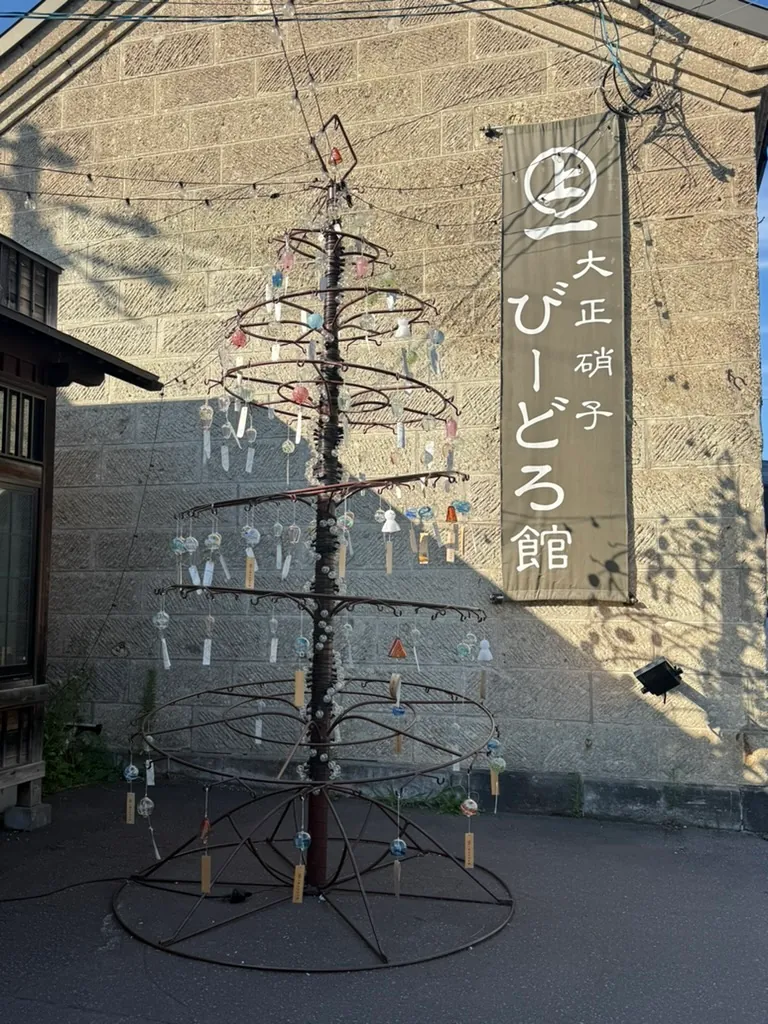
- Craft workshops: glassblowing and tonbo-dama glass beads at Taishō Glass studios, music-box making at Orgel-do's Yū-kōbō, and candle-making50.
Food experiences
- Sushi: sushi counters around Sushiya-dōri. Near the station, the Otaru Yatai-mura Renga Yokochō is a cluster of small food stalls35.
- Otaru Central Market (小樽中央市場, Inaho 3): after the war this was the supply base for the "gangan butai" peddlers who carried fresh fish to the Sorachi coal towns. It is now part of the Tantetsukō heritage24. Shin-Nantaru Market (新南樽市場) is in Chikkō35.
- Brewery and winery visits: Tanaka Shuzo brewery tours39, tastings at the Otaru Wine Gallery40 and Otaru Beer's Zenibako brewery tours41.
Roadside stations (Michi-no-Eki)
No Michi-no-Eki is located in Otaru. The official list of Hokkaido's roadside stations has no entry for the city; it numbers 131 registrations, three of which (Ashoro-ko, Forest 276 Ōtaki and Maruseppu) have since been cancelled60. Nearby stations in neighbouring municipalities are listed below. Hours are as of September 2026; check before visiting.
- Space Apple Yoichi (道の駅スペース・アップルよいち): in Yoichi, at Kurokawa-chō 6-4-1 on National Route 229 by the Yoichi River.
- The Yoichi Space Memorial Museum "Space Dome" honours Yoichi-born astronaut Mohri Mamoru. The shops sell space food and products made from local fruit; soft-serve and apple pie are popular.
- The museum and museum shop are open 9:00–17:00 from 18 Apr to 29 Nov 2026. The museum closes for the winter from 1 Dec 2026 to 16 Apr 2027. The general shop stays open in winter, 9:30–17:30 from 3 Nov, and closes on Mondays from 9 Nov.
- Parking for 38 cars and 5 large vehicles61.
- Akaigawa (道の駅あかいがわ): in Akaigawa, on National Route 393 (the "Maple Kaidō" linking the Sapporo area with Niseko).
- The site was once a government post station. A farm stand sells vegetables grown in the caldera basin; it currently operates from a temporary building, 1 Aug–31 Oct.
- Main building 8:30–18:00, direct-sales stand 9:00–17:00, restaurant 11:00–15:30.
- Parking for 57 cars and 10 large vehicles; registered 15 Apr 201562.
- The main building was closed from 1 Apr 2026 and provisionally reopened on 8 Aug 202663.
- Ishikari "Airoad Atsuta" (道の駅石狩「あいろーど厚田」): in Ishikari, on National Route 231.
- A rare three-storey station with sunset views over the Sea of Japan. It placed 2nd for scenery in the MLIT Hokkaido Michi-no-Eki ranking in 2018 and 2019.
- Soba restaurant, bakery and gelato shop, with 24-hour toilets.
- About 200 parking spaces, including one EV charger.
- Open 9:30–19:00 in June–August and 10:00–16:00 in November–March. All tenants close for the winter64.
- Furubira Tarako Museum (道の駅ふるびらたらこミュージアム): in Furubira, registered on 31 Jan 202560.
Otaru's closest equivalent inside the city is Minato Oasis Otaru (みなとオアシス小樽), a port visitor hub registered by MLIT on 21 Apr 2024. It is not a Michi-no-Eki. Its core facility is the Otaru International Information Center on Pier 3, open 9:00–20:00 every day. The center has multilingual staff, the Port Marché otarue shop for Otaru, Shiribeshi and Hokkaido products, toilets and container food stalls. The nearby sightseeing car park holds 238 cars3134.
Getting there & around
- Rail:
- JR Hakodate Main Line stations in the city, from east to west: Zenibako (銭函), Asari (朝里), Otaru-Chikkō (小樽築港), Minami-Otaru (南小樽), Otaru (小樽), Shioya (塩谷) and Ranshima (蘭島)2.
- The Rapid Airport (快速エアポート) runs from New Chitose Airport through Sapporo and stops at Otaru-Chikkō, Minami-Otaru and Otaru. Sapporo–Otaru takes from 32 minutes and New Chitose Airport–Otaru from about 75 minutes. A reserved "U-seat" costs ¥520 extra65.
- Otaru Station's 1934 building is a registered tangible cultural property10. One platform was named "Yūjirō Home" (裕次郎ホーム) in 2003, the station's centenary7.
- West of Otaru, the JR line toward Oshamambe is to be replaced by buses when the Hokkaido Shinkansen reaches Sapporo7. A Shin-Otaru station is planned on the Shinkansen2.
- Buses:
- Road:
- The Sasson Expressway (札樽自動車道) has interchanges at Zenibako, Asari and Otaru. Otaru JCT connects it to the Shiribeshi Expressway (後志自動車道) and Otaru-Shioya IC. National Routes 5, 337 and 393 also run through the city2.
- Sapporo is about an hour away by Route 5 and the expressway2. The tourism association estimates about 1 h 20 min on Route 5 alone, and about 2 h 30 min from New Chitose Airport on ordinary roads65.
- Ferries:
- Shin Nihonkai Ferry (新日本海フェリー) sails from the Otaru Ferry Terminal at Katsunai pier. Niigata–Otaru takes about 18 hours and Maizuru–Otaru about 20 hours. The terminal is about 10 minutes by taxi from Otaru Station65.
- The new ship Keyaki joined the Maizuru route on 14 Nov 2025, and a new Hamanasu was scheduled for June 202666.
- Nearest airport: New Chitose Airport, reached by the Rapid Airport train65.
- Getting around: the station, canal and Sakaimachi area can be covered on foot; the canal is about 8 minutes' walk from Otaru Station. Sightseeing boats from Pier 3 serve Shukutsu and the Otamoi coast8. Rickshaws and rental bikes are also available50.
Practical tips
- Best times to visit:
- Visitor centres34:
- JR Otaru Station, 9:00–18:00.
- Otaru Canal Tourist Information, inside the Otaru Art Base Ukiyo-e Museum since June 2025, 9:00–18:00.
- Otaru International Information Center on Pier 3, 9:00–20:00, with multilingual staff and 91 parking spaces.
- Sakaimachi Street information centre.
- Night information desk at Otaru Yatai-mura, 17:00–22:00.
- Seasonal closures:
- Winter: Otaru averages 556 cm of snowfall a year27, and the town is built on hills. Wear shoes with good grip and allow extra time on steep streets and in bus queues.
- Brown bears: the first brown-bear advisory (ヒグマ注意報) covering Otaru, under a Hokkaido Government system started in 2022, was issued in June 20232. In 2026 the city recorded sightings, droppings and tracks mainly around Asarigawa Onsen and National Route 393 near the Mt. Kenashi viewpoint, as well as at Oshoro, Haruka and near the Tenjin water-treatment plant67. Check the city's bear map before hiking. Report sightings to the city (0134-32-4111) or Otaru Police (0134-27-0110)67.
- Sea safety: swim only at the staffed beaches. The shores at Asari, Toyoi-hama, Hariusu and Otamoi are not bathing beaches and have no lifeguards or rescue facilities59. Boaters should keep away from the Blue Cave entrance because of the 2025 rockfall54.
Photos
-
 Aug 2026
More about Otaru
At a glance
| Field | Details |
|---|---|
| Type | City (市). It is the only city in Shiribeshi Subprefecture and belongs to the Sapporo metropolitan area2 |
| Subprefecture | Shiribeshi (後志総合振興局). Otaru is not where the subprefectural office sits2 |
| District | none (city). The former Otaru (小樽郡), Takashima (高島郡) and Oshoro (忍路郡) districts ceased to exist through the 1940 and 1958 mergers2 |
| Population | 111,299 at the 2020 Census (−8.71% vs. 2015)3 · 100,838 in 59,262 households on the resident register, 31 Aug 20264 |
| Area | 243.87 km² (GSI, 1 Apr 2026)5. The city measures about 36.5 km east–west by 20.4 km north–south and has 68.62 km of coastline6 |
| Density | ≈413 people/km² (latest register figure ÷ GSI area); ≈456/km² at the 2020 Census (calculated) |
| Municipal history | 1865: the shogunate made Otarunai a village-equivalent (村並). 1869: renamed Otaru. 1899: became a ward (区) under the Hokkaido ward system and an open port. 1 Aug 1922: city status. 1940: absorbed Takashima town (高島町) and Asari village (朝里村). 1958: absorbed Shioya village (塩谷村)7. 1975: took in part of Ishikari town (Zenibako 4–5 chōme)2 |
| Neighboring municipalities | Yoichi, Akaigawa, Sapporo (Teine and Minami wards), Ishikari2 |
| Symbols | Flower: azalea (ツツジ, 1968) · Tree: Japanese white birch (シラカンバ, 1968) · Bird: white-bellied green pigeon (アオバト, 1986) · Emblem: a six-pointed snowflake enclosing 小, the first character of Otaru. It was adopted as the city emblem on 28 Aug 19226 and started out as the ward emblem of 19012 |
| Mascot | No official city mascot found. The Otaru Tourism Association endorses the local character "Otaru Un-gappa" (おたる運がっぱ)2 |
| Official website | https://www.city.otaru.lg.jp/ |
Name origin
- The name comes from the Ainu ota-or-nay (オタ・オㇽ・ナイ), "river within the sandy beach"2. English Wikipedia gives the meaning as "possibly 'river running through the sandy beach'"15.
- The original Ota-or-nay was not today's city centre. It was the lower Otarunai River (小樽内川), the lower reach of the Hoshioki River (星置川) near the present Otaru–Sapporo boundary. The Matsumae domain opened its Otarunai trading post (オタルナイ場所) at that river mouth, but the site took the full force of the winter wind. The post therefore moved to Kuttar-ushi (クッタㇽウㇱ), "place where knotweed (itadori) grows", around present-day Irifune (入船). It kept its old name, written variously as 小樽内, 尾樽内 and 穂足内2. In 1869 the name was shortened to 小樽7.
- The sources agree on the meaning. The only complication is location: the "sandy-beach river" in the name lies outside the modern downtown. The name travelled with the trading post.
- Other Ainu-derived names in the city:
History
- Jōmon and Zoku-Jōmon eras:
- The Oshoro Stone Circle (忍路環状列石) measures about 33 × 22 m and is roughly 3,500 years old (Late Jōmon). It is the largest of more than 80 stone circles found between Otaru and Yoichi, and in 1886 it became the first stone circle reported to Japanese scholars18. It was designated a National Historic Site in 196119.
- The Temiya Cave (手宮洞窟) carvings date from about 1,600 years ago (Zoku-Jōmon period). They show horned human figures and animals, probably shamanic, and resemble rock art along the Amur River. A stonemason from Odawara found them in 1866, and they became a National Historic Site in 192120.
- Matsumae trading posts: by tradition, Yagi Kan'emon (八木勘右衛門) of Matsumae entered Otarunai in 1596. The Otarunai, Takashima and Oshoro trading posts later became the three districts of the same names. The forerunner of Oshoro Shrine (1674) and Otaru Inari Shrine (1690) date from this period2.
- Kitamae-bune and herring:
- Trading ships sailing between Osaka and Ezo called at Otaru. The Nishikawa family, trading-post contractors who also ran ships, left business diaries covering the period from the end of the Edo era to about 189721.
- Shipowners from Hokuriku built the Kitahama warehouses. Examples are the Old Ōie Warehouse (旧大家倉庫, 1891) of Ōie Shichihei from Segoshi in Kaga (Ishikawa), and the Old Otaru Warehouse (旧小樽倉庫, 1890–94), which has shachihoko ornaments on its roof and was built by owners from Hashidate21.
- Otaru was added to the "Kitamae-bune" Japan Heritage in 20187.
- Settlers:
- Rail, coal and port (Meiji):
- The government-run Horonai Railway, Hokkaido's first, opened between Temiya and Sapporo in 1880 and was completed in 1882. It carried Sorachi coal to Otaru's harbour247.
- Otaru became a special export port in 1889, and a ward and open port in 18997.
- The North Breakwater, designed and supervised by engineer Hiroi Isami and completed in 1908, was Japan's first open-sea breakwater10.
- The commercial capital:
- Otaru Higher Commercial School (now Otaru University of Commerce) opened in 1911. Canal construction began in 1914 and finished in 19237.
- The first national census in 1920 counted 108,113 people in Otaru ward. That made it second in Hokkaido after Hakodate and larger than Sapporo27. City status followed on 1 Aug 19227.
- In 1924 about 13 tonnes of explosives exploded while being unloaded, killing or leaving missing 85 people. The city history places the blast in the Temiya station yard7; Japanese Wikipedia places it at the Otaru station wharf2.
- War and mergers: Takashima and Asari joined the city in 1940, and Shioya in 19587. Otaru was bombed in the 1945 air raids on Hokkaido2.
- Decline: after the war, herring catches failed, Karafuto (Sakhalin) was lost, demand for coal fell and Sapporo grew. Together these hollowed out Otaru's wholesale economy. The population peaked at 207,093 (resident register, Sept 1964)2.
- From the canal debate to a tourism city:
- A long argument over filling in the neglected canal led to Hokkaido's first landscape ordinance (1983) and the compromise canal walkway (1986). Historic buildings came to be valued as tourism assets27.
- Other milestones: designation as a new industrial city (1964), the first ferries (1970) and the Sasson Expressway (1971)7.
- 1990s–2010s:
- 1999, the port's centenary year, brought the first Snow Light Path and the Chikkō waterfront redevelopment, with a new Otaru-Chikkō Station and the mall now called Wing Bay Otaru. The Otaru Museum opened in 200772.
- Otaru was designated a depopulated area in 20102.
- The Shiribeshi Expressway linked Yoichi and Otaru JCT in 2018, the same year "Otaru's railway heritage" (小樽の鉄道遺産) was selected as a Hokkaido Heritage. The coal–steel–port "Tantetsukō" story became Japan Heritage in 20197.
- Recent events:
- 2021: a record high of 36.2 °C7.
- 2022: the city's centenary. The former Mitsui Bank Otaru branch became an Important Cultural Property. Bus conversion was decided for the JR Hakodate Line between Oshamambe and Otaru, the conventional line that will run parallel to the Hokkaido Shinkansen7.
- 2023: the canal's centenary7.
- 2025: Otaru's own Japan Heritage designation and a nationally certified plan for maintaining its historic townscape7.
- 15 Jan 2026: the port's North, South and Island breakwaters were designated an Important Cultural Property25.
Geography & climate
- Otaru lies in western Hokkaido, in the curve of Ishikari Bay where it bends toward the Shakotan Peninsula2. The city faces the Sea of Japan on one side and is ringed by mountains on the other three, so much of the town climbs steep slopes6. Central Otaru is about 40 km from Sapporo2.
- Mountains: the highest listed peak is Asari-dake (朝里岳, 1,281 m). Others include Tenguyama (天狗山, 533 m), Kenashi-yama (毛無山) and Akaiwa-yama (赤岩山, 371 m)2.
- Rivers and lakes: the main rivers include the Asari (朝里川), Katsunai (勝納川), Shioya (塩谷川) and Ranshima (蘭島川)2. Lake Otarunai (オタルナイ湖) is the reservoir of Asari Dam, completed in autumn 1993 and named by public vote26.
- Coast: about 69 km of coastline with the natural harbour of Otaru Port at its centre. The rugged western coast (Otamoi, Akaiwa, Shukutsu, Oshoro) is part of the Niseko-Shakotan-Otaru Kaigan Quasi-National Park (ニセコ積丹小樽海岸国定公園), designated in 196367. The eastern end, Zenibako, has flatter land at the northwestern edge of the Ishikari Plain17.
- Climate: the city profile describes a maritime climate with small temperature swings6, yet Otaru is officially a heavy-snow area (豪雪地帯)2. The 1991–2020 normals at the Japan Meteorological Agency's Otaru station are27:
- Annual mean temperature 8.8 °C.
- January mean −3.1 °C, with a mean daily low of −5.8 °C.
- August mean 21.7 °C, with a mean daily high of 25.6 °C.
- Precipitation 1,281.6 mm and sunshine 1,586.2 h a year.
- Snowfall 556 cm a year, an average seasonal maximum depth of 118 cm and about 131 snow days.
- Extremes and warming: records at the station are28:
- Highest temperature 36.2 °C (28 Jul 2021); lowest −18.0 °C (24 Jan 1954).
- Deepest snow 173 cm (19 Feb 1945); heaviest one-day snowfall 84 cm (8 Jan 1996); most snow in a season 792 cm (winter 1999–2000).
- Summers are getting hotter. 2025 set a record with 92 days reaching 25 °C, and the only nights on record that stayed at or above 25 °C came in 2023 and 2025.
Economy & industry
- Structure: services dominate. Wholesale and retail is the largest sector by both establishments and employees. By employees it is followed by medical/welfare and manufacturing2.
- Tourism: FY2025 (Apr 2025–Mar 2026) brought 8,346,300 visitors, 103.4% of the previous year and the second year running above 8 million1:
- 7,345,400 day-trippers and 1,000,900 overnight guests. This was the first time overnight guests topped one million, partly thanks to new hotels.
- 3,601,800 visitors came from outside Hokkaido.
- Foreign overnight guests reached a record 297,496. Travel restraint in China hurt, but visitors from North America, Europe and elsewhere grew.
- Manufacturing: the 2024 Economic Structure Survey counted 256 manufacturing establishments with 7,362 employees, and shipments of ¥220.0 billion (22,001,097万円) for calendar 202329. Food and drink shape the city's image: kamaboko, confectionery, sake, wine and beer (see Local specialties).
- Port:
- Otaru Port has had Shin Nihonkai Ferry services since 1970 (for routes, see Getting there & around), opened a regular container route to China in 2002, and in 2013 gained a regular RO-RO cargo route to Vladivostok7.
- Cruise ships call regularly: nineteen calls are scheduled for 2026, including the Costa Serena, Westerdam, Asuka II and Asuka III30.
- The Ishikari Bay New Port straddles Otaru and Ishikari2.
- In April 2024 the Pier 3 area was registered as "Minato Oasis Otaru" (みなとオアシス小樽), the 161st such port hub in Japan and the 13th in Hokkaido31.
- Population: the 2020 Census counted 111,299 people, 10,625 (8.71%) fewer than in 20153. Of these, 41.2% were 65 or older and only 8.3% were under 1532. In 2022 the population dropped below 110,000 (into the "100,000s", 10万人台) for the first time in 103 years2. It stood at 100,838 at the end of August 20264.
- Revitalization:
- The city relies on historic-district landscape rules, Japan Heritage branding and a nationally certified historic-townscape plan (2025)7.
- The former Hokkai Seikan No. 3 warehouse on the North Canal was given to the city in 20217. Furusato nozei donors can earmark their gifts for its preservation and use33.
- The Otaru International Information Center opened on Pier 3 in March 2024. It includes Port Marché otarue, a shop selling Otaru and Shiribeshi products34.
- A Shin-Otaru station (新小樽, provisional name) is planned on the Hokkaido Shinkansen extension to Sapporo2.
Local specialties
| Specialty | Category | Details & where to get it |
|---|---|---|
| Sushi (寿司) | Signature dish | More than 100 sushi restaurants in the city2. Examples are the head shop of Otaru Masazushi (おたる政寿司) in the Sushiya-dōri/Hanagin area and Otaru Yamatoya (おたる大和家) near the station35 |
| Otaru ankake yakisoba (小樽あんかけ焼そば) | ご当地グルメ | Fried noodles with mixed toppings under a thick sauce, served by many restaurants in and around Otaru2. One example is Toroian (小樽あんかけ処 とろり庵) in Chikkō35 |
| Wakadori hanmi-age (若鶏半身揚げ), pan-roll (パンロール) | Local dishes | Deep-fried half chicken and a local bread roll, both listed among Otaru's signature foods2 |
| Mantis shrimp (シャコ) | Seafood | In season in spring (Mar–May) and autumn (Sep–Nov); billed as the largest in Japan13. Celebrated at the Shako Festival seafood beer garden (18–20 Jul 2026, Otaru Port Square)36 |
| Herring (ニシン), kazunoko, sea urchin | Seafood | Herring arrive in spring; red (bafun) and white (murasaki) sea urchin come in summer13. Seafood gifts on the furusato nozei portal include kazunoko, tarako, salted sockeye salmon, sliced whelk (tsubu) sashimi and Pacific cod; tarako, salmon, tsubu and cod head its popularity ranking37 |
| Kamaboko (かまぼこ) | Processed seafood | Kamaei (かま栄) has a factory outlet in Sakaimachi and a shop in front of the station. Its five-kind kamaboko set ranks among the city's most popular furusato nozei gifts3837. Daihachi Kurihara Kamaboko (大八栗原蒲鉾) has a shop in the Nantaru Market near Minami-Otaru38 |
| Takarakawa (宝川) sake | Sake | Tanaka Shuzo (田中酒造) was founded in 1899 and brews all year round (四季醸造)39. Its head shop in Irinai is a listed historic building, and its Kikkō-gura brewery occupies the former Okazaki warehouses (1905)10 |
| Otaru Wine (おたるワイン) | Wine | Hokkaido Wine (北海道ワイン) was founded in January 1974 and is headquartered at Asarigawa Onsen. It uses only domestic grapes, with vineyards at Tsurunuma in Urausu. "Otaru Niagara" was released in 1986, and the Otaru Wine Gallery reopened as a hands-on winery in 202440 |
| Otaru Beer (小樽ビール) | Craft beer | The canal-side pub "Otaru Sōko No. 1" (小樽倉庫No.1) and the Zenibako brewery, which offers tours and Saturday markets41 |
| Sweets | Confectionery | LeTAO (ルタオ), which calls itself an "Otaru confectioner" (小樽洋菓子舗), is known for its Double Fromage (ドゥーブルフロマージュ) cheesecake3842. Traditional sweets include hanazono dango, pan-jū, suama, beko-mochi and Sawa-no-tsuyu crystal candy2. The confectioner Niikuraya (新倉屋) has shops in Hanazono, by the station and in Chikkō35 |
| Glassware (ガラス) | Craft | Kitaichi Glass (oil lamps from 1901; its Hall No. 3 is an 1891 stone warehouse)11. Taishō Glass (大正硝子) shops and many studios line Sakaimachi Street and the canal38 |
| Music boxes (オルゴール) | Craft | Otaru Orgel-do: the main hall with its steam clock, the No. 2 hall with antique music boxes and pipe-organ performances, and music-box-making workshops1238 |
| Furusato nozei (ふるさと納税) | Gifts & causes | Donations can be earmarked for 12 purposes, including the old Temiya Line, the Otaru Museum's railway vehicles, the nō stage in the public hall and the Hokkai Seikan No. 3 warehouse33. The portal notes that some gifts end on 30 Sep 2026 because the rules on local products tighten on 1 Oct37 |
Culture & festivals
| Event | When | Highlights |
|---|---|---|
| Otaru Snow Light Path (小樽雪あかりの路) | About a week in early–mid February (6–13 Feb 2027) | Candles in glass floats on the canal between Asakusa-bashi and Chūō-bashi, snow candles along the old Temiya Line, a candle-lit path to Tenguyama Shrine with night views, and about 20 neighbourhood venues. Volunteers started it in 19991443 |
| Tanaka Shuzo seasonal fairs | Hina festival Feb–Mar; umeshu festival Apr–May; amazake festival Jun–Jul | Displays and sales at the head shop in Irinai (the hina and umeshu fairs also at the Kikkō-gura)4436 |
| Otaru Shukutsu Nishin & Otate Festival (おたる祝津にしん・おタテ祭り) | Early June (6–7 Jun 2026) | Herring and scallop festival in the Shukutsu fishing district, with events on the sightseeing-boat routes36 |
| Otaru Spring Festival (おたる春祭り) and Suitengū–Taga Shrine festival (小樽水天宮多賀神社例祭) | 12–28 Jun 2026 (21st spring festival); shrine festival 14–16 Jun | Events at venues across the city; annual festival of Suitengū shrine in Aioi-chō36 |
| Otaru Canal Road Race (おたる運河ロードレース) · Otaru Wine Carnival (おたるワインカーニバル) | Late June (21 Jun and 27 Jun 2026) | Citizens' running race (38th); wine party (40th) at Hokkaido Wine on the slopes of Mt. Kenashi36 |
| Otaru Ushio Festival (おたる潮まつり) | Late July, Friday–Sunday (60th: 24–26 Jul 2026) | Citizens' festival giving thanks to the sea and praying for the city's prosperity, first held in 1967. The main venue is the sightseeing car park by Pier 3. 2026 also marked 50 years of "Ushio Odori-uta" (潮踊り唄), the festival's second dance song4573136 |
| Otaru Glass Market (小樽がらす市) | Late July (15th: 24–26 Jul 2026) | Glass studios from Otaru and elsewhere set up along the old Temiya Line. Winning designs from a glass-design contest for local schoolchildren and others are made by Otaru glassmakers46 |
| Hokkaido JAZZ in Otaru · Otaru Takashima Fireworks (小樽髙島花火) | Early–mid August (8–11 Aug; 8 Aug 2026) | Jazz stage at the canal's Asakusa-bashi; fireworks at the Takashima fish market36 |
| Takashima Echigo Bon Odori (高島越後盆踊り) | 14–16 Aug, 19:00–21:00 | Bon dance brought by settlers from Niigata and designated a municipal intangible folk cultural property; held at Takashima Park22 |
| Otaru Shukutsu Fireworks (おたる祝津花火大会) · TENGUU FES | Early September (5 Sep; 5–6 Sep 2026) | Fireworks off the beach in front of the Herring Mansion; music festival on the summit of Tenguyama47 |
| KITAUNGA DESIGN DISTRICT · YUMMY市 North Canal Night Market | Mid–late September (19 Sep–4 Oct; 19–26 Sep 2026) | Design and food events around the North Canal and the former Hokkai Seikan No. 3 warehouse47 |
| YOI-TARU Taste Festival (味覚祭) | Early October (10–12 Oct 2026) | Autumn food fair at Otaru Port Square, run jointly by the Otaru and Yoichi tourism associations47 |
| Blue Canal (青の運河) | 1 Nov – 31 Jan | Blue lighting on the canal between Asakusa-bashi and Chūō-bashi4743 |
- Traditions and performing arts:
- Takashima Echigo Bon Odori keeps a pre-modern style of bon dancing and is a reminder of Otaru's ties to Hokuriku22.
- Mukai-ryū swimming (向井流水法), originally the swimming style of the shogun's navy, is a municipal intangible cultural property. It is demonstrated each summer at Higashi-Otaru beach (2 Aug 2026)23.
- Matsumae Kagura (松前神楽), a nationally designated Important Intangible Folk Cultural Property (2018), spread north with herring fishermen from southern Hokkaido. Preservation groups remain in Matsumae, Hakodate, Fukushima and Otaru48.
- The Oshoro herring-fishing ritual (忍路鰊漁労の行事) is also city-designated19.
- Snow Light Path award: the festival won the grand prize of the 10th Furusato Event Awards (Minister for Internal Affairs Award), the first Hokkaido event to do so49.
- Shrines: Sumiyoshi Shrine (住吉神社), Otaru's chief guardian shrine, near Minami-Otaru50. Its first torii was donated in 1899 by the Kitamae shipowners Ōie Shichihei and Hiromi Nisaburō21.
- Museums:
- The Otaru Museum (小樽市総合博物館) was formed in 2007 by merging the 1956 city museum, the transport museum and the youth science centre. Its Main Building in Temiya covers transport and science; its Canal Building covers local history and nature51.
- City Literature Museum (1978) and City Art Museum (1979)7.
- Otaru Art Base (小樽芸術村): the former Mitsui Bank building, the Nitori Art Museum (似鳥美術館), and stained-glass, ukiyo-e and Western-art museums105034.
- The Kitaichi Venetian Art Museum38.
- The former Nippon Yusen Otaru branch (1906) held its 120th-anniversary festival on 19–20 Sep 20261047. The festival listing gives 1905 as the completion year; the city's heritage page gives 1906.
Ainu heritage
Ainu heritage in Otaru is less well documented than in many other parts of Hokkaido. It survives mainly in place names and archives:
- Place names: Otaru itself (ota-or-nay), the Kuttar-ushi site of the relocated trading post, and Oshoro (oshoro-kot) all come from Ainu216.
- Zenibako: before Japanese settlement the Zenibako coast was known in Ainu as Moihasama, "the far end of the bay"17.
- Archaeology: the Oshoro Stone Circle (Jōmon) and the Temiya Cave carvings (Zoku-Jōmon) are both older than the Ainu cultural period1820.
- Archives and art:
- In 2023 the city designated a set of draft paintings of Ainu life formerly owned by the Hayashi family (林家旧蔵アイヌ風俗画画稿) as a municipal tangible cultural property19.
- Contemporary Ainu embroidery is shown from time to time. For example, embroiderer Yamakita Yukako exhibited at the Otaru Bazaar Vita Art Museum in May–June 202644.
- People: Japanese Wikipedia lists the Ainu activist Amakawa Keizaburō (天川恵三郎) among people from or associated with Otaru2.
- Facilities: there is no dedicated Ainu cultural facility in the city. The national museum and park Upopoy is in Shiraoi.
Sister & friendship cities
Notable people
- Kobayashi Takiji (小林多喜二, 1903–1933): proletarian novelist (Kanikōsen). He lived in Otaru from 1907 to 1930, most of his short life44.
- Itō Sei (伊藤整): novelist and critic (Wakai shijin no shōzō). The tourism association counts him among Otaru's own13, and the Itō Sei Literary Prize was presented in Otaru from 1990 to 20147.
- Nakamura Zensaku (中村善策): painter whose landscapes record Otaru's boom and decline1013.
- Ishihara Yūjirō (石原裕次郎): actor and singer. He and his brother Shintarō lived in Otaru for seven years13. A memorial museum operated in the city from 1991 to 201727.
- Aochi Seiji (青地清二): ski jumper, bronze medallist on the 70 m hill at the 1972 Sapporo Olympics2.
- Yagi Hirokazu (八木弘和): ski jumper, silver medallist on the 70 m hill at the 1980 Lake Placid Olympics2.
Sources
Numbers in the text link to these sources. Figures as of 23 September 2026
- 令和7年度小樽市観光入込客数の概要 — 小樽市 JA accessed 2026-09-23
- 小樽市 — Wikipedia JA accessed 2026-09-23
- 令和2年国勢調査(確報値) — 小樽市 JA accessed 2026-09-23
- 小樽市の人口(令和8年)[令和8年8月末現在の世帯数及び人口] — 小樽市 JA accessed 2026-09-23
- 令和8年全国都道府県市区町村別面積調(4月1日時点) — 国土地理院 JA accessed 2026-09-23
- 小樽市のプロフィル — 小樽市 JA accessed 2026-09-23
- 小樽市のあゆみ — 小樽市 JA accessed 2026-09-23
- 小樽運河 — 小樽市 JA accessed 2026-09-23
- 「北海道の『心臓』と呼ばれたまち・小樽」が日本遺産に認定されました。 — 小樽市 JA accessed 2026-09-23
- ストーリーの概要と構成文化財(北海道の「心臓」と呼ばれたまち・小樽) — 小樽市 JA accessed 2026-09-23
- 小樽と北一硝子の歩み — 北一硝子 JA accessed 2026-09-23
- オルゴール専門店「オルゴール堂」 — 小樽オルゴール堂 JA accessed 2026-09-23
- 小樽を知る(小樽のご紹介) — 小樽観光協会「おたるぽーたる」 JA accessed 2026-09-23
- 第28回小樽雪あかりの路 開催日程について — 小樽市 JA accessed 2026-09-23
- Otaru — Wikipedia EN accessed 2026-09-23
- 忍路 — Wikipedia JA accessed 2026-09-23
- 銭函 — Wikipedia JA accessed 2026-09-23
- 忍路環状列石 — Wikipedia JA accessed 2026-09-23
- 小樽市の文化財 — 小樽市 JA accessed 2026-09-23
- 手宮洞窟保存館 — 小樽市 JA accessed 2026-09-23
- ストーリーの概要と構成文化財(北前船) — 小樽市 JA accessed 2026-09-23
- 高島越後盆踊りの行事 — 小樽市 JA accessed 2026-09-23
- 向井流水法 — 小樽市 JA accessed 2026-09-23
- ストーリーの概要と構成文化財(炭鉄港(たんてつこう)) — 小樽市 JA accessed 2026-09-23
- 小樽港防波堤施設 — 小樽市 JA accessed 2026-09-23
- 朝里川温泉郷 — 小樽市 JA accessed 2026-09-23
- 小樽(後志地方) 平年値(年・月ごとの値) — 気象庁 JA accessed 2026-09-23
- 小樽(後志地方) 観測史上1~10位の値 — 気象庁 JA accessed 2026-09-23
- 経済構造実態調査(旧:工業統計調査) — 小樽市 JA accessed 2026-09-23
- 小樽港クルーズ寄港情報 — 小樽市 JA accessed 2026-09-23
- みなとオアシス小樽について — 小樽市 JA accessed 2026-09-23
- 小樽市の人口 ー人口等基本集計結果ー(令和2年国勢調査) — 小樽市 JA accessed 2026-09-23
- 小樽市ふるさと納税のご案内 — 小樽市 JA accessed 2026-09-23
- 観光案内所 — 小樽市 JA accessed 2026-09-23
- 小樽で食べる — 小樽観光協会「おたるぽーたる」 JA accessed 2026-09-23
- イベント 夏 — 小樽観光協会「おたるぽーたる」 JA accessed 2026-09-23
- 北海道小樽市のふるさと納税 お礼の品ランキング — ふるさとチョイス JA accessed 2026-09-23
- 小樽で買う — 小樽観光協会「おたるぽーたる」 JA accessed 2026-09-23
- 小樽の造り酒屋 田中酒造株式会社 — 田中酒造 JA accessed 2026-09-23
- 企業情報 — 北海道ワイン株式会社 JA accessed 2026-09-23
- Otaru Beer – 小樽ビール — 小樽ビール JA accessed 2026-09-23
- 【ルタオ公式】ケーキ・スイーツ・洋菓子の通販 ギフト — ルタオ JA accessed 2026-09-23
- イベント 冬 — 小樽観光協会「おたるぽーたる」 JA accessed 2026-09-23
- イベント 春 — 小樽観光協会「おたるぽーたる」 JA accessed 2026-09-23
- 第59回おたる潮(うしお)まつり — 小樽市 JA accessed 2026-09-23
- 【終了しました!】第15回小樽がらす市 7/24~7/26 — 小樽市 JA accessed 2026-09-23
- イベント 秋 — 小樽観光協会「おたるぽーたる」 JA accessed 2026-09-23
- 松前神楽 — 小樽市 JA accessed 2026-09-23
- 小樽雪あかりの路 「第10回ふるさとイベント大賞」大賞(総務大臣表彰)を受賞 — 小樽市 JA accessed 2026-09-23
- 小樽で楽しむ — 小樽観光協会「おたるぽーたる」 JA accessed 2026-09-23
- 小樽市総合博物館( Otaru Museum ) — 小樽市 JA accessed 2026-09-23
- 小樽天狗山ロープウエイ・スキー場 — 中央バス観光開発 JA accessed 2026-09-23
- 小樽海岸自然探勝路(オタモイ~赤岩~祝津) — 小樽市 JA accessed 2026-09-23
- 「青の洞窟」の落石情報について[注意喚起] — 小樽市 JA accessed 2026-09-23
- 開館時間・休館日・入館料(小樽市総合博物館) — 小樽市 JA accessed 2026-09-23
- 蒸気機関車アイアンホース号 — 小樽市 JA accessed 2026-09-23
- 小樽市鰊(にしん)御殿(北海道有形文化財) 令和8年度の営業のお知らせ — 小樽市 JA accessed 2026-09-23
- 営業期間・時間 — 【公式】おたる水族館 JA accessed 2026-09-23
- 海水浴場オープン情報(令和8年度) — 小樽市 JA accessed 2026-09-23
- 住所等一覧 — 北の道の駅 JA accessed 2026-09-23
- スペース・アップルよいち — 北の道の駅 JA accessed 2026-09-23
- あかいがわ — 北の道の駅 JA accessed 2026-09-23
- 仮オープンについて(あかいがわからのお知らせ) — 北の道の駅 JA accessed 2026-09-23
- 石狩「あいろーど厚田」 — 北の道の駅 JA accessed 2026-09-23
- 交通アクセス — 小樽観光協会「おたるぽーたる」 JA accessed 2026-09-23
- 新日本海フェリーの新造船「けやき」小樽~舞鶴航路に就航! — 小樽市 JA accessed 2026-09-23
- R8年度 小樽市内ヒグマ出没情報 — 小樽市 JA accessed 2026-09-23