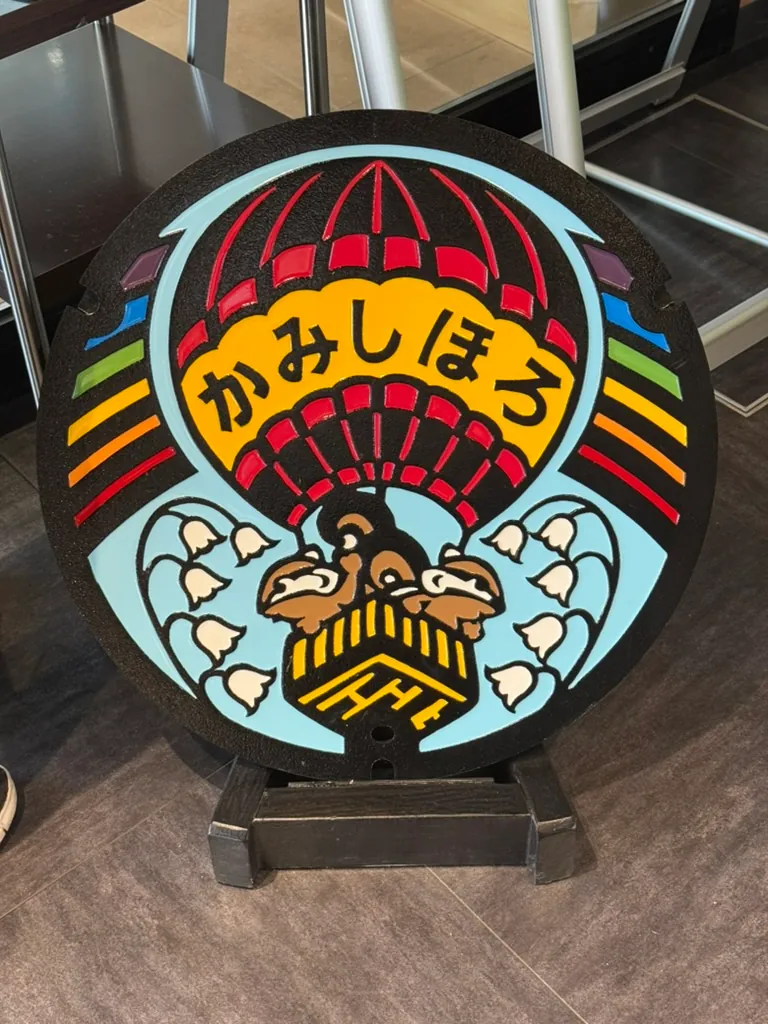
Kamishihoro 上士幌町
かみしほろちょう
Kamishihoro is a dairy and forest town of about 4,600 people at the eastern foot of the Daisetsuzan mountains. Japan's first hot-air balloon festival was held here in 1974. The town also has Naitai Kogen Farm, which the town bills as the largest public ranch in Japan, and the Taushubetsu River Bridge, an old railway arch that rises out of Lake Nukabira each winter and sinks again by autumn.
- Population (2020 Census)
- 4,778
- Area
- 694.23 km²
- District
- Katō District (河東郡)
- Official website
- www.kamishihoro.jp
Known for
- Hokkaido Balloon Festival (北海道バルーンフェスティバル): Japan's first hot-air balloon event, first held in 197411 and staged most Augusts since (it was cancelled in 2010, 2020 and 2021)10. A winter balloon meeting has been held since 198210.
- Taushubetsu River Bridge (タウシュベツ川橋梁): a 1937 railway arch in Lake Nukabira. It appears as the lake falls in winter and is under water by late summer or autumn, which is why it is called the "phantom bridge"12. It is part of the Shihoro Line concrete arch bridges, chosen as Hokkaido Heritage in 200113.
- Naitai Kogen Farm (ナイタイ高原牧場): about 1,700 ha, which the town calls the largest public ranch in Japan, with the Naitai Terrace lookout at about 800 m14.
- Nukabira Gensenkyo (ぬかびら源泉郷): a small spa village inside Daisetsuzan National Park where every inn uses unrecycled, free-flowing spring water (源泉かけ流し)1516.
- Cattle country: the town described itself in 2020 as "4,980 people and 40,000 cattle"6. Its brand beef, Tokachi Naitai Wagyu, became a regional collective trademark in 201617.
- Mikuni Pass (三国峠): at 1,139 m, the highest point on any national road in Hokkaido18.
- Population and policy experiments: free childcare paid for with furusato nozei donations, a population rebound, a national SDGs award (2020)7 and regular self-driving bus services from 202219, though the bus has been suspended for vehicle maintenance since June 202620.
Sights & activities
Nature & scenery
- Naitai Kogen Farm and Naitai Terrace: The ranch covers about 1,700 ha, the area of 358 Tokyo Domes. In summer about 11 herds of some 250 cattle each graze there. The lookout at the top, about 800 m up, faces the Tokachi Plain and, on clear days, the Akan mountains14. Naitai Terrace (opened April 2019) has floor-to-ceiling windows and a café1458. In 2026 it opens 25 April–31 October, 9:00–17:00, and serves fresh-milk soft-serve and Naitai Wagyu burgers37. The ranch gate opens 7:00–18:00 (7:00–19:00 June–September) and is closed from November to late April. The terrace is about 16 km from the town center14.
- Taushubetsu River Bridge: This 130 m, 11-arch bridge was finished in 1937 and taken out of use in 1955, and ice, water pressure and frost keep damaging it24. On 29 June 2024 a large part of the upper side wall of its sixth arch collapsed13. It usually appears on the frozen lake around January, starts to sink in June, and is under water from about August to October, depending on the year48. There are three ways to see it. The Taushubetsu Observatory is 8 km from Nukabira toward Asahikawa on Route 273. From its parking bay (about 10 cars) a 200 m forest path leads to a view from about 750 m away59. The NPO Higashi Taisetsu Nature Guide Center runs paid tours4860. Or you can borrow a key for the forest-road gate at the Michi-no-Eki, booked online in advance; this is not possible in winter48.
- Other arch bridges: About 60 concrete arch bridges, large and small, of the old Shihoro Line stand around Nukabira and along Route 273 toward Tokachi-Mitsumata. A car is needed to see the main ones1512. Nine structures, including the Third Otofuke River Bridge and the Horoka Station platform, are Registered Tangible Cultural Properties1. A local NPO repaired the Third Otofuke River Bridge in 2020 with donations from across Japan7.
- Mikuni Pass: There is a lookout over the forest and the Matsumi Ōhashi bridge61. Mikuni Pass Café serves hand-drip coffee and meals from late April to early November6237.
- Lake Nukabira: Canoeing, cycling and fishing for rainbow trout and yamame from early summer to autumn. The autumn leaves are reflected in the lake15.
Onsen
- Nukabira Gensenkyo: 9 lodgings with 160 rooms15. The springs are 50–60 °C simple, weak-salt and bicarbonate waters, all free-flowing16. Most inns take day bathers. Yumotokan (湯元館), founded by the man who found the spring, takes day visitors 13:00–19:00 for ¥1,000 (adults)63. In 2026 a free spring-fed footbath in the Onsen Park is open from 25 April to early November, 8:00–17:0037.
- Fureai Plaza (ふれあいプラザ): This public bath in the town center uses an alkaline simple spring and has saunas. Admission is ¥300 for adults. It opens 14:00–22:00 on weekdays and 13:00–22:00 on weekends and holidays, and closes on the 1st and 3rd Mondays64.
Museums & heritage
- Higashi Taisetsu Museum of Natural History (ひがし大雪自然館): Opened on 1 May 2013 at ぬかびら源泉郷48-2, it combines a Ministry of the Environment visitor center with the town's natural-history museum. Its exhibits cover the nature of eastern Daisetsu, including insects from the area and around the world. Admission is free, and it opens 9:00–17:00, closed Wednesdays651566. The town's tourist information desk is inside67.
- Kamishihoro Railway Museum (上士幌町鉄道資料館): On the site of the old Nukabira station, it has maps, photos, tools, a diorama and cab-view film of the Obihiro–Nukabira run. In 2026 it is open 25 April–31 October, 9:00–16:00, closed Mondays; admission ¥1006837.
Outdoor & seasonal activities
- Pedal trolleys: Higashi Taisetsu Kōgen Tetsudō runs on 662 m of the old line beside the railway museum (about 20 minutes return; weekends in June, Friday–Sunday July–September)69. Mori no Torokko Eco Rail at San-no-sawa has 500 m of track (1 km, about 20 minutes return). It costs ¥600 per person for groups of two or more and ¥900 alone, and runs night trips in winter51.
- Skiing: The Nukabira Gensenkyo Ski Area's 4.3 km run through the conifer forest is popular. The season is late December to about April1570.
- Ice fishing: Wakasagi fishing on frozen Lake Nukabira, where some anglers land 200–300 fish a day1571.
- Camping: The Kamishihoro Aviation Park campground by the Otofuke River is a free-pitch site with no booking. In 2026 it is open 1 May–31 October, at ¥500 per adult72. The National Nukabira Campground near the lake is open 25 June–12 October 2026 (¥600 per adult per night; no pets, no cars on site)73. At the top of Naitai Kogen Farm, whose gate is otherwise shut at night, the seasonal Naitai Grass Camp Field runs on Fridays, weekends and holidays from 10 July to 4 October 2026, booked through the Nap camping site74.
- Hiking and guided nature tours: The museum posts trail news for the east-Daisetsu peaks; Mt. Nipesotsu's Horoka Onsen route reopened in July 201866. The NPO Higashi Taisetsu Nature Guide Center runs nature programs year-round60.
- Hot-air balloon tethered rides: Rides are offered at both balloon festivals5449.
Food experiences
- tobachi (鉄板焼きレストラン tobachi): Run by Tokachi Yōhōen in a former school at 居辺東15線 (opened 2014), about 20 minutes from town. It serves Naitai Wagyu hamburg steak and steak, and honey parfaits. Open 11:00–17:00, closed Tuesdays38.
- Dairy and cheese workshops: Butter-making (¥1,000) and fresh-cheese-making (¥1,300) at the Michi-no-Eki7576.
Roadside stations (Michi-no-Eki)
Kamishihoro (道の駅かみしほろ)
- Location: 上士幌町字上士幌東3線227番地1 (〒080-1408), on National Route 241 in the town center7739. The Obihiro–Kamishihoro buses stop at "Michi-no-Eki Kamishihoro"78. Naitai Kogen Farm is about 10 km from the town center39. Map code 424 800 61239.
- Hours: The station and its shops open 9:00–18:00 from late April to early October (from 18 April in 2026), and 9:00–17:00 from mid/late October to mid-April. It is closed 31 December–3 January, and toilets are open 24 hours79808139. The restaurant serves breakfast 8:00–10:00 (last order 9:30) and lunch 11:00–16:00 (winter 11:00–15:00). Tenants may close on some days8239. As of September 2026 — check before visiting.
- Shops & products: The shop sells souvenirs and local goods80, including magnets of the town's new Horon-chan country sign (¥280)8. The station's featured foods are Tokatoka's Naitai Wagyu curry bread, a milk-chocolate cookie, a "Shirobel" burger made with Tokachi ingredients, and a modern cupcake39. Free manhole cards are handed out here while stocks last; the supply for FY2026 has run out83.
- Food: La Table de KAMISHIHORO is a Western-style restaurant whose name means "Kamishihoro's dining table". Its menu changes with the seasons82. Tokatoka (トカトカ) bakes bread from Hokkaido wheat with house-made yeast, using a slow cold fermentation (9:00–17:00)84. THE SANDO sells premium Tokachi-milk soft-serve, a hojicha mix soft-serve, Basque cheesecake and a honey lemonade soda43. The hamburger stand of tobachi, a restaurant popular with locals, sells burgers with 100% Tokachi beef patties, some made with Tokachi cheese (10:00–17:30, last order 17:00; irregular holidays)85. The operator's site navigation now labels this take-out counter "UC STAND", so the tenant may have changed (unverified)80.
- Facilities: Parking for 265 cars (including 36 overflow spaces), 12 large vehicles, 3 accessible spaces and 19 motorcycles, plus 10 camper-van spaces7786. It has one EV quick charger77, Wi-Fi39, 23 toilet fixtures including two multipurpose rooms (one each for right- and left-handed users), a nursing room, a baby corner and a kids' space7786. Outside there are a dog run, lockers and a large lawn used for balloon rides when the weather allows8687. Inside are a tourist information desk, a one-stop desk for people moving to the town and for free job placement, backup power and a disaster-supply store77. Rental bicycles are available80. From 18 April 2026 the station also offers butter-making (¥1,000, 12:30 and 15:00), fresh-cheese-making (¥1,300, 10:30 and 14:00) and sensory-bottle craft (¥500) sessions757688.
- Notes: Its official site uses the nickname 四季風路バルーンのふるさと ("home of the balloons")77. It was registered on 13 March 2020 as Hokkaido's 127th Michi-no-Eki (1,173rd in Japan, 15th in Tokachi) and opened on 11 June 20207739. It is run by karch Co. (株式会社karch) under contract from the town77. The building covers 2,222 m², with 1,719 m² of floor space86. The stamp is available during opening hours39. In the Hokkaido Development Bureau's 2024 ranking by stamp-rally finishers, it placed 3rd for "a relaxing break", 4th for clean toilets, 6th for road and area information and 7th for "want to visit again"89. It is also where you borrow the key for the Taushubetsu forest road48.
Getting there & around
- Rail: The town has no railway. The Shihoro Line closed in 1987, and the nearest station is JR Obihiro on the Nemuro Main Line7.
- Bus: Tokachi Bus and Takushoku Bus run between Obihiro Station Bus Terminal and Kamishihoro, about 1 hour 20 minutes. Tokachi Bus route 51 continues to Nukabira Gensenkyo, about 1 hour 45 minutes from Obihiro78. The Kamishihoro Transport Terminal (opened April 2018) has free Wi-Fi, a nursing room and a ticket window, and is open 6:00–21:00. It sells tickets for the North Liner bus to Asahikawa, which must be booked by the day before90. Car sharing starts from the terminal90.
- By car: National Routes 241 and 273 cross the town7. From the town center it is about 40 km (50 min) to Obihiro and 70 km (1 h 20 min) to Tokachi-Obihiro Airport. Nukabira is 27 km (30 min) away, Mikuni Pass 60 km (1 h), Sōunkyō 80 km (1 h 30 min), Asahikawa 160 km (3 h), Kitami 130 km and Furano 120 km91. Sapporo is about 3.5 hours by expressway6.
- Nearest airport: Tokachi-Obihiro Airport, about 1 hour 20 minutes by car91.
- In town: The self-driving bus's Saturday Michi-no-Eki loop35 has been suspended since 20 June 202620. Rental bicycles are available at the Michi-no-Eki80, and the town is on the Tokachi Plain–Sanroku Scenic Byway route7.
Practical tips
- Best seasons: Early August brings the balloon festival11. Late April to October is the season for the ranch14. The Taushubetsu bridge can be seen from the observatory from April, once the snow has gone, until it sinks around September59. January to early March is the season for the ice, smelt fishing and the winter balloon meeting5049. Autumn colors peak at Mikuni Pass from late September to early October18.
- Seasonal closures: The Naitai ranch gate, Naitai Terrace, the railway museum and Mikuni Pass Café close in winter. The Taushubetsu forest road is not cleared of snow and is closed in winter143748. Lake Nukabira closes to visitors as the ice weakens: in 2026 access from Go-no-sawa ended on 24 February and the whole lake closed on 9 March. There are hidden gas holes in the ice, and mobile coverage on the lake is poor50.
- Brown bears: The town is brown-bear habitat. Bears have been seen on the Taushubetsu forest road (April 2024), a cub at the observatory (September 2021)4859, possibly at the Aviation Park park-golf course (August 2026)92 and near Tokachi-Mitsumata and Horoka Onsen (July 2026)66. Carry a bell or radio, avoid dusk and take food waste home93.
- Fuel and supplies: There is no gas station on the roughly 110 km of Route 273 between Kamishihoro and Kamikawa town91. Nukabira has no shop selling fresh food, only a souvenir shop73.
- Information: Kamishihoro Tourism Association (01564-7-7272). The tourist information desk in the Higashi Taisetsu Museum of Natural History opens 9:00–17:00 (8:00–18:00 in July–August), closed Wednesdays67.
Photos
-
 Aug 2026
More about Kamishihoro
At a glance
| Field | Details |
|---|---|
| Type | Town (町) |
| Subprefecture | Tokachi (十勝総合振興局) |
| District | Katō District (河東郡) |
| Population | 4,778 at the 2020 Census (2,350 households)1; 4,581 on the resident register at the end of August 2026 (2,542 households)2. The Census peak was 13,608 in 19553 |
| Area | 694.23 km² (GSI, 1 April 2026)4. The GSI figure leaves out Lake Shikaribetsu (3.59 km²), because the lake's boundary with Shikaoi has not been fixed4. The town's own figure is 696.00 km², and it measures 18.2 km east–west and 48 km north–south5 |
| Density | About 6.6 people/km² (latest figure) and 6.9/km² (2020 Census), calculated from the figures above |
| Municipal history | Kawakami Village (川上村) split from Otofuke Village in April 1921 and was renamed Shihoro Village on 1 June 1926. Kamishihoro Village split from Shihoro on 1 April 1931 and became a town on 1 April 19543. A Heisei-era merger council was dissolved in 2004, and the town stayed independent6 |
| Neighboring municipalities | Shihoro, Shikaoi, Shintoku, Honbetsu and Ashoro in Tokachi; Kamikawa in Kamikawa; Kitami and Oketo in Okhotsk7 |
| Symbols | Tree: Japanese white birch (しらかば). Flower: lily of the valley (すずらん). Bird: common cuckoo (かっこう). All three were designated on 3 August 1981. The emblem (1 May 1968) turns the character 上 into wings rising into the sky and young leaves rooted in the ground5 |
| Mascot | Horon-chan (ほろんちゃん), the town's official character8. She is a shy hot-air-balloon fairy, unveiled on 1 December 20089. A real balloon, the Horon-chan-gō, was bought with furusato nozei donations in 201610 |
| Official website | https://www.kamishihoro.jp/ |
Name origin
- Kamishihoro means "upper Shihoro". The area lies on the upper Shihoro River21, and it was the northern part of Shihoro Village until it split off in 19313.
- Shihoro (士幌) is the Ainu name of the Shihoro River. Place-name scholar Yamada Hidezō reads it as su-horo-pet, "the river where a pot was soaked". A legend recorded by Sarashina Genzō tells of raiders who attacked Tokachi and were wiped out by the Otofuke Ainu, and who threw a pot into the river as they died. This gave the name shu-woro, "pot, put in the water"22.
- Nukabira (糠平) comes from noka-pira, "cliff with a figure". A rock shaped like a person once stood on a cliff by the Otofuke River, in the area now flooded by the dam23. The town explains the name the same way, as "a rock in the shape of a person"15. People often misread 糠平 as 糖平, which was one reason the spa district's name was changed in 2009 to the hiragana Nukabira Gensenkyo16.
- Other Ainu names in the town: Naitai is explained by the town as nai-etaye-pet, "a deep stream"14. Taushubetsu is said to mean "river with many birches"24. Otofuke comes from otopke, "where hair grows"25. Mt. Upepesanke is upepe-sanke, "puts out snowmelt water"26. For Mt. Nipesotsu, one proposed reading is nipes-ot-i, "where linden bark abounds", but scholars have not confirmed it27.
History
- Before settlement: The Shimaki Site (嶋木遺跡) at 上士幌東4線 has been a town-designated historic site since 19851. Records of Ainu life inside the present town are thin. The Otofuke Ainu appear in the legend behind the name Shihoro22.
- 1896–1907: Settlers from outside Hokkaido began opening up Tokachi in 1896. They passed over the Kamishihoro area because it was remote and its climate and soil were thought poor. From 1907, farmers already in Tokachi moved here for larger plots7. They were led by Yasumura (安村治高丸), who moved in from Komaba on 11 March 19073.
- 1913–1919: Nagasawa Onsen opened at Yūnnai in 1913. A post station (駅逓) and a school followed in 1914, and work on the Otofuke mountain road started in 1918. In March 1919 Shima Takami (島隆美) found the Nukabira hot spring in the forest3.
- 1921–1931: Kawakami Village split from Otofuke with 772 households in 1921 and was renamed Shihoro in 1926. The Shihoro Line railway reached Kamishihoro in July 1926. The upper district declared its separation in November 1930 and became Kamishihoro Village on 1 April 19313.
- 1934–1939: Daisetsuzan National Park was created on 4 December 193428. The railway was extended to Nukabira in 1937 and to Tokachi-Mitsumata on 18 November 1939. It was meant to continue over the mountains to Rubeshibe (today's Kamikawa), but never did, and timber from the mountain forests became its main freight. Its concrete arch bridges, including Taushubetsu (1937), date from this work1329. A mercury mine opened at Seta in 1938, and a kaolin plant followed there in 19523.
- 1954–1956: Kamishihoro became a town on 1 April 19543. The Electric Power Development Co. (J-Power) finished Nukabira Dam in 1955–5628. Nine workers died in a tunnel collapse in March 195530. The railway was moved to a new route in August 1955, leaving the Taushubetsu bridge in the reservoir24. The population peaked at 13,608 in the 1955 Census3.
- 1970s: National Route 273 opened over Mikuni Pass in 1972, and Naitai Kogen Farm was completed the same year714; the town's timeline dates the farm's completion ceremony to 1 September 19733. The first hot-air balloon festival took place on 26 July 1974 with five balloons10. Logging traffic on the line ended in 1975. The Mitsumata school closed in 1976, and from December 1978 buses replaced trains between Nukabira and Tokachi-Mitsumata29.
- 1987–2001: The Shihoro Line closed in March 1987, and a railway museum opened in the old Nukabira station in January 1988. In October 1998 the town bought the arch bridges and the track bed. Several bridges were registered as Tangible Cultural Properties from 1999, and the group was chosen as Hokkaido Heritage in 200113.
- 2003–2019: The 26 September 2003 Tokachi-oki earthquake broke part of the Taushubetsu bridge24. On 1 June 2009 the Nukabira spa district was renamed Nukabira Gensenkyo. In February 2019 "ice bubbles" in Lake Nukabira drew national attention, and the spa marked its centennial that April28.
- 2015 onward: The town used furusato nozei money to make childcare free. The resident population rose in 2016, and the town won the Chief Cabinet Secretary's prize at the 4th Japan SDGs Awards (December 2020) and was named an SDGs Future City for 202173. It declared itself a zero-carbon city in 2021 and was among the Ministry of the Environment's first Decarbonization Leading Areas in April 202231. Self-driving buses began regular services in December 2022. A Level 4 (driverless) trial followed in October 2024, and a robot-taxi trial on snowy roads in January 202619. In April 2024 the town left the national list of municipalities "at risk of disappearing". The municipal solar plant "Mirai Power Kamishihoro" opened in October 20253.
Geography & climate
- Setting: Kamishihoro is at the northern end of the Tokachi Plain, at the eastern foot of Daisetsuzan National Park, the largest national park in Japan5. Forest covers 532 km² (76.5%) of the town and farmland 99.7 km² (14.3%). Of the 53,122 ha of forest, 89.2% is national forest1.
- Mountains: The north is high mountain country. Peaks include Mt. Nipesotsu (2,013 m), Mt. Ishikari (1,967 m), Mt. Otofuke (1,932 m) and Mt. Upepesanke (1,848 m). Apart from the Tokachi-Mitsumata basin there is little flat land in the north, while the south is gently sloping farmland7. Mikuni Pass (1,139 m) on Route 273 is the highest point on Hokkaido's national roads. It is known for its sea of spruce and fir, which turns yellow from late September to early October18.
- Rivers: The main rivers are the Otofuke, Shihoro and Ioppe (居辺川)7. The Otofuke is a steep, fast river, and the towns along it (Otofuke, Shihoro, Kamishihoro) are among Japan's largest field-crop areas25.
- Lakes: Lake Nukabira is the reservoir of Nukabira Dam, a 76 m concrete gravity dam used only for hydropower. It feeds the 42,000 kW Nukabira power station. The lake covers 822 ha at 520 m above sea level. Wikipedia gives a 33 km shoreline and a maximum depth of 60 m30, while the town gives 34 km and 70 m32. The dam was recognized as civil-engineering heritage by the Japan Society of Civil Engineers in 202130. Lake Shikaribetsu lies on the boundary with Shikaoi4. Its Dolly Varden trout (オショロコマ) habitat is a Hokkaido natural monument7.
- Natural monuments: The town protects the Mitsumata permafrost and the Maruyama geyser cones (丸山噴泉塔群) at Horoka, both designated in 1985. The Siberian salamander (キタサンショウウオ) was added in November 20241.
- Climate: The climate is humid continental (Köppen Dfb), and the town is a designated heavy-snow area. At the Kamishihoro weather station (287 m) the annual mean is 5.8 °C: −7.7 °C in January and 18.9 °C in August. The record high is 37.2 °C (24 July 2025) and the record low −25.9 °C (17 February 1978). Precipitation averages 981.7 mm and snowfall 363 cm79. Nukabira Gensenkyo (540 m) is colder and snowier: 4.0 °C mean, a record low of −30.8 °C (17 February 1978), 1,382.6 mm of precipitation and 494 cm of snow7. The town describes its range between summer highs and winter lows as about 60 °C6.
Economy & industry
- Farming dominates: Gross agricultural output was ¥25.5 billion in FY2025. Livestock made up ¥21.9 billion of that, about 86%. Potatoes brought in ¥1.45 billion, sugar beet ¥686 million, wheat ¥562 million and beans ¥528 million1.
- Dairy and beef: In 2024 the town had 22,874 dairy cattle and 12,797 beef cattle, and milk output was about 125,700 t in FY20251. Naitai Kogen Farm rears young dairy heifers for farmers. It takes calves from six months old, breeds them and returns them close to calving14. JA Zen-Noh's embryo-transfer (ET) research institute is also in the town7.
- Crops: In FY2025 the town grew 3,187 ha of pasture, 2,557 ha of dent corn, 653 ha of potatoes, 625 ha of wheat, 551 ha of sugar beet, 323 ha of adzuki beans and 274 ha of soybeans1. JA Kamishihoro grows six potato varieties and focuses on processing types for crisps and fries. Other crops are Kitahonami wheat, Hayahikari soybeans, nagaimo yam, burdock and cabbage for processing33.
- Manure to energy: In 2020, six biogas plants turned cattle manure into electricity and liquid fertilizer, and a town-backed power retailer supplied 353 customers6.
- Jobs: Of 2,540 workers in the 2020 Census, 33.8% worked in primary industry, and 807 in farming alone1.
- Tourism: Visitors numbered 820,800 in FY2025, of whom 276,100 came from outside Hokkaido, compared with 827,400 in FY20241. In FY2017 the figure was about 450,0006.
- Population policy: Resident numbers bottomed out at 4,886 in 20156. The town used furusato nozei donations for childcare, cutting fees at its certified children's center from FY2015 and making it free for ten years from FY2016. The resident count rose to 4,917 in 20167. Childcare there is still free34. In the five years to FY2019, 244 more people moved in than moved out, over 70% of them in their 20s to 40s6. Deaths still outnumber births: 87 against 23 in 20251. Donations (寄付金) made up ¥1.50 billion, or 14.1%, of the FY2025 general-account budget1.
- Mobility: A NAVYA ARMA self-driving bus (capacity 11 including crew) began a Saturday Michi-no-Eki loop on 2 May 2026. It runs at Level 2, with an operator on board35. The bus has been suspended for vehicle maintenance since 20 June 2026, and no restart date had been announced as of September 202620. A robot-taxi trial for residents, free and with a safety driver on board, is scheduled for weekdays from 2 to 30 October 202636.
Local specialties
| Specialty | Category | Details & where to get it |
|---|---|---|
| Tokachi Naitai Wagyu (十勝ナイタイ和牛) | Beef | Tokachi-born Japanese Black cattle finished in Kamishihoro. Only grades 5 and 4 with oleic acid of 55% or more qualify. Development began in 1993, and the brand launched in 2009 after 16 years of trials. About 140 head a year are shipped. It won fifth place (優等5席) at the 2007 national Wagyu show and became a regional collective trademark in 201617. Served as burgers at Naitai Terrace37, as hamburg steaks at tobachi38 and in curry bread at the Michi-no-Eki39 |
| Tokachi Herb Beef (十勝ハーブ牛) | Beef | Listed among the town's specialties7 |
| Milk jam (ミルクジャム) and grazed milk | Dairy | Tokachi Shinmura Farm (十勝しんむら牧場) runs a grazing dairy and turns its milk into milk jam (plain is its best seller), clotted cream and scones40. In 2026 its Cream Terrace café at the farm opens 10:30–16:30 (last order 16:00). It closes on Tuesdays and Wednesdays, and for the winter from January to March41 |
| Honey | Sweets | Tokachi Yōhōen (十勝養蜂園) sells domestic honey from Tokachi flowers. Its shop at 上士幌東3線233 opens 9:00–18:00 and closes on Tuesdays42. THE SANDO at the Michi-no-Eki makes a lemonade soda with Tokachi linden honey and beet sugar43 |
| Venison, beans | Meat / crops | Venison and bean products are local specialties7. JA's main beans are soybeans, adzuki and kidney beans33 |
| Kusa-daifuku (草大福) | Wagashi | Noda Kōfūen (のだ香風園), founded 86 years ago according to the town's listing, makes it with mugwort the owner picks each spring. It also sells sweets in balloon- and Naitai-themed boxes (8:00–18:00, closed Sundays)44 |
| Grison (グリゾン) | Sweets | A German-style pastry from Peacocks (ピーコックス) on the edge of town. It closes on Thursdays and from 1 January to 31 March45 |
| Tokachi-ishi (十勝石) crafts | Craft | Obsidian crafts made and sold by Tokachi Kōgeisha (十勝工芸社)46 |
| Potatoes, nagaimo, burdock | Crops | Kamishihoro burdock is sold under the town's own name33 |
| Furusato nozei gifts | Gifts | The town's list on Furusato Choice includes 93 beef items, 20 cheese and butter items, 21 honey and sugar items and 18 ice cream and yogurt items, as well as potatoes, bread and lodging vouchers (counts as listed in September 2026)47. Vouchers for Nukabira inns are also offered48 |
Culture & festivals
| Event | When | Highlights |
|---|---|---|
| Kamishihoro Winter Balloon Meeting (上士幌ウィンターバルーンミーティング) | Early February (42nd: 7–8 February 2026) | About 15–18 balloons fly from the Aviation Park from 7:30 to about 10:00. Tethered rides at the Michi-no-Eki cost ¥2,000 for adults and ¥1,000 for children, and the station holds a snow camping festival at the same time4910 |
| Lake Nukabira ice season | January to early March | Smelt (wakasagi) ice fishing, ice bubbles and "mushroom ice", cycling on the ice, and walks across the lake to the Taushubetsu bridge. In 2026 the lake closed in stages, fully from 9 March5030 |
| Eco Rail winter runs | Late January to late February | The pedal trolley runs by day and at night under the stars. It has held a winter "Nukabira Railway Haisen Festival" since 201551 |
| Hifumi Yataimura (ひふみ屋台村) | July (28th: 11 July 2026, 16:00–20:00) | Food stalls, games and a Kamishihoro High School band at Fureai Park52 |
| Night in Beer Party (ナイトinビアパーティー) | Late July (23rd: 24 July 2026) | Outdoor beer party at Fureai Park. Advance tickets are ¥1,200 for three beers53 |
| Hokkaido Balloon Festival (北海道バルーンフェスティバル) | Early August (53rd: 7–9 August 2026) | Japan's first balloon event (1974), sanctioned by the Japan Balloon Federation, at Kamishihoro Aviation Park11. Tethered rides run 7:00–10:00 (about 200 riders a day; ¥2,500 adults, ¥1,000 children)54. A balloon glow was scheduled for 19:00 on 8 August 202655. The 50th festival (2023) had 63 balloons10 |
| Town marathon (町民マラソン大会) | September (52nd: 12 September 2026) | Community race56 |
- Performing arts: Nukabira Taiko (ぬかびら太鼓) drumming made its debut in 197628. Horon Taisō, an exercise dance created in 2022 by the staff of the town's children's center, is performed on the balloon-festival stage57.
- Museums: The Higashi Taisetsu Museum of Natural History (ひがし大雪自然館) and the Kamishihoro Railway Museum (上士幌町鉄道資料館) are both in Nukabira (see Sights).
Ainu heritage
Little is documented. No Ainu cultural facility or living-tradition group in the town was found. The Ainu heritage survives mainly in place names such as Shihoro, Nukabira, Naitai, Taushubetsu, Otofuke and Upepesanke (see Name origin), and in the legend of the Otofuke Ainu behind the name Shihoro22.
Sister & friendship cities
- Domestic: No current partner city was found. The town made a friendship pact with Tanba Town (丹波町), Funai District, Kyoto, in 1976, but it was later ended7.
- International: None found.
Notable people
- Tokachi Hanako (十勝花子, 1946–2016): actress and TV personality, born in Kamishihoro94.
- Nemoto Nami (根本奈美, b. 1975): speed skater from Kamishihoro who skated at the 1998, 2002 and 2006 Winter Olympics95.
- Date Chūichi (伊達忠一): 31st President of the House of Councillors. Sources differ on whether he is from Ashibetsu or Kamishihoro96.
Sources
Numbers in the text link to these sources. Figures as of 23 September 2026
- 上士幌町町勢要覧資料編(2025年版) — 上士幌町 JA accessed 2026-09-23
- 人口・世帯数 — 上士幌町 JA accessed 2026-09-23
- 上士幌町の歩み — 上士幌町 JA accessed 2026-09-23
- 令和8年全国都道府県市区町村別面積調(4月1日時点) — 国土地理院 JA accessed 2026-09-23
- 上士幌町の概要 — 上士幌町 JA accessed 2026-09-23
- 北海道上士幌町はこれで人口を増やした 第4回ジャパンSDGsアワード官房長官賞・2021年度SDGs未来都市 — 朝日新聞SDGs ACTION! JA accessed 2026-09-23
- 上士幌町 — Wikipedia JA accessed 2026-09-23
- 新デザインのカントリーサインデビューのお知らせ! — 上士幌町観光協会 JA accessed 2026-09-23
- Kamishihoro, Hokkaido — Wikipedia EN accessed 2026-09-23
- 上士幌町の歩み「熱気球とバルーンフェスティバル」 — 上士幌町 JA accessed 2026-09-23
- 北海道バルーンフェスティバルとは — 北海道バルーンフェスティバル組織委員会 JA accessed 2026-09-23
- 旧国鉄士幌線コンクリートアーチ橋梁群 — 上士幌町観光協会 JA accessed 2026-09-23
- 上士幌町の歩み「旧国鉄士幌線と鉄道遺産」 — 上士幌町 JA accessed 2026-09-23
- ナイタイ高原牧場 — 上士幌町観光協会 JA accessed 2026-09-23
- ぬかびら源泉郷 — 上士幌町観光協会 JA accessed 2026-09-23
- ぬかびら温泉 — Wikipedia JA accessed 2026-09-23
- 十勝ナイタイ和牛 — JA上士幌町 JA accessed 2026-09-23
- 三国峠 (北海道) — Wikipedia JA accessed 2026-09-23
- 上士幌町の歩み「自動運転バスの取り組み」 — 上士幌町 JA accessed 2026-09-23
- 自動運転バス運休のお知らせ — 上士幌町 JA accessed 2026-09-23
- 上士幌駅 — Wikipedia JA accessed 2026-09-23
- 士幌川 — Wikipedia JA accessed 2026-09-23
- 糠平駅 — Wikipedia JA accessed 2026-09-23
- タウシュベツ川橋梁 — Wikipedia JA accessed 2026-09-23
- 音更川 — Wikipedia JA accessed 2026-09-23
- ウペペサンケ山 — Wikipedia JA accessed 2026-09-23
- ニペソツ山 — Wikipedia JA accessed 2026-09-23
- 上士幌町の歩み「ぬかびら源泉郷の歴史」 — 上士幌町 JA accessed 2026-09-23
- 士幌線 — Wikipedia JA accessed 2026-09-23
- 糠平ダム(糠平湖) — Wikipedia JA accessed 2026-09-23
- 上士幌町の歩み「SDGsの取り組み」 — 上士幌町 JA accessed 2026-09-23
- 糠平湖 — 上士幌町 JA accessed 2026-09-23
- 農産物 — JA上士幌町 JA accessed 2026-09-23
- 認定こども園 — 上士幌町 JA accessed 2026-09-23
- 自動運転の地域実装プロジェクト — 上士幌町 JA accessed 2026-09-23
- ロボットタクシー(ロボタク)実証運行を10月2日より開始します。 — 上士幌町 JA accessed 2026-09-23
- 【2026年度】上士幌町観光スポット 春オープン情報 — 上士幌町観光協会 JA accessed 2026-09-23
- 鉄板焼きレストラン tobachi [トバチ] — 上士幌町観光協会 JA accessed 2026-09-23
- かみしほろ — 北の道の駅 JA accessed 2026-09-23
- 十勝しんむら牧場オンラインショップ — 十勝しんむら牧場 JA accessed 2026-09-23
- 2026年 カフェクリームテラスの営業に関して — 十勝しんむら牧場 JA accessed 2026-09-23
- 十勝養蜂園 — 上士幌町 JA accessed 2026-09-23
- THE SANDO — 道の駅かみしほろ JA accessed 2026-09-23
- のだ香風園 — 上士幌町 JA accessed 2026-09-23
- ピーコックス — 上士幌町 JA accessed 2026-09-23
- 十勝工芸社 — 上士幌町 JA accessed 2026-09-23
- 北海道上士幌町 自治体・ふるさと納税情報 — ふるさとチョイス JA accessed 2026-09-23
- タウシュベツ川橋梁 — 上士幌町 JA accessed 2026-09-23
- 第42回上士幌ウィンターバルーンミーティング2026 — 上士幌町 JA accessed 2026-09-23
- 糠平湖の立入制限について(2026年2月25日~) — 上士幌町観光協会 JA accessed 2026-09-23
- 森のトロッコ鉄道 エコレール — 上士幌町観光協会 JA accessed 2026-09-23
- 【第28回 ひふみ屋台村】開催のお知らせ! — 上士幌町観光協会 JA accessed 2026-09-23
- 【第23回 ナイトinビアパーティー】開催のお知らせ — 上士幌町観光協会 JA accessed 2026-09-23
- 熱気球係留体験搭乗 — 北海道バルーンフェスティバル組織委員会 JA accessed 2026-09-23
- 【公式】北海道バルーンフェスティバル/上士幌町 — 北海道バルーンフェスティバル組織委員会 JA accessed 2026-09-23
- 北海道 上士幌町(トップページ お知らせ・カレンダー) — 上士幌町 JA accessed 2026-09-23
- 【ステージイベント】ほろん体操 8月9日(日) 出演決定! — 北海道バルーンフェスティバル組織委員会 JA accessed 2026-09-23
- ナイタイテラス — 上士幌町 JA accessed 2026-09-23
- タウシュベツ展望台 — 上士幌町 JA accessed 2026-09-23
- NPO法人ひがし大雪自然ガイドセンター — 上士幌町 JA accessed 2026-09-23
- 三国峠 — 上士幌町観光協会 JA accessed 2026-09-23
- 三国峠café — 上士幌町 JA accessed 2026-09-23
- 湯元館 — 上士幌町 JA accessed 2026-09-23
- ふれあいプラザ — 上士幌町 JA accessed 2026-09-23
- 事業案内(ご利用案内) — ひがし大雪自然館 JA accessed 2026-09-23
- ひがし大雪自然館公式サイト — ひがし大雪自然館 JA accessed 2026-09-23
- 上士幌町観光協会(観光情報トップ) — 上士幌町観光協会 JA accessed 2026-09-23
- 上士幌町鉄道資料館 — 上士幌町 JA accessed 2026-09-23
- ひがし大雪高原鉄道 — 上士幌町観光協会 JA accessed 2026-09-23
- ぬかびら源泉郷スキー場 — 上士幌町 JA accessed 2026-09-23
- ワカサギ釣り — 上士幌町観光協会 JA accessed 2026-09-23
- 上士幌航空公園キャンプ場 — 上士幌町 JA accessed 2026-09-23
- 国設ぬかびら野営場 — 上士幌町 JA accessed 2026-09-23
- ナイタイグラスキャンプフィールド2026年7月4日(土)10:00から予約受付開始! — 道の駅かみしほろ(株式会社karch) JA accessed 2026-09-23
- 【道の駅かみしほろ】道の駅でバター作り体験ができるようになりました! — 北の道の駅 JA accessed 2026-09-23
- 【道の駅かみしほろ】道の駅でチーズ作りも体験できちゃうって知ってました? — 北の道の駅 JA accessed 2026-09-23
- 道の駅かみしほろ — 上士幌町観光協会 JA accessed 2026-09-23
- 上士幌線 共通時刻表(十勝バス・拓殖バス) — 上士幌町 JA accessed 2026-09-23
- 《道の駅かみしほろ営業時間変更のお知らせ》 — 北の道の駅 JA accessed 2026-09-23
- 【公式】道の駅 かみしほろ — 株式会社karch JA accessed 2026-09-23
- ご利用案内 営業時間 — 道の駅かみしほろ JA accessed 2026-09-23
- La table de KAMISHIHORO — 道の駅かみしほろ JA accessed 2026-09-23
- 下水道(マンホールカード情報) — 上士幌町 JA accessed 2026-09-23
- トカトカ — 道の駅かみしほろ JA accessed 2026-09-23
- tobachi ハンバーガー専門店 — 道の駅かみしほろ JA accessed 2026-09-23
- ご利用案内 館内案内図 — 道の駅かみしほろ JA accessed 2026-09-23
- 道の駅かみしほろ — 上士幌町観光協会 JA accessed 2026-09-23
- 【道の駅かみしほろ】体験できる道の駅‼‼新ワークショップがはじまります♪ — 北の道の駅 JA accessed 2026-09-23
- 【道の駅かみしほろ】道の駅ランキング4部門ランクイン! — 上士幌町観光協会 JA accessed 2026-09-23
- 上士幌町交通ターミナル — 上士幌町 JA accessed 2026-09-23
- 上士幌町へのアクセス — 上士幌町観光協会 JA accessed 2026-09-23
- 上士幌町航空公園 — 上士幌町 JA accessed 2026-09-23
- ヒグマにご注意ください — 上士幌町 JA accessed 2026-09-23
- 十勝花子 — Wikipedia JA accessed 2026-09-23
- 根本奈美 — Wikipedia JA accessed 2026-09-23
- 伊達忠一 — Wikipedia JA accessed 2026-09-23