Village Okhotsk Subprefecture
Nishiokoppe 西興部村
にしおこっぺむら
Nishiokoppe is a forested village of about 930 people in the hills inland from the Sea of Okhotsk. It is known for its orange-painted buildings, grass-fed dairy, a hunting area that covers the whole village for managing Ezo deer, and a set of facilities named with the character 夢 ("dream"), among them a wooden-toy museum, a flower-park roadside station and a forest hotel.
- Population (2020 Census)
- 1,053
- Area
- 308.08 km²
- District
- Monbetsu District (紋別郡)
- Official website
- www.vill.nishiokoppe.lg.jp
Known for
- The "orange village": a 1999 Beautiful Village Ordinance (美しい村づくり条例) and subsidies steered buildings toward orange and warm-brown walls, a warm contrast to white winters and green summers chosen by Mayor Miyake Yutaka (三宅豊, 1987–2003)6.
- Michi-no-Eki Nishiokoppe Kamu (道の駅にしおこっぺ花夢): a roadside station on National Route 239 with a flower park of about 6 ha and a wind-powered mechanical organ played by wooden dolls10.
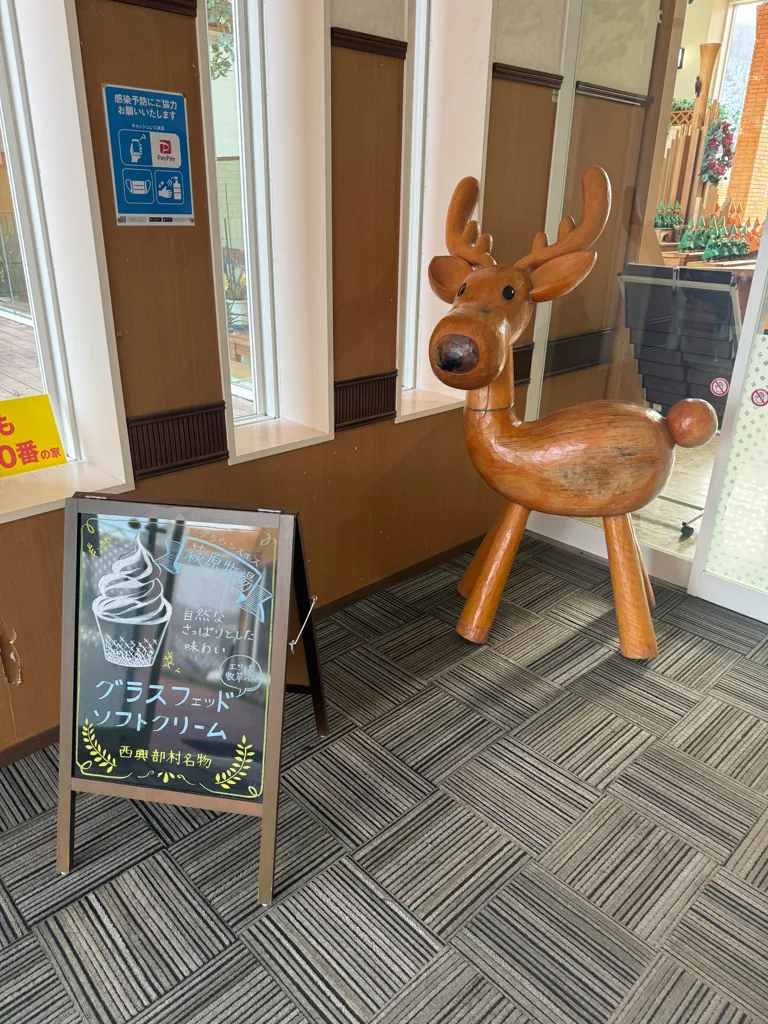
- Ezo deer: since 2004 the whole village (about 30,000 ha) has been a licensed hunting area (猟区) run by a local NPO for managed hunting and research11. There is also a deer park, and deer meat is canned locally1213.
- Komu, the Forest Museum (森の美術館「木夢」): an indoor "wooden amusement park" opened in 1997. It holds about 3,000 handmade wooden toys and has a sandpit filled with 160,000 wooden balls14.
- Dairy and grass-fed milk: dairy is the main industry. Thirteen farms produced 19,290 t of raw milk worth about ¥2.56 billion in the year to March 202615. A local start-up, Milk Design (ミルクデザイン), makes pasture-fed milk, butter and yogurt16.
- The Ice Tunnel (氷のトンネル): a summer-surviving tunnel of avalanche snow (around 4 °C inside) below Mt. Uenshiri (ウエンシリ岳). Since a 2001 collapse it opens only one day a year17.
Sights & activities
Nature & scenery
- Mt. Uenshiri (1,142 m): views of the Sea of Okhotsk and the Daisetsu range, and more than 100 alpine plant species. The climbing season runs from late June to October9. The most popular route, from Uenshiri Campground, is short but steep and rocky, so treat it as an intermediate climb20. The village describes the route from the central trailhead as easy enough for school climbing trips32.
- Three waterfalls in Oku-Okoppe: Gyōja Falls (行者の滝) is named after a woman ascetic who prayed for a cure beneath it in the late Meiji era55. Akaiwa Falls (赤岩の滝) drops 8 m over black andesite onto a brick-red bed of oxidized volcanic tuff5634. Kuroiwa Falls (黒岩の滝), further upstream, flows through virgin Ezo spruce forest57. Turn off Route 239 at the Gyōja Falls sign: Gyōja is 4.5 km in, and the Akaiwa parking lot 3.7 km further, followed by a short walk34. Go between early June and the end of October, because the roads are not plowed in winter9.
- Ice Tunnel (氷のトンネル): about 3 m high and up to 500 m long in snowy years. Entry is allowed only on the annual open day17.
- Kōrakuen (興楽園): a free Japanese garden, listed as a "Northern Landscape Heritage" site (北の造園遺産), with ponds, centuries-old trees, moss beds and Kōrakutei (興楽亭), a tea house built entirely of Ezo spruce that anyone may use (289-1 Nishiokoppe). It is usually open from late April to October, but the 2026 season was set to start in mid-May95859.
Onsen
- Hotel Rimu (ホテル森夢), 492 Nishiokoppe: the hotel calls its bath Kōmyōseki Onsen (光明石温泉), after the mineral stone used as its source. It has a sauna, bubble bath, lie-down bath, weekly herbal bath and cold plunge. Day bathing costs ¥500 for adults and ¥200 for children, 11:00–23:00 (last entry 22:00), plus a morning bath from 6:00 to 8:0060. The village guide says it is half price on the 6th, 16th and 26th of each month9.
Museums & heritage
- Komu (森の美術館「木夢」), 276 Nishiokoppe: wooden playground hall, toy theater (three shows a day), puzzle rooms and the wooden-ball sandpit. Open 10:00–17:00 (April–October) or 10:00–16:30 (November–March), closed Tuesdays; adults ¥500, children ¥100–30061.
- Kami-Okoppe Railway Museum (上興部鉄道資料館): the original wooden station building of the former Nayoro Main Line, with station equipment, a KiHa 27 diesel railcar and the rotary unit of a DD14 snowplow25. It holds about 100 railway exhibits and is open late April to late October, 10:00–16:30, closed Wednesdays, and free62.
Outdoor & seasonal activities
- Nishiokoppe Forest Park (西興部森林公園): 3 ha beside the village center, with what the village calls Japan's northernmost batting center, plus go-karts, bouldering and rental bikes. Open late April to mid-October63. Camping costs ¥500 per tent or car per night. Log cabins can be booked through Hotel Rimu64.
- Uenshiri Campground: free, with a 10-person bungalow, 40 minutes' drive from the center65. Deer Park (鹿牧場): 7 ha of fenced meadow with Ezo deer in Naka-Mo, 4 km from the center12.
- Hunting and eco-tours: the Nishiokoppe Wildlife Association (西興部村猟区管理協会) runs guided hunts66, hunting schools, deer eco-tours and children's wildlife camps. Hunters took 294 deer in fiscal 2025 (provisional figure)67.
- Winter: Miya-no-Mori ski slope (400 m according to the village guide, 330 m in the village statistics; simple lift, night lighting; mid-December to mid-March)915. A Snowmobile Land (1 km course, ¥1,000 a day) has been held at the roadside station, but it was canceled in 2022, so check whether it still runs68.
- Park golf: a free 18-hole course (990 m) at Ikoi-no-Mori Park, about 1 km from the roadside station9.
Food experiences
Roadside stations (Michi-no-Eki)
Nishiokoppe Kamu (道の駅にしおこっぺ花夢)
- Location: 37 Kami-Okoppe, Nishiokoppe, on National Route 239, about 30 km inland from the Sea of Okhotsk. The Kami-Okoppe Railway Museum is about 1 km away109.
- Hours: 9:00–17:00 from March to October and 9:00–16:00 from November to February. Closed Tuesdays (the next day if Tuesday is a holiday) and 31 December–5 January. It opened daily during the 2026 summer holidays (22 July–17 August). The paid flower-park area closes for the season on 18 October 2026. The toilets and stamp are available 24 hours (as of September 2026; check before visiting)107045.
- Shops & products: Shikamu-kan deer cans, Higuma-kan bear cans, deer-leather crafts, wild vegetables, Milk Design dairy products including the prize-winning haskap drinking yogurt, and Setoushi-kun cookies and cake104547.
- Food: grass-fed soft-serve made from milk of cows grazed in the village10. Japanese Wikipedia lists a restaurant and a light-meal corner (unverified whether currently operating)71. Food stalls appear during the Nishi-Okoppe Marché53.
- Facilities: parking for 66 cars and 2 large vehicles, 24-hour toilets (with an accessible toilet and diaper-changing tables), Wi-Fi, cashless payment (transit IC cards not accepted) and a park with a giant slide and a water-play area10. No EV charger or RV park is listed. The flower park covers about 6 ha, with around 500 flower species from April to October, a 50 m border garden of red monarda and a "Man'yō hill" of wild plants from the Man'yōshū poetry anthology. Entry to the paid area is ¥200 for high-school age and up7010.
- Notes: registered on 18 August 2000 as Hokkaido registration No. 6810. The highlight is the mechanical organ "Otogibayashi" (音木林): 58 wooden dolls "play" along to music from dozens of wooden pipes blown by bellows70. It was built by street-organ maker Tanime Motoki (谷目基), described as one of only two such craftsmen in Japan10, and restarted after repairs in August 202672. In autumn 2026 the station is promoting the Guru-Fura Drive garden stamp rally54.
Getting there & around
- Rail: there is no railway in the village. The nearest station is JR Nayoro on the Sōya Main Line in Nayoro6.
- Bus: the Meishi Bus Okoppe Line (名士バス 興部線) runs between Nayoro and Okoppe along Route 239, stopping at Kami-Okoppe and Nishiokoppe6. There are seven buses a day toward Okoppe (timetable from 1 July 2026)73. From Asahikawa: limited express to Nayoro (about 55 minutes), then the bus (about 1 hour 10 minutes). From Monbetsu: Hokumon Bus to Okoppe, then change (about 1 hour 30 minutes of bus travel)74.
- Road: National Route 239 crosses the village over Tenpoku Pass6. From Sapporo it is 282 km, about 3.5 hours using the expressway (5.5 hours without). Asahikawa is 127 km (2.5 hours)75. Drivers leave the Dō-Ō Expressway at Shibetsu-Kenbuchi IC and take Routes 40 and 239 (about 1 hour 20 minutes). Monbetsu is about 50 minutes away via Routes 238 and 23974.
- Air: Okhotsk Monbetsu Airport is the nearest, about 1 hour 20 minutes by bus. Asahikawa Airport is the alternative756.
Practical tips
- Best season: June to October, when the waterfalls, the flower park, Mt. Uenshiri and the Forest Park are all open. Plan around the Ice Tunnel open day in July and the Mura-okoshi Matsuri at the end of August91750.
- Tourist information: Rizumu (里住夢) is in the Forest Park at 108-1 Nishiokoppe (tel. 0158-85-7125). It is open 9:00–17:00, daily from May to October and on weekdays from November to April, and has Wi-Fi and a local-products display76.
- Where to stay: Hotel Rimu has 24 rooms and 50 free parking spaces7774. Other options are the Forest Park log cabins, farm-stay cottages and the guesthouse GA.KOPPER, which is in the former Kami-Okoppe Junior High School966.
- Wildlife: the village logged 28 brown-bear sightings from April to 1 September 2026, including near the Gyōja Falls road and on Route 239. Carry a bell, don't hike alone, and take extra care at dawn and dusk78. Collisions with Ezo deer on the national route are rising, and the village publishes a map of collision spots79.
- Winter: expect deep snow and temperatures that can drop below −30 °C. Roads to the waterfalls are not plowed369.
Photos
-
 Mar 2026
More about Nishiokoppe
At a glance
| Field | Details |
|---|---|
| Type | Village (村) |
| Subprefecture | Okhotsk (オホーツク総合振興局) |
| District | Monbetsu District (紋別郡) |
| Population | 2020 Census: 1,053 (520 male, 533 female; 499 households), down 5.6% from 20151. 2025 Census (preliminary): 914 (−13.2%), the third-smallest in Hokkaido, ahead of only Kamoenai and Otoineppu2. Resident register: 930 (including 53 foreign residents; 631 households) for August 20263 |
| Area | 308.08 km²41 |
| Density | 3.4 people/km² (2020 Census)1. About 3.0/km² using the August 2026 register figure (calculated) |
| Municipal history | Split off from Okoppe Village (now Okoppe town) on 1 January 192556. It has stayed a village and has had no mergers. It marked its centennial in 20255 |
| Neighboring municipalities | Okoppe to the east and north, Takinoue to the south, and Shimokawa (Kamikawa Subprefecture) to the west7. Japanese Wikipedia also lists Omu as a neighbor6 |
| Symbols | Tree: Japanese yew (イチイ, called onko locally). Flower: Rhododendron dauricum (エゾムラサキツツジ). Both were designated on 26 June 19867. No village bird was found. The flag and emblem date from 20 December 19676 |
| Mascot | Setoushi-kun (セトウシくん), a cow character chosen in July 2016 after a public call and a residents' vote8. The village guide calls him a "2-year-old cow who never ages". His birthday is 27 March, and he loves music, tasty grass and the FujiGen guitars made in the village9 |
| Official website | https://www.vill.nishiokoppe.lg.jp/ |
Name origin
- Nishi-Okoppe means "west Okoppe". The village lies west of its parent town, Okoppe7.
- Okoppe (興部) comes from the Ainu o-u-kot-pe (オウコッペ), "the place where the river mouths join" (literally "river mouth – each other – stuck together – river")187. The Okoppe and Mo-Okoppe (藻興部川) rivers now reach the sea about 4 km apart. Place-name scholar Yamada Hidezō (山田秀三) thought they once met behind the coastal dunes, and the Okoppe town history agrees18.
- Setoushi (瀬戸牛), the old name of the village center, is said to come from the Ainu set-us-nay ("stream with many nests"). Whether the nests were birds' or fox dens is disputed19. The area was first called Nanae (七重), but the 1921 station was named Setoushi to avoid confusion with Nanae Station (七飯駅) on the Hakodate Main Line19. The mascot Setoushi-kun shares the name.
- Uenshiri (ウエンシリ), the highest peak, is from the Ainu wen-sir, "rugged/dangerous mountain", which fits its steep ridges and deep valleys20.
History
- Prehistory: people have lived here for about 12,000 years. Microblade cores from the Oshorokko (忍路子) and Sakkotsu (札滑) sites have lent their names to two Paleolithic toolmaking techniques, the "Sakkotsu-type Yūbetsu technique" and the "Oshorokko technique"21.
- Edo period: the area was part of the Matsumae domain's Sōya and Monbetsu trading posts (場所)6.
- Meiji settlement: the area became part of Okoppe Village. Clearing began in 1904, and settlers arrived from about 1906, once the Okoppe–Nayoro road opened. The first two schools followed in 190921. Oral histories the village published in 1977 name pioneers from Fukuoka, Miyagi and Noto (Ishikawa)2223. A group from Gifu Prefecture moved to Kami-Mo (上藻) in 1913 after its first plot, in Engaru, proved too swampy to farm24.
- Timber, mint and potatoes: logging began around 1911, with logs floated to the sea. Mint (hakka) arrived in 1913, and from 1914 wartime prices made beans, mint and potato starch the cash crops. Rice, tried in 1923, failed in cold summers21.
- Railway era: the Nayoro Line (later the Nayoro Main Line) reached Kami-Okoppe from Shimokawa on 25 October 1920 and Okoppe on 5 October 1921, when Setoushi Station opened. It was renamed Nishi-Okoppe in 19612519.
- 1925: on 1 January the western half of Okoppe Village became Nishiokoppe Village621.
- 1935: a Hokkaido-government limestone quarry with its own rail siding opened at Kami-Okoppe. It closed on 31 August 200625. The 1935 census recorded the village's highest population, 4,86715.
- Post-war: Typhoon No. 15 (1954) destroyed much of the natural conifer forest, and replanting with larch and pine began in 1955. Falling starch demand and crop failures had turned the village fully to dairying by the Shōwa 40s (1965–1974). The last mint was distilled in 197921.
- 1989: the Nayoro Main Line closed on 1 May19. On 22 November the village opened its own cable TV network. It was upgraded to fiber to every home in 2001, the same year the IT夢 (read "Atom") multimedia center opened26.
- 1990s–2000s: the deer park opened in 19906, the Kami-Okoppe railway museum in 199425, Komu in 199714 and the roadside station in 200010. The hunting area followed in 200411, then wildlife-research agreements with Rakuno Gakuen University (2007) and Sapporo's Maruyama Zoo (2009)2728.
- Recent: the village marked 10,000 days without a traffic death in June 202229 and 30 years in January 20256. Kami-Okoppe Elementary School closed in March 202315. The centennial ceremony was held on 19 October 20255. Mayor Kikuchi Hiroshi (菊池博), in office since February 201530, ends his term on 31 January 2027, and the election is set for 24 January 202731.
Geography & climate
- Setting: the village lies in the northeastern Kitami Mountains, in the northwest corner of Okhotsk Subprefecture. It measures 21 km east–west by 24 km north–south. Farms occupy narrow strips along the Okoppe and Mo-Okoppe rivers, and the hills average about 400 m7. Forest covers 27,476 ha, about 89% of the land (calculated), and 82% of it is Hokkaido prefectural forest15.
- Mountains: Mt. Uenshiri (1,142.3 m), on the border with Takinoue and Shimokawa, is one of the Hokkaido Hyakumeizan (北海道百名山, Hokkaido's 100 famous mountains)20. It has been part of Teshiodake Prefectural Natural Park (天塩岳道立自然公園) since 197832. Other peaks are Mt. Sakkotsu (993 m) and Mt. Poronupuri (835 m)6. Rocky Genkotsu-yama ("Fist Mountain", 667 m) stands out from Route 2399.
- Rivers: the Okoppe River (53.6 km) rises north of Poronupuri, turns east near Tenpoku Pass (天北峠) and follows Route 239 to the sea. Pink salmon are collected in it for hatcheries33. Akaiwa Falls on its upper reaches is one of the Hokkaido 100 geological sites (北海道地質百選)34.
- Climate (JMA Nishiokoppe station, 1991–2020 normals): the annual mean is 5.7 °C, from −7.8 °C in January to 19.0 °C in August. Annual precipitation is 1,015 mm and snowfall 623 cm, with an average deepest snow of 105 cm35. Records are 36.4 °C (3 August 1978), −33.2 °C (17 February 1978) and 163 cm of snow on the ground (16 January 2004)36. The village is a special heavy-snowfall area (特別豪雪地帯)6.
Economy & industry
- Dairy: as of March 2026 there were 13 dairy farms (3 incorporated) with 3,456 cattle. They produced 19,290 t of milk a year worth ¥2.556 billion. Of the 1,681 ha of farmland, 1,324 ha is pasture and hay meadow15. Milk Design was founded in 2021 by a newcomer who moved to the village in 2020, and it is recognized as a Hokkaido University start-up37. It uses milk from Hagiwara Farm (萩原牧場), which grazes about 30 cows day and night on 60 ha without pesticides or chemical fertilizers16.
- Other industry: the village profile lists an electric-guitar factory, a deer-meat processing plant and a biogas plant38. The village guide says the guitars are FujiGen guitars9. The 2021 Economic Census counted 3 factories with 56 workers and ¥1.27 billion in shipments15.
- Jobs: of 577 working residents in 2020, 20.1% worked in primary industries (mostly farming and forestry), 15.8% in construction and manufacturing, and 64.1% in services. Welfare is a major employer: an 80-bed nursing home, a 40-place disability support facility and several group homes15.
- Tourism: 30,900 visits in fiscal 2025 (97% of the year before), including 6,900 overnight stays. Only about 900 visitors came from outside Hokkaido39.
- Population and revival: the population fell from 4,867 (1935) to 1,053 (2020). In 2025 there were 2 births and 20 deaths, and by March 2026 about 36% of residents were 65 or older (calculated)15. The village's responses include the orange townscape, fiber broadband and the hunting-area model. There is also a flight subsidy for visitors from outside Hokkaido who fly Haneda–Monbetsu and book a special Hotel Rimu plan: ¥10,000 for one night, up to ¥20,000 for a round trip with two nights40.
Local specialties
| Specialty | Category | Details & where to get it |
|---|---|---|
| Shikamu-kan (鹿夢缶) deer-meat cans | Game meat | Local Ezo deer canned yamato-ni (soy-ginger), miso or curry style. Loin blocks are also sold. Distributed by the village deer-raising group (西興部村養鹿研究会) through Tao Shōten (田尾商店), and also sold at the roadside station1310 |
| Higuma-kan (ひぐま缶) | Game meat | Canned brown bear, yamato-ni style. Rare, because only a few bears are taken a year. Sold at the roadside station10 |
| Sonchō Ramen (村長ラーメン, "village mayor's ramen") | Signature dish | Ramen made with Ezo deer meat, served at Hotel Rimu's Green Leaf restaurant along with other deer dishes9. A renewed version, in limited quantities, came out in June 202641 |
| Setoushi Udon (セトウシうどん) | Noodles | Dried udon made with raw Brown Swiss milk from the village and Hokkaido Kitahonami wheat, boxed with kombu broth. Sold at the Hotel Rimu front desk and served there as nabeyaki udon in winter42 |
| Matsutake shōchū "Nishiokoppe" (まつたけ焼酎「にしおこっぺ」) | Spirits | Made from wild matsutake mushrooms that grow in the village and distilled outside it under contract436. Matsutake ramen is also sold as a souvenir44 |
| Grass-fed dairy (Milk Design) | Dairy | Low-temperature pasteurized, non-homogenized milk, cheese, cultured butter, cream and drinking yogurt16. The haskap drinking yogurt won gold at FM North Wave's Hokkaido Souvenir Grand Prix. Sold at the roadside station and Q-Mart45. Grass-fed soft-serve is served at the station and Hotel Rimu1045 |
| Wild mountain vegetables (山菜) | Foraged food | Fuki, bracken, udo and bamboo shoots in spring and summer, and mushrooms in autumn, packed by Murata Foods (村田食品)4610 |
| Setoushi-kun cookies & chocolate cake | Sweets | Mascot-printed souvenirs sold at the roadside station and Hotel Rimu47 |
| Furusato nōzei gifts | Donation gifts | Grass-fed butter and dairy sets from the village, including Milk Design's, held the top three places in the village's Furusato Choice popularity ranking (September 2026)48 |
Culture & festivals
| Event | When | Highlights |
|---|---|---|
| "Waga Mura wa Utsukushiku" flower planting (我が村は美しく事業) | June every year (since 1996) | More than 300 residents plant the flowerbeds along the national route, including orange marigolds in the village color49 |
| Ice Tunnel open day | A Sunday in mid-July (12 July in 2026) | The youth division of the village chamber of commerce opens the path to the tunnel. A shuttle bus runs from Uenshiri Campground17 |
| Mura-okoshi Matsuri (むら興しまつり) | Last Sunday of August (43rd edition on 30 August 2026) | At the Forest Park: a lumberjack race, stalls, a prize draw, guest singers and the revived Uenshiri Taiko drumming. There were 846 visitors in 2025505 |
| Kami-Okoppe Shrine festival | 7 September | Mikoshi (portable shrine) procession51 |
| Nishiokoppe Shrine festival | 11 September | Mikoshi procession52 |
| Nishi-Okoppe Marché (西おこっぺマルシェ) | Seasonal (autumn 2026 edition: 20–21 September) | Stalls at the roadside station entrance: tempura soba made with village vegetables, birch-sap chiffon cake, Ezo deer dishes, local produce53 |
| Guru-Fura Drive (ぐるふらドライブ) | 4 September–12 October 2026 | Stamp rally linking gardens and events in Nishiokoppe, Takinoue and Kamikawa, with prize draws54 |
| Komu Woody Schools | Summer, autumn and winter | Woodworking and wooden-toy courses at Komu. The summer school has run since 199414 |
- Discontinued: the Gyōja Falls festival (行者の滝まつり) used to be held every 19 July with a Buddhist memorial service. It was last held in 202055.
- Local History Museum (郷土館): inside the Sōmukan woodcraft center. It covers the prehistoric sites, logging, farming, a restored Taishō-era farmhouse and mint distilling. Open 1 May–31 October, closed Tuesdays, free219.
Ainu heritage
The land was part of Ainu territory before Meiji settlement, and it is recorded mainly through place names: Okoppe (o-u-kot-pe), Setoushi (set-us-nay) and Uenshiri (wen-sir)181920. The older Oshorokko and Sakkotsu archaeological sites date to the Paleolithic, long before Ainu culture21. No Ainu cultural facility or documented living tradition was found in the village. For Ainu history of the wider Okhotsk coast, see Okoppe and Monbetsu.
Sister & friendship cities
None found. The village has no formal sister city6. It has, however, run an informal friendship exchange with Juneau, Alaska (USA) since 1992. Village junior-high students visit Juneau about every two years, and since 1994 the Juneau Board of Education has sent English teachers to the village. Juneau presented a certificate marking 25 years of exchanges in 2018806.
Notable people
Sources
Numbers in the text link to these sources. Figures as of 23 September 2026
- 第1表 男女別人口、面積、人口密度及び世帯数(令和2年国勢調査結果) — Hokkaido Government, Statistics Division (北海道総合政策部計画局統計課) JA accessed 2026-09-23
- 令和7年国勢調査速報 北海道の人口・世帯数(要計表に基づく人口・世帯数の集計) — Hokkaido Government, Statistics Division JA accessed 2026-09-23
- 西興部村の人口・世帯数 — Nishiokoppe Village JA accessed 2026-09-23
- 令和8年全国都道府県市区町村別面積調(4月1日時点) — Geospatial Information Authority of Japan (国土地理院) JA accessed 2026-09-23
- 西興部村開村100周年記念事業 — Nishiokoppe Village JA accessed 2026-09-23
- 西興部村 — Wikipedia JA accessed 2026-09-23
- 西興部村の概要 — Nishiokoppe Village JA accessed 2026-09-23
- 西興部村イメージキャラクター、ロゴ等について — Nishiokoppe Village JA accessed 2026-09-23
- 西興部村おすすめスポット(PDF, 2024年9月作成) — Nishiokoppe Village Tourist Information Center JA accessed 2026-09-23
- にしおこっぺ花夢 — 北の道の駅(北海道地区「道の駅」連絡会) JA accessed 2026-09-23
- 西興部村猟区について — NPO Nishiokoppe Wildlife Association (西興部村猟区管理協会) JA accessed 2026-09-23
- 鹿牧場 — Nishiokoppe Village JA accessed 2026-09-23
- 特産物:鹿肉缶詰 — Nishiokoppe Village JA accessed 2026-09-23
- 施設の概要 — 森の美術館「木夢(コム)」 Komu Museum of Art JA accessed 2026-09-23
- 西興部村村勢要覧 資料編 2026年版(PDF) — Nishiokoppe Village JA accessed 2026-09-23
- 北海道の放牧酪農 グラスフェッドミルク — ミルクデザイン Milk Design JA accessed 2026-09-23
- 日本一の氷のトンネル — Nishiokoppe Village JA accessed 2026-09-23
- アイヌ語地名リスト エン~オニシ P21-30(Internet Archive copy) — Hokkaido Government, Ainu Policy Promotion Office (北海道環境生活部アイヌ政策推進室) JA accessed 2026-09-23
- 西興部駅 — Wikipedia JA accessed 2026-09-23
- ウエンシリ岳 — Wikipedia JA accessed 2026-09-23
- 郷土館 — Nishiokoppe Village Board of Education JA accessed 2026-09-23
- 開拓よもやま話(昭和52年11月3日発行) — Nishiokoppe Village JA accessed 2026-09-23
- 開拓よもやま話 1. 上興部附近の開拓(伊藤勇市郎, 1977) — Nishiokoppe Village JA accessed 2026-09-23
- 開拓よもやま話 27. 岐阜団体の入殖(大沢くめ, 1977) — Nishiokoppe Village JA accessed 2026-09-23
- 上興部駅 — Wikipedia JA accessed 2026-09-23
- 西興部村コミュニケーションネットワーク — Wikipedia JA accessed 2026-09-23
- 酪農学園大学と西興部村地域総合交流協定を締結 — Nishiokoppe Village JA accessed 2026-09-23
- 円山動物園と西興部村相互協力協定を締結 — Nishiokoppe Village JA accessed 2026-09-23
- 交通事故死ゼロ10,000日達成記念住民大会 — Nishiokoppe Village JA accessed 2026-09-23
- 村長からのごあいさつ — Nishiokoppe Village JA accessed 2026-09-23
- 西興部村長選挙 — Nishiokoppe Village Election Commission JA accessed 2026-09-23
- ウエンシリ岳 — Nishiokoppe Village JA accessed 2026-09-23
- 興部川 — Wikipedia JA accessed 2026-09-23
- 北海道地質百選 0452「興部川 赤岩の滝」 — Geological Society of Japan Hokkaido Branch, Hokkaido Geosites Group JA accessed 2026-09-23
- 西興部 平年値(年・月ごとの値) — Japan Meteorological Agency (気象庁) JA accessed 2026-09-23
- 西興部 観測史上1~10位の値(年間を通じての値) — Japan Meteorological Agency JA accessed 2026-09-23
- 会社概要 — ミルクデザイン株式会社 Milk Design JA accessed 2026-09-23
- 西興部村勢要覧 令和5年版(裏)(PDF) — Nishiokoppe Village JA accessed 2026-09-23
- 北海道観光入込客数調査報告書 令和7(2025)年度 資料編(市町村別・月別観光入込客数) — Hokkaido Government, Tourism Bureau (北海道経済部観光局) JA accessed 2026-09-23
- 西興部村オホーツク紋別空港利用促進助成事業を令和8年度も実施します。 — Nishiokoppe Village JA accessed 2026-09-23
- ホテル森夢(リム) 公式サイト(お知らせ:西興部村長ラーメンリニューアル, 2026年6月30日) — Hotel Rimu JA accessed 2026-09-23
- セトウシうどん 発売中! — Nishiokoppe Village / Hotel Rimu JA accessed 2026-09-23
- 特産物:まつたけの特産焼酎「にしおこっぺ」 — Nishiokoppe Village JA accessed 2026-09-23
- グルメ・特産品 — Nishiokoppe Village JA accessed 2026-09-23
- のむヨーグルト【ハスカップ味】新登場!! — 北の道の駅(にしおこっぺ花夢からのお知らせ) JA accessed 2026-09-23
- 特産物:山菜 — Nishiokoppe Village JA accessed 2026-09-23
- 西興部村イメージキャラクター『セトウシくん』の菓子販売について — Nishiokoppe Village JA accessed 2026-09-23
- 北海道西興部村のふるさと納税 お礼の品ランキング — ふるさとチョイス Furusato Choice JA accessed 2026-09-23
- わが村は美しく事業 — Nishiokoppe Village JA accessed 2026-09-23
- 第43回むら興しまつり(令和8年8月30日開催) — Nishiokoppe Village JA accessed 2026-09-23
- 上興部神社祭 — Nishiokoppe Village JA accessed 2026-09-23
- 西興部神社祭 — Nishiokoppe Village JA accessed 2026-09-23
- 秋の西おこっぺマルシェ開催【9/20~21】 — 北の道の駅(にしおこっぺ花夢からのお知らせ) JA accessed 2026-09-23
- ぐるふらドライブ2026開催のお知らせ — 北の道の駅(にしおこっぺ花夢からのお知らせ) JA accessed 2026-09-23
- 行者の滝 — Nishiokoppe Village JA accessed 2026-09-23
- 赤岩の滝 — Nishiokoppe Village JA accessed 2026-09-23
- 黒岩の滝 — Nishiokoppe Village JA accessed 2026-09-23
- 周辺ガイド — ホテル森夢(リム) Hotel Rimu JA accessed 2026-09-23
- 興楽園 — Nishiokoppe Village JA accessed 2026-09-23
- 大浴場 — ホテル森夢(リム) Hotel Rimu JA accessed 2026-09-23
- 入館について — 森の美術館「木夢(コム)」 Komu Museum of Art JA accessed 2026-09-23
- 鉄道資料館 — Nishiokoppe Village JA accessed 2026-09-23
- 西興部森林公園 — Nishiokoppe Village JA accessed 2026-09-23
- 森林公園キャンプ場 — Nishiokoppe Village JA accessed 2026-09-23
- ウェンシリキャンプ場 — Nishiokoppe Village JA accessed 2026-09-23
- 村の有名人(達人) — Nishiokoppe Village JA accessed 2026-09-23
- 西興部村猟区管理協会 Nishiokoppe Wildlife Association ホームページ — NPO Nishiokoppe Wildlife Association JA accessed 2026-09-23
- スノーモービルランド(令和4年はコロナ対策で中止) — Nishiokoppe Village JA accessed 2026-09-23
- レストラン「グリーンリーフ」 — ホテル森夢(リム) Hotel Rimu JA accessed 2026-09-23
- 道の駅にしおこっぺ「花夢(カム)」 — Nishiokoppe Village JA accessed 2026-09-23
- 道の駅にしおこっぺ花夢 — Wikipedia JA accessed 2026-09-23
- からくりオルガン再稼働 — 北の道の駅(にしおこっぺ花夢からのお知らせ) JA accessed 2026-09-23
- 名士バス時刻表(興部方面) — Nishiokoppe Village JA accessed 2026-09-23
- アクセス — ホテル森夢(リム) Hotel Rimu JA accessed 2026-09-23
- 交通アクセス — Nishiokoppe Village JA accessed 2026-09-23
- 観光情報発信・子育て支援センター「里住夢(りずむ)」 — Nishiokoppe Village JA accessed 2026-09-23
- 客室 — ホテル森夢(リム) Hotel Rimu JA accessed 2026-09-23
- ヒグマ出没情報 — Nishiokoppe Village JA accessed 2026-09-23
- エゾ鹿衝突事故防止 — Nishiokoppe Village JA accessed 2026-09-23
- A relationship between Juneau, Alaska and Nishiokoppe — Nishiokoppe Village EN accessed 2026-09-23
- 西興部出身の力士: 羽黒花 統司さん — Nishiokoppe Village JA accessed 2026-09-23
- 西興部出身の野球選手:荻野 一雄さん — Nishiokoppe Village JA accessed 2026-09-23