Furano 富良野市
ふらのし
Furano sits in the middle of the Furano Basin and bills itself as the "navel of Hokkaido" (北海道のへそ). It is known for lavender, powder snow, a city-run winery and the TV drama "Kita no Kuni kara" (北の国から).12 Its farms grow onions, melons and watermelons, and its tourism is busiest in July and again in the ski season.34
- Population (2020 Census)
- 21,131
- Area
- 600.71 km²
- Official website
- www.city.furano.hokkaido.jp
Known for
- "Kita no Kuni kara" (北の国から): Kuramoto Sō's drama was filmed here from 1981 to 2002. The Kuroita family's homes still stand in Rokugō (麓郷). His later dramas "Yasashii Jikan" (優しい時間) and "Kaze no Garden" (風のガーデン) were also set in Furano, and fans call the three the "Furano trilogy."2
- Lavender: Highland Furano (ハイランドふらの) has the city's largest lavender field, in bloom from early to late July.12 The Environment Ministry named "Furano's lavender" (ふらののラベンダー) one of Japan's 100 Fragrant Landscapes (かおり風景100選) in 2001.10
- Skiing: Furano Ski Resort (富良野スキー場) has hosted the FIS World Cup 12 times: 10 alpine events and 2 snowboard events.1 It has two zones and a 101-passenger ropeway.13
- "Navel of Hokkaido": a survey marker at Furano Elementary School is known as Hokkaido's center point.14 The belly-painting Hokkai Heso Matsuri (北海へそ祭り) grew out of it and is held every 28–29 July.15
- Furano Wine (ふらのワイン): made by the city's own Grape and Fruit Research Institute, set up in 1972. It released Japan's first commercial ice wine in 2005 and in 2026 won a gold medal at the Japan Wine Competition.1617
- Farm produce: onions are the largest crop, with 1,426 ha. Sweet corn, carrots, pumpkins, melons (sold under the "Furano Melon" brand) and watermelons follow.13
- Dairy and sweets: Furano Cheese Factory (富良野チーズ工房) and the bottled Furano milk pudding (ふらの牛乳プリン) from Furano Delice.1819
- Furano omu-curry (富良野オムカレー): the town's signature dish is omelette-rice curry made with local rice, vegetables and eggs, always served with a glass of Furano milk.20
Sights & activities
Nature & scenery
- Rokugō Observatory (麓郷展望台): a hilltop view over the Rokugō farm landscape where "Kita no Kuni kara" was set. The area was chosen as one of Japan's 100 Beautiful Village Landscapes (美しい日本のむら景観百選).3610
- Highland Furano (ハイランドふらの), Shimanoshita: the city's largest lavender field, at its best from early to late July.12
- Kaze no Garden (風のガーデン): a British-style garden of about 2,000 m² on the grounds of the New Furano Prince Hotel, created for the 2008 drama. About 20,000 plants of more than 400 varieties grow there, around the drama's greenhouse. Open late April to mid-October.46 Admission ¥1,200 for adults and ¥700 for elementary pupils (as of September 2026 — check before visiting).37
- Torinuma Park (鳥沼公園): a park around a pond that is said never to freeze.21
- Yamabe Nature Park Taiyō no Sato (山部自然公園 太陽の里): a park inside the Furano-Ashibetsu Prefectural Natural Park, 3 km from the old Yamabe station. It has a lodge, campground, athletic course, park golf and flower beds of azaleas, lavender and baby's breath.3
Onsen
- Furano Onsen "Shisai no Yu" (富良野温泉 紫彩の湯): at the New Furano Prince Hotel, with water drawn from 1,010 m underground.37
- Highland Furano: a hotel with a natural hot spring and day bathing. Its open-air bath looks onto lavender in summer and snowy peaks in winter.12
Museums & heritage
- "Kita no Kuni kara" sets in Rokugō: three sites share a ¥1,200 combined ticket.47
- Gorō's Stone House (五郎の石の家) and the family's first house: built from stones cleared out of the fields. Open 12 April–29 November in 2026; closed in winter. Admission ¥500.47
- Hirotte Kita Ie (拾って来た家): houses made of salvaged materials, open all year. In winter it closes on Mondays and Thursdays, and it closes for about two weeks of maintenance in early to mid-April.48
- Rokugō no Mori (麓郷の森): Gorō's log cabin and the family's "third house."36
- Hokkaido Center Marker (北海道中心標): the survey base set in 1914 by Kyoto Imperial University professor Shinjō Shinzō at Furano Elementary School.14 The Heso Matsuri site instead credits Yamamoto Issei and dates it to 1909.15
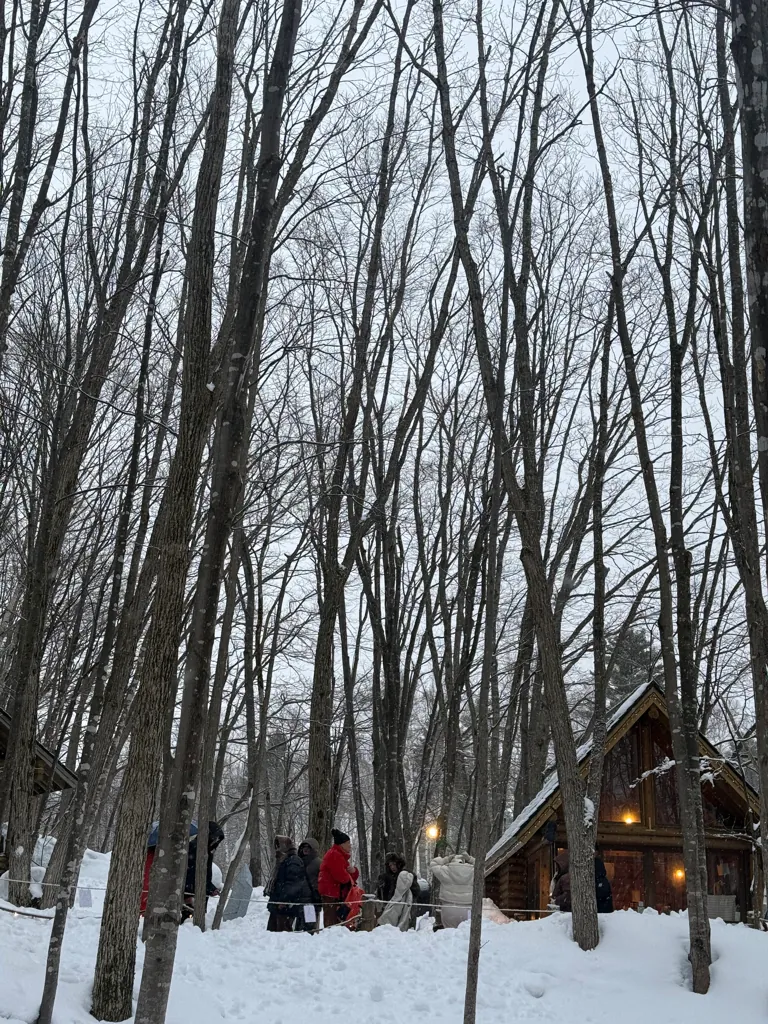
- Ningle Terrace (ニングルテラス): 15 craft-shop log cabins in the forest by the New Furano Prince Hotel. Open 11:00–19:45 in summer and 12:00–20:45 in winter. Nearby are the drama café "Mori no Tokei" (珈琲 森の時計, noon–21:00), the coffee shop from "Yasashii Jikan," and the Furano Drama-kan shop.37492
Outdoor & seasonal activities
- Furano Ski Resort (富良野スキー場): the long runs of the Furano Zone and the varied Kitanomine Zone. It has eight lifts, a six-person gondola and the 101-passenger ropeway, which reaches the top in about 5 minutes.13 In winter 2026–27 (1 Dec–31 Mar), Furano Bus runs a new ¥500 ski shuttle from Furano Station through downtown and Kitanomine to the New Prince Hotel.50
- Cross-country skiing: the Asahigaoka Park course, once used for the National Sports Festival, plus the Jukai and Sports Center courses.13
- Guided tours: mountain biking, snowshoeing, stream fishing and snowmobile touring around Rokugō and Fureibetsu.36
Food experiences
- Furano Winery (ふらのワイナリー), Shimizuyama: a free visit to the production line and aging cellars, with tastings. Individuals need no booking; groups of 10 or more should book. A separate guided winery tour can also be reserved.34
- Furano Cheese Factory (富良野チーズ工房): free admission, with parking for 120 cars. On the same site are an ice-milk shop, a pizza workshop (10:30–16:00) and a hands-on craft workshop (手作り体験工房).18
- Furano Delice: a café terrace overlooking the city. Open 10:00–18:00; closed Tuesdays.19
- Campana Rokkatei (カンパーナ六花亭), Shimizuyama: a Rokkatei confectionery shop and café. Both open 10:00–16:30 (café last order 16:00), with parking for 200 cars (as of September 2026 — check before visiting).51
- Rokugō shops: Furano Jam-en (ふらのジャム園) and the Anpanman Shop.36
Roadside stations (Michi-no-Eki)
No Michi-no-Eki is located in Furano. The official Hokkaido roadside station list has no station in the city.52 The nearest ones are:
- Minamifurano (道の駅南ふらの), Minamifurano: south on National Route 38 at Ikutora. It reopened after renovation on 26 April 2025. It has a large freshwater aquarium and a local-products shop, and parking for 74 cars and 10 large vehicles.53
- Star Plaza Ashibetsu (道の駅スタープラザ芦別), Ashibetsu: west on National Route 38.54
- Shizen Taikan Shimukappu (道の駅自然体感しむかっぷ), Shimukappu: south on National Route 237, the "Kajin Kaidō" (花人街道) flower route toward eastern Hokkaido.55
- Biei "Oka no Kura" (道の駅びえい「丘のくら」), Biei: north, in central Biei.52
Stop in town instead: Furano Marche (フラノマルシェ). Furano Marche is not a registered roadside station; its operator says it wants to be a "town veranda" (まちの縁側) rather than a drive-through Michi-no-Eki.24 In practice it is the city's main stop for drivers.
- Location: 13-1 Saiwai-chō (幸町13-1), about 7 minutes' walk from JR Furano Station.56
- Hours: generally 10:00–18:00, extended to 19:00 in summer (in FY2025, 14 June–31 August). Closed for maintenance for several days in mid-November (in 2026, 9–13 November) and on 31 December and 1 January (as of September 2026 — check before visiting).5657
- Shops & products: Marche 1 has the Argent local-products center (物産センターアルジャン), with more than 2,000 Furano items, and Ogāru, JA Furano's farm store. Marche 2 has sweets, a florist, a lifestyle shop and a gallery.24
- Food: a food-court style row of cafés and takeout stalls. Marche 2 also has a ramen shop and a Western-style restaurant.24
- Facilities: 131 parking spaces and 3 bus spaces, with overflow at the free Sunrise Park lot (Hinode-machi 7-10). There are accessible toilets and a nursing room, a wheelchair to borrow, and the Tamariba (タマリーバ) indoor atrium for events. Note that the parking and toilets are not open 24 hours; they close with the building.2456
- Notes: it opened in 2010 and is run by Furano Machizukuri Co., a company funded by local businesses and residents and set up in 2003.241
Getting there & around
- Rail: JR Furano Station (富良野駅) is the end of two lines.2558
- The Furano Line (富良野線) runs north to Asahikawa in about 1 hour and also stops at Gakuden (学田) in the city.5810
- The Nemuro Line (根室本線) runs west to Takikawa, where you change to Hakodate Line limited expresses for Sapporo. The local train to Takikawa takes about 70 minutes and the express to Sapporo about 50 minutes, so allow about 2 hours plus the transfer. From New Chitose Airport it is about 2 h 35 min plus transfers.5856
- The Furano–Shintoku section closed on 1 April 2024, so there is no longer a direct rail link to Tokachi.25
- Buses:
- Chūō Bus's "Kōsoku Furano-gō" (高速ふらの号) runs from Sapporo in about 2.5 hours.58
- Furano Bus's "Lavender-gō" (ラベンダー号) links Furano with Asahikawa Airport (about 1 hour) and Asahikawa city.5810
- The "North Liner" goes via Minamifurano to Obihiro.10
- Hokkaido Bus's "Bus Gorilliner Furano" runs to New Chitose Airport.10
- Car:
- From New Chitose Airport, take the Dōtō Expressway to Shimukappu IC, then National Route 237: about 124 km, 2 hours.
- The alternative via Mikasa IC and the Bibai–Furano road is about 140 km, 2.5 hours.
- From Asahikawa Airport, take Route 237: about 43 km, 1 hour.58
- The main roads are National Routes 38 and 237 and the Asahikawa–Tokachi Road (Kitanomine, Furano and Nunobe interchanges).10
- Nearest airport: Asahikawa Airport, about 1 hour away. New Chitose is about 2 hours by car.58
Practical tips
- Best seasons: early to late July for lavender.12 July is the busiest month, and the Heso Matsuri (28–29 July) fills the town, so book early.415 December to March is powder-ski season. Winter visitors from Australia stay longest.31
- Seasonal closures: the Rokugō drama sites mostly close from late November to mid-April. Gorō's Stone House cannot even be seen from a distance in winter.47 Kaze no Garden is open only from late April to mid-October.46
- Visitor center: the Furano-Biei Regional Tourist Information Center is beside Furano Station (日の出町1-30). Open 9:00–18:00 daily (as of 2023 — check before visiting).59 The tourism association's phone number is 0167-23-3388.20
- Volcano: since 12 September 2026 Tokachidake has been at alert Level 3, and Furano is one of the municipalities told to restrict access near the crater. Check JMA before hiking Furano-dake or the Tokachi Range.27
- Wildlife: Furano Cheese Factory posted a brown bear warning on 23 September 2026.18 The tourism association asks visitors never to feed wild animals, which can make them approach people and cause crop damage and traffic accidents.60
- Winter driving: snowfall averages 628 cm a year and it has dropped as low as −34.5 °C, so rent a car with winter tires and allow extra time.2830
- Getting around without a car: local buses run to Rokugō. Gorō's Stone House is about 40 minutes' walk from the Rokugō terminus.47 Rental bicycles are available at Hirotte Kita Ie from spring to autumn.48
Photos
-
 Oct 2024
 -
 Mar 2026
More about Furano
At a glance
| Field | Details |
|---|---|
| Type | City (市) |
| Subprefecture | Kamikawa (上川総合振興局) |
| District | None (city). Before 1966 it was Furano Town in Sorachi District (空知郡富良野町).5 |
| Population | 21,131 at the 2020 Census.1 The preliminary 2025 Census count was 19,321, down 8.6%.6 The resident register showed 19,063 people in 10,550 households at the end of August 2026. That figure includes 787 foreign residents.7 The Hokkaido Government's register figure for 1 January 2026 was 19,394, including 827 foreign residents.8 |
| Area | 600.71 km².9 That makes it the 13th-largest of Hokkaido's 35 cities and 9th-largest in Kamikawa. About 71.6% of the land is forest.1 |
| Density | About 31.7 people/km² (end of March 2026). It was 35.1/km² at the 2020 Census.1 |
| Municipal history | Settlement began in 1897. Shimo-Furano Village (下富良野村) was split from Furano Village on 8 July 1903. It became Furano Town (富良野町) in April 1919 and absorbed Higashiyama Village (東山村) in September 1956. On 1 May 1966 it merged with Yamabe Town (山部町) and became Hokkaido's 29th city.1 |
| Neighboring municipalities | Kamifurano, Nakafurano and Minamifurano in Kamikawa. Ashibetsu is across the Yubari Mountains in Sorachi.105 |
| Symbols | Adopted 14 September 1973. Flower: Rhododendron dauricum (エゾムラサキツツジ). Trees: Japanese yew (イチイ) and Japanese bigleaf magnolia (ホオノキ). Bird: black woodpecker (クマゲラ). Animal: Ezo red squirrel (エゾリス).1 |
| Mascot | Hesomaru (へそ丸) is the official character of the Hokkai Heso Matsuri. His official birthday is 15 August 1969, and he first appeared as a yuru-chara at the 43rd festival in July 2011.11 |
| Official website | https://www.city.furano.hokkaido.jp/ |
Name origin
- Main theory: the city says "Furano" most likely comes from the Ainu hura-nu-i (フラヌイ), meaning "odor–have–place" (臭・もつ・所). The Furano River rises on Tokachidake, and its water carries a sulfur smell.1
- Variant glosses: the Britannica entry on Kotobank renders furanui as "land of sulfur-smelling flame" (硫黄臭い火炎の土地).5 English Wikipedia gives "stinky flame" or "foul-smelling place."21 All of these point to the volcanic sulfur of the Tokachi Range.
- Where the name was first used: the first Furano Village office opened in 1899 in what is now Kamifurano. When the southern part split off as Shimo-Furano ("lower Furano") in 1903, the original village became Kami-Furano ("upper Furano"). Shimo-Furano took the plain name "Furano" when it became a town in 1919.1
History
- Prehistory: the city lists 142 archaeological sites. They date from the Paleolithic to the Epi-Jōmon period and include stone tools, pottery, dwellings and graves.22 Few sources describe the later Ainu period in detail (see Ainu heritage).
- 1857–1858, first surveys: in 1857 Matsuda Ichitarō (松田市太郎), a foot soldier from the shogunate's Ishikari office, climbed Tokachidake and saw the Furano Basin. The next year explorer Matsuura Takeshirō (松浦武四郎) crossed Genshigahara (原始ヶ原) on Furano-dake and praised the open plain in his Tokachi Nisshi (十勝日誌).3
- 1886–1897, planned settlement: a Hokkaido Government survey in 1886 chose the Furano plain as a colony site, but it was too remote to settle for another decade. Land plots were laid out in 1896. In 1897 Nakamura Chikara (中村千幹), from Fukuoka Prefecture, settled at Ōgiyama (扇山) with his wife and three tenant farmers. He is honored as the founder of Furano.31 A group from Mie Prefecture settled in the same year in what is now Kamifurano.10
- University farm settlers: the Sapporo Agricultural College (later part of Tohoku Imperial University, today Hokkaido University) took part of the basin as its "8th Farm" (第八農場) in 1896. Its first three tenant households arrived in 1898. By 1909 the farm had 734 tenant households, who put up clearing-completion memorials that year. Settlers from Toyama Prefecture brought the Tonami-style lion dance (獅子舞), first performed at the 1909 memorial ceremony.14
- 1899–1903: 操上貞次 (probably Kurigami Sadaji; reading unverified) first grew rice here in 1899, using the Ishikari Akage variety at Ōgiyama.3 The Tokyo Imperial University forest was also founded in 1899.10 The railway from Kami-Furano to Shimo-Furano (today's Furano Station) opened in 1900.10 Shimo-Furano Village was created on 8 July 1903, and its office opened in today's downtown on 1 September.1
- 1915–1956, town growth: Yamabe Village split off in 1915. Furano became a town in 1919. Higashiyama split from Yamabe in 1940, and Furano absorbed Higashiyama in 1956.1 Mines operated at Nunobe (1940–1949), Nozawa (1942–1969) and Yamabe (1942–1974). US Navy aircraft bombed the town in July 1945.1021
- Skiing: climbing enthusiasts, many of them railway workers, were skiing the Kitanomine slopes by about 1912. The Kitanomine hut was built in 1931, and lifts opened in 1962 through a company funded by residents. In 1977 the first alpine World Cup was held, and the resort was renamed Furano Ski Resort.23
- 1966, city status: Furano merged with Yamabe Town on 1 May 1966 and became a city.1 The Heso Matsuri began in 1969. The city's Grape and Fruit Research Institute, which makes Furano Wine, was founded in 1972.1016
- From rice to vegetables: national rice-reduction policy began in 1970. Farmers switched to vegetables, and Furano became a major producer of onions, watermelons and melons.3
- Drama tourism: "Kita no Kuni kara" aired from 1981 to 2002. It made Rokugō a pilgrimage site, and the set village Rokugō no Mori (麓郷の森) opened in 1984.210
- Downtown revival: Furano Marche, a food and shopping complex run by a company funded by local businesses and residents, opened in 2010. It was built on the former site of the regional hospital to bring life back to the city center.24
- Recent events: the city was designated a depopulated area (過疎地域) on 1 April 2022.1 The last trains between Furano and Shintoku ran on 31 March 2024, and that part of the Nemuro Line closed on 1 April 2024.25 Furano signed a friendship agreement with Tainan, Taiwan, on 28 August 2024.26 On 12 September 2026 the Japan Meteorological Agency raised Tokachidake to volcanic alert Level 3 ("do not approach the volcano"). Furano is one of the municipalities covered by the warning.27
Geography & climate
- Setting: the city measures about 32.8 km east to west and 27.3 km north to south. It forms the core of the Furano Basin, almost at the geographic center of Hokkaido. City Hall stands at 171.3 m above sea level.1
- Mountains: the Tokachi Range rises in the east, topped by Furano-dake (富良野岳, 1,912 m). The Yubari Mountains in the west include Ashibetsu-dake (芦別岳, 1,726 m).1 The northeastern corner lies in Daisetsuzan National Park (大雪山国立公園). The western mountains around Ashibetsu-dake belong to Furano-Ashibetsu Prefectural Natural Park (富良野芦別道立自然公園).5
- Rivers: the Sorachi River (空知川), the longest river in the Ishikari system, flows north through the basin. It collects the Nishitappu, Yamabe, Nunobe and Fureibetsu rivers. North of downtown it meets the Furano River (富良野川).5
- Forests: the University of Tokyo Hokkaido Forest (東京大学北海道演習林) covers 227.16 km² in the south. Forest covers 71.6% of the city, fields 11.9% and rice paddies 6.2%.1
- Climate: the basin has a humid continental climate (Köppen Dfb) with wide day–night temperature swings.103 The whole city is a designated Special Heavy Snowfall Area.1 At the Furano weather station, 1991–2020 normals are:2829
- annual mean temperature 6.7 °C;
- January mean −8.3 °C, with an average daily low of −14.4 °C;
- August mean 20.8 °C, with an average daily high of 26.3 °C;
- 77.7 days a year when the temperature stays below freezing all day;
- annual precipitation 1,032.1 mm;
- annual snowfall 628 cm, with an average peak snow depth of 78 cm.
- Records: since 1976 the record high is 38.5 °C (7 August 2021) and the record low is −34.5 °C (29 January 1977). The deepest snow was 119 cm, on 2 March 2021 and on 6 March 1999.30 In 2025 the range was 36.0 °C to −22.0 °C.1
- Volcano: Tokachidake (十勝岳) is an active volcano. As of 21 September 2026 JMA kept it at Level 3 and warned of large volcanic bombs within about 3 km of the crater.27
Economy & industry
-
Workforce: at the 2020 Census, 20.3% of workers were in farming and other primary industries, 11.2% in manufacturing and construction, and 67.3% in services, including tourism.1
-
Agriculture: in FY2024, 485 farm households cultivated 9,035 ha. Farm and livestock sales totaled ¥20.695 billion. Vegetables made up 49%, livestock 16%, and rice only 2%.1 Main crops by area:1
- onions 1,426 ha;
- sweet corn 215 ha;
- carrots 181 ha, down from a peak of 1,380 ha in FY1985;3
- pumpkins 157 ha;
- melons 152 ha;
- watermelons 130 ha;
- asparagus 37 ha;
- wine grapes 32 ha.
Since September 2018, melons from the area have shipped under the unified "Furano Melon" (ふらのメロン) brand.3
-
Dairy: only 17 dairy farms remain, but they keep 6,638 cattle, about 390 per farm. They produced about 32,323 t of raw milk in FY2024, and milk yield per cow is among the highest in Hokkaido.3
-
Manufacturing and commerce: manufacturers shipped ¥6.14 billion of goods in 2024, from 24 plants with 268 workers. Retail and wholesale sales were ¥42.3 billion in 2021.1
-
Furano Wine: the city runs the winery as a public enterprise. In FY2024 it sold 130,690 L of wine (about 181,500 bottles of 720 ml) worth ¥264 million.1
-
Tourism: in FY2025 the city counted 1,814,066 tourist visits, down 2.1%. There were 466,406 overnight guests, down 13.1%. Foreign guests rose 5.4% to 156,156, and their nights rose 10.6% to 346,425.14 July was the busiest month, with 323,263 visits.4 Taiwan sent the most foreign overnight guests (28,423). Australians were fewer (10,750) but stayed longest, with 42,543 nights, mostly in winter.31
-
Population and revival: people aged 65 and over were 35.9% of residents in March 2026.1 Hometown-tax (furusato nōzei) donations reached 151,495 gifts worth ¥2.55 billion in FY2025.32 For scale, the FY2026 general-account budget is ¥17.545 billion.1 Its sixth comprehensive plan (2021–2030) is built on four "WA!" themes (people, work, town and nature) and two approaches, co-creation and digital technology.1
Local specialties
| Specialty | Category | Details & where to get it |
|---|---|---|
| Furano Wine (ふらのワイン) | Wine | Made only from Furano-grown grapes, including Seyval, Zweigelt, Kerner and Müller-Thurgau, plus the institute's own "Furano No. 2" (ふらの2号), a cross with local wild grapes. Look for the red "Higuma no Banshaku" (羆の晩酌) and Japan's first commercial ice wine. The winery dates that to 2005; the city's agriculture overview says development began in 2004.33163 Buy at the brick winery on Shimizuyama (清水山), in city shops or at Furano Marche.3420 |
| Furano grape juice (ふらのぶどう果汁) | Juice | 100% juice from Furano-grown grapes, unfiltered and additive-free. Made since 1989.3316 |
| Furano cheese (ふらのチーズ) | Dairy | Made by the city-backed Furano Nōsan Kōsha at Furano Cheese Factory (中五区). Look for Japan's only wine cheese and an award-winning squid-ink camembert.201 |
| Furano milk pudding (ふらの牛乳プリン) | Sweets | Pudding baked in a small milk bottle. Also try the two-layer cheesecake "Double Fromage" at Furano Delice (フラノデリス), Shimo-Goryō.19 |
| Furano Melon (ふらのメロン) | Fruit | Sweet red-fleshed varieties such as King Ruby (キングルビー) and Rupia Red (ルピアレッド). Many melon farms line National Route 38 toward Yamabe (山部), and many sell direct.203 |
| Onions, carrots, sweet corn, watermelon | Vegetables | Onions are the top crop. Watermelon growing started in the Goryō area in the early 1960s.3 The JA farm store Ogāru (農産物直売所オガール) at Furano Marche sells seasonal produce.24 |
| Furano omu-curry (富良野オムカレー) | Local dish | Curry served over omelette rice, using Furano rice, vegetables and eggs, and always with a glass of Furano milk. Member restaurants each have their own recipe.20 |
| Yuigadokuson curry (唯我独尊) | Restaurant dish | A long-established curry house in Hinode-machi. Its curry uses 29 spices, and it serves homemade frankfurters and smoked meats.35 |
| Jams (ふらのジャム園) | Preserves | More than 60 handmade jams, including gooseberry and beet, sold in Higashi-Rokugō.36 |
| Lavender goods | Crafts & souvenirs | Potpourri, aroma oil, soap and herbal tea.20 |
| Drama goods | Souvenirs | Replica "Gorō-san jumper" and other "Kita no Kuni kara" goods. Sold at Furano Drama-kan (富良野・ドラマ館) and Furano Marche.2037 |
| Furusato nōzei gifts | Hometown-tax gifts | Farm produce is a major gift. In 2025 the city could not send white corn (ホワイトコーン) to 2,385 donors after a poor harvest.38 Donations go to child-rearing, medical care, farming and tourism, and environmental projects.32 |
Culture & festivals
| Event | When | Highlights |
|---|---|---|
| GREAT EARTH Hokkaido Furano Ride (北海道富良野ライド) | June (2025: 22 June) | Cycling ride; 2025 was the 17th edition.1 |
| Hokkai Ikada-kudari in the Sorachi River (北海イカダくだり in 空知川) | July | Raft descent (イカダくだり) on the Sorachi River.10 |
| Hokkai Heso Matsuri (北海へそ祭り) | 28–29 July every year | Dancers paint pictures on their bellies for the zuhara odori (図腹踊り) belly dance. The festival also has a women's mikoshi, food stalls and fireworks. The two days draw about 4,000 dancers and 70,000 visitors. The dates are fixed because it is also the annual festival of Heso Shrine. 2026 was the 58th edition.1539 |
| Furano Fireworks (ふらの花火大会) | Mid-August (2025: 16 August) | Summer fireworks.1 |
| Furano Shrine annual festival (富良野神社例大祭) | 25–26 August | The main Shinto festival of the town shrine, founded in 1902.10 |
| bonchi fes. Furano | Late August (2025: 29–31 August) | Three-day late-summer event.1 |
| Furano Wine Grape Festival (ふらのワインぶどう祭り) | Early September (2026: 6 September, 10:00–15:00) | Held at the winery. Entry is free, and visitors are asked to bring their own glass. It features grape-stomping, special wine releases, ¥100 all-you-can-bag onions and stands from four Furano-area wineries.40 First held in 1987.16 |
| Furano Cheese Festival (ふらのチーズ祭り) | Late September (2026: 27 September) | Held at Furano Cheese Factory.18 |
| Furano Theater Festival (ふらの演劇祭) | October (2025: 11–13 October) | Annual theater festival.1 |
| Furano Kankan-mura (ふらの歓寒村) | Late December–February (2025–26: 21 Dec–28 Feb) | Winter event.1 |
| Furano bonchi powder Festival (ふらの bonchi powder フェスティバル) | Late Jan–early Feb (2026: 31 Jan–1 Feb) | Successor to the long-running Furano Ski Festival (ふらのスキー祭り).141 |
- Heso Matsuri origins: the festival grew from the 1969 citizens' charter, which begins "We are citizens of Furano, where the marker of Hokkaido's center stands." Suzuran shopping-street merchants invented the belly dance. At the first festival only 11 reluctant young people could be persuaded to dance. It moved from 15 August to 28–29 July from its third year.15
- Heso Shrine (へそ神社): formally Hokushin Shrine (北真神社), in Naka-Goryō. Next to it, the Hahako-dō (母子堂, built 1978) keeps umbilical cords sent from all over Japan.15
- Furano Shishimai (富良野獅子舞): a centipede-style lion dance (百足獅子) from Goromaru in Tonami, Toyama Prefecture. Eight dancers form the lion and face a lion-tamer; its six pieces include "Miyamairi" and "Nirami." It became City Cultural Property No. 1 in February 1969, the year Furano Technical High School students revived it after a postwar lull.141 After another pause, young townspeople took it up again in 1984 and still perform it.14
- Cultural properties: besides the lion dance, the city protects the Hokkaido Central Longitude–Latitude Survey Marker (北海道中央経緯度観測標, 1914) and two 1909 clearing memorials of the university farm. The Shimada family house (島田家住宅主屋), a modern Japanese-style home built of local timber, became a national Registered Tangible Cultural Property in March 2024.14
- Theater: Kuramoto Sō (倉本聰) ran the Furano Juku (富良野塾) drama school in Fureibetsu from 1984 to 2010. He then wrote and directed national tours for Furano GROUP (富良野GROUP), a company formed mainly of its graduates, until he retired from theater after a 2017 performance.42 The Furano Theater Factory (富良野演劇工場) in Naka-Goryō was built by the city and is run by the NPO Furano Engeki Kōbō (ふらの演劇工房). It opened in October 2000.43 Under his real name, Yamaya Kaoru (山谷馨), Kuramoto became the city's tenth honorary citizen in 2003.110
- Museum: the Furano City Museum (富良野市博物館) is in the Lifelong Learning Center in Yamabe. It covers natural history, archaeology and pioneer life, and has a reconstructed home from the Shōwa 30s (1955–1964). Admission is free. Open 9:00–17:00; closed Mondays and 31 Dec–5 Jan.441
Ainu heritage
Furano's Ainu history is thinly documented in the sources consulted. The city's name comes from the Ainu hura-nu-i (see Name origin).1 The city's 142 archaeological sites date from the Paleolithic to the Epi-Jōmon period.22 Nothing in these sources records a later Ainu village, a chashi (fort) site or a local Ainu cultural group. In 1858 the explorer Matsuura Takeshirō described the Furano plain in his Tokachi Nisshi (十勝日誌).3 The Ainu place name is also used in modern branding: Furano Wine sells an "Asiri Furanui" (アシリフラヌイ) range of Pinot Noir, Zweigelt and Kerner wines, one of which won gold in 2026.1740 The city has no dedicated Ainu cultural facility. For in-depth exhibits, visit Upopoy, the National Ainu Museum and Park in Shiraoi.45
Sister & friendship cities
- Schladming, Austria: friendship agreement signed 23 February 1977. Schladming is a ski and tourism town in Styria.261
- Nishiwaki, Hyōgo Prefecture (西脇市): friendship agreement signed 20 October 1978. Nishiwaki calls itself the "navel of Japan" because the 135°E meridian and 35°N parallel cross there.261
- Tainan, Taiwan (台南市): friendship and exchange agreement signed 28 August 2024. It covers local products, tourism, education, youth exchange and mutual help in disasters.2661
- National "Navel Towns" Council (全国へそのまち協議会): Furano belongs to this group, founded in 1997, of nine municipalities that claim to be a "navel" or center point. Members have signed a mutual disaster-support memorandum.62
Notable people
- Kuramoto Sō (倉本聰): screenwriter of the "Furano trilogy," founder of the Furano Juku drama school and former writer-director for Furano GROUP. He became the tenth honorary citizen in 2003 under his real name, Yamaya Kaoru.1422
- Kurigami Kazumi (操上和美): photographer, born in Furano.1021
- Segawa Ayaka (瀬川あやか): singer-songwriter from Furano and a Furano tourism goodwill ambassador.10
- Kimura Kiminobu (木村公宣): former international alpine skier who runs a ski school at Furano Ski Resort.1310
Sources
Numbers in the text link to these sources. Figures as of 23 September 2026
- 令和8年度 富良野市の概要 (PDF) — Furano City (富良野市) JA accessed 2026-09-23
- TVドラマ・映画のロケ地を巡る — Furano Tourism Association (ふらの観光協会) JA accessed 2026-09-23
- 令和7年度 富良野農業の概要 (PDF) — Furano City (富良野市) JA accessed 2026-09-23
- 令和7年度観光客月間入込客数・宿泊数 (PDF) — Furano City (富良野市) JA accessed 2026-09-23
- 富良野市(フラノシ)とは — 日本歴史地名大系・ブリタニカ国際大百科事典 — Kotobank (コトバンク) JA accessed 2026-09-23
- 令和7年国勢調査速報 北海道の人口・世帯数(要計表に基づく人口・世帯数の集計) — Hokkaido Government, Statistics Division (北海道総合政策部計画局統計課) JA accessed 2026-09-23
- 富良野市の人口 — Furano City (富良野市) JA accessed 2026-09-23
- 令和8年住民基本台帳人口・世帯数(令和8年1月1日現在)市区町村別 (XLSX) — Hokkaido Government, Statistics Division (北海道総合政策部計画局統計課) JA accessed 2026-09-23
- 令和8年全国都道府県市区町村別面積調(4月1日時点) — Geospatial Information Authority of Japan (国土地理院) JA accessed 2026-09-23
- 富良野市 — Wikipedia (日本語版) JA accessed 2026-09-23
- へそ丸 — Wikipedia (日本語版) JA accessed 2026-09-23
- 【公式】ハイランドふらの | 富良野観光に最適な天然温泉付ホテル — Highland Furano (ハイランドふらの) JA accessed 2026-09-23
- スキーのまち富良野 — Furano Tourism Association (ふらの観光協会) JA accessed 2026-09-23
- 富良野市の文化財 — Furano City (富良野市) JA accessed 2026-09-23
- へそ祭りヒストリー — Hokkai Heso Matsuri Executive Committee (北海へそ祭り実行委員会) JA accessed 2026-09-23
- ふらのワインとは(About us / History) — Furano City Grape and Fruit Research Institute (富良野市ぶどう果樹研究所) JA accessed 2026-09-23
- 【ふらのワイン】JAPAN WINE COMPETITION(日本ワインコンクール)2026「金賞・銀賞・銅賞」受賞のお知らせ — Furano City Grape and Fruit Research Institute (富良野市ぶどう果樹研究所) JA accessed 2026-09-23
- 富良野チーズ工房 - Top Page- — Furano Cheese Factory (富良野チーズ工房) JA accessed 2026-09-23
- フラノデリス — Furano Tourism Association (ふらの観光協会) JA accessed 2026-09-23
- 富良野自慢のお土産 特産品 — Furano Tourism Association (ふらの観光協会) JA accessed 2026-09-23
- Furano, Hokkaido — Wikipedia EN accessed 2026-09-23
- 埋蔵文化財の保護と手続き — Furano City (富良野市) JA accessed 2026-09-23
- 富良野スキー場の歴史 — Furano Tourism Association (ふらの観光協会) JA accessed 2026-09-23
- フラノマルシェとは — Furano Marche (フラノマルシェ/ふらのまちづくり株式会社) JA accessed 2026-09-23
- 富良野駅 — Wikipedia (日本語版) JA accessed 2026-09-23
- 友好都市・姉妹都市 — Furano City (富良野市) JA accessed 2026-09-23
- 火山活動の状況(十勝岳) — Japan Meteorological Agency (気象庁) JA accessed 2026-09-23
- 富良野(上川地方)平年値(年・月ごとの値)主な要素 — Japan Meteorological Agency (気象庁) JA accessed 2026-09-23
- 富良野(上川地方)平年値(年・月ごとの値)詳細(気温) — Japan Meteorological Agency (気象庁) JA accessed 2026-09-23
- 富良野(上川地方)観測史上1~10位の値 — Japan Meteorological Agency (気象庁) JA accessed 2026-09-23
- 令和7年度外国人観光客国別宿泊数 (PDF) — Furano City (富良野市) JA accessed 2026-09-23
- ふるさと納税 寄附の使い道別充当事業 — Furano City (富良野市) JA accessed 2026-09-23
- ふらのワイン — Furano City Grape and Fruit Research Institute (富良野市ぶどう果樹研究所) JA accessed 2026-09-23
- ワイナリー(Furano Winery) — Furano City Grape and Fruit Research Institute (富良野市ぶどう果樹研究所) JA accessed 2026-09-23
- 唯我独尊 — Furano Tourism Association (ふらの観光協会) JA accessed 2026-09-23
- 「北の国から」のふるさと 富良野 麓郷・布礼別 Map & Guide — Furano Tourism Association (ふらの観光協会) JA accessed 2026-09-23
- 施設案内 — Shin Furano Prince Hotel (新富良野プリンスホテル) JA accessed 2026-09-23
- ふるさと納税返礼品(ホワイトコーン)の発送不能とお詫びについて — Furano City (富良野市) JA accessed 2026-09-23
- ふらの北海へそ祭り公式サイト — Hokkai Heso Matsuri Executive Committee (北海へそ祭り実行委員会) JA accessed 2026-09-23
- 「ふらのワインぶどう祭り2026」開催!! — Furano City Grape and Fruit Research Institute (富良野市ぶどう果樹研究所) JA accessed 2026-09-23
- 教育・文化 — Furano City (富良野市) JA accessed 2026-09-23
- 倉本聰 — Wikipedia (日本語版) JA accessed 2026-09-23
- 富良野演劇工場/ふらの演劇工房 — Furano Engeki Kōbō (NPO ふらの演劇工房) JA accessed 2026-09-23
- 富良野市博物館 — Furano City (富良野市) JA accessed 2026-09-23
- ウポポイ(民族共生象徴空間) NATIONAL AINU MUSEUM and PARK — Foundation for Ainu Culture (公益財団法人アイヌ民族文化財団) JA accessed 2026-09-23
- 風のガーデン — Furano Tourism Association (ふらの観光協会) JA accessed 2026-09-23
- 五郎の石の家・最初の家 — Furano Tourism Association (ふらの観光協会) JA accessed 2026-09-23
- 拾って来た家-やがて町 — Furano Tourism Association (ふらの観光協会) JA accessed 2026-09-23
- 珈琲 森の時計 — Furano Tourism Association (ふらの観光協会) JA accessed 2026-09-23
- New Ski Shuttle Service — Furano Tourism Association EN accessed 2026-09-23
- 施設案内 — Rokkatei (六花亭) JA accessed 2026-09-23
- 住所等一覧(登録年度) — 北の道の駅 (Hokkaido Michi-no-Eki official site) JA accessed 2026-09-23
- 南ふらの — 北の道の駅 (Hokkaido Michi-no-Eki official site) JA accessed 2026-09-23
- スタープラザ 芦別 — 北の道の駅 (Hokkaido Michi-no-Eki official site) JA accessed 2026-09-23
- 自然体感 しむかっぷ — 北の道の駅 (Hokkaido Michi-no-Eki official site) JA accessed 2026-09-23
- アクセス — Furano Marche (フラノマルシェ/ふらのまちづくり株式会社) JA accessed 2026-09-23
- Furano Marche | まちのえんがわフラノマルシェ — Furano Marche (フラノマルシェ/ふらのまちづくり株式会社) JA accessed 2026-09-23
- 富良野市へのアクセスについて — Furano City (富良野市) JA accessed 2026-09-23
- 邪神ちゃんドロップキックⅩ富良野編 聖地巡りデジタルスタンプラリー開催決定! — Furano City (富良野市) JA accessed 2026-09-23
- Don't Feed the Animals — Furano Tourism Association EN accessed 2026-09-23
- 富良野市の概要 — Furano City (富良野市) JA accessed 2026-09-23
- 全国へそのまち協議会 — Furano City (富良野市) JA accessed 2026-09-23